
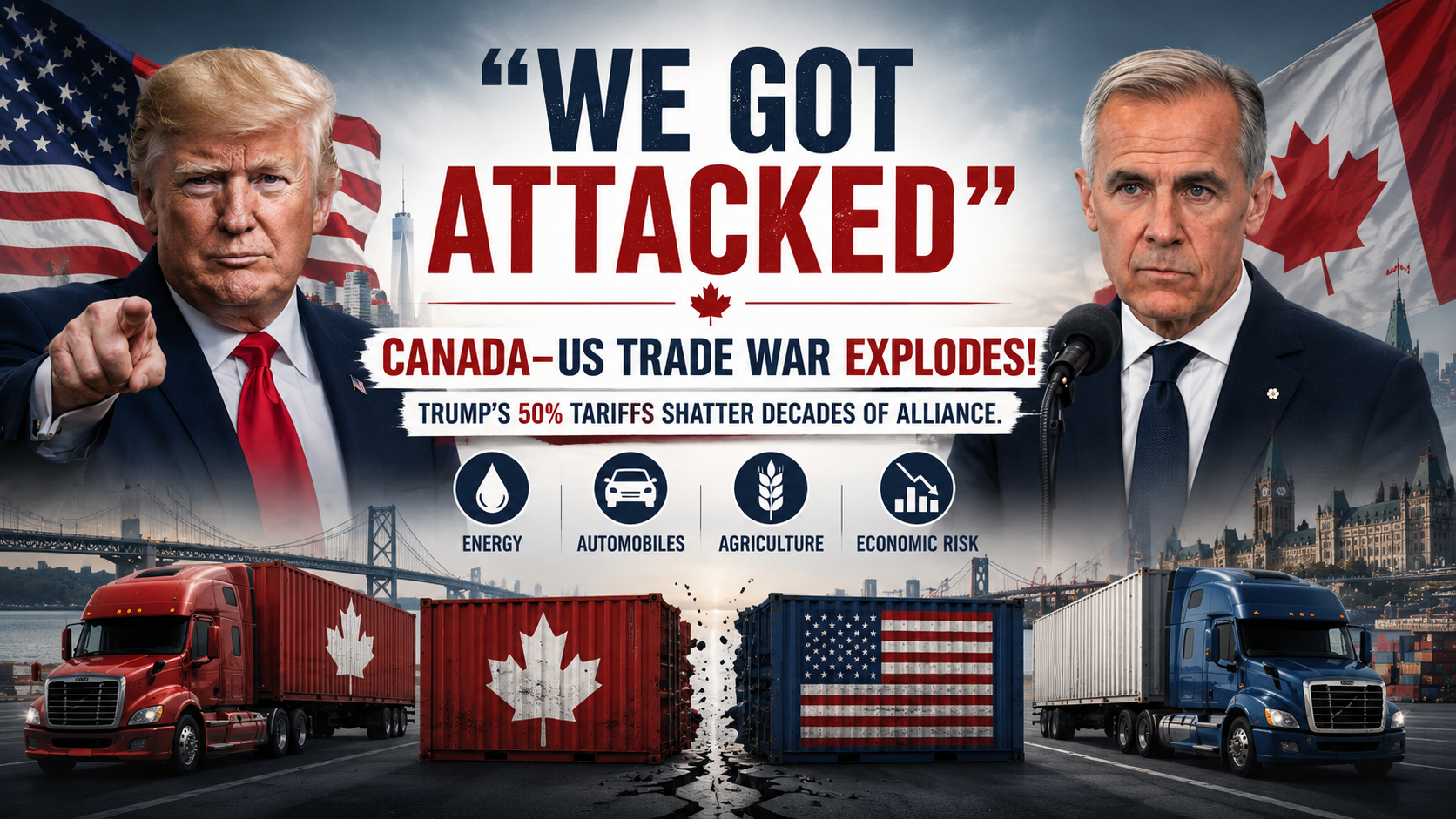
🔥 A Friendship on Fire
For decades, Canada and the United States stood shoulder to shoulder, economically integrated, politically aligned, and strategically inseparable. They shared the world’s longest border, deeply interwoven manufacturing systems, and robust defense cooperation. But today, that partnership is unravelling at breakneck speed.
Canadian Prime Minister Mark Carney’s explosive statement - “We got attacked” - wasn’t about missiles or armies. It was about tariffs, trade, and an economic war that could reshape North America’s future.
💣 The Trigger: Trump’s 50% Tariff
The breaking point came when the US slapped a 50% tariff on $20 billion worth of Canadian goods, from wine and cement to furniture and even hockey equipment. Though only 5% of Canadian exports were directly hit, the symbolic damage was immense.
Canada retaliated with a “dollar-for-dollar” response, promising equivalent tariffs on American steel, dairy, electronics, and appliances starting September 8. What began as a negotiation collapsed into a tit-for-tat escalation.
⚡ Why Negotiations Collapsed
Canada accused the US of last-minute unfair demands that threatened its economic sovereignty.
The proposed deal would have forced Canada to seek US approval before striking trade agreements with other nations like India, Japan, or the European Union.
America, on the other hand, claimed it was offering Canada “favourable treatment”, but insisted Ottawa wasn’t flexible enough.
This clash wasn’t just about tariffs. It was about power, autonomy, and control.
🌍 Canada’s Vulnerability
Geography is Canada’s curse. With the US as its primary export destination- energy, automobiles, agriculture- Canada is dangerously dependent. When Washington changes course, Ottawa has little room to manoeuvre.
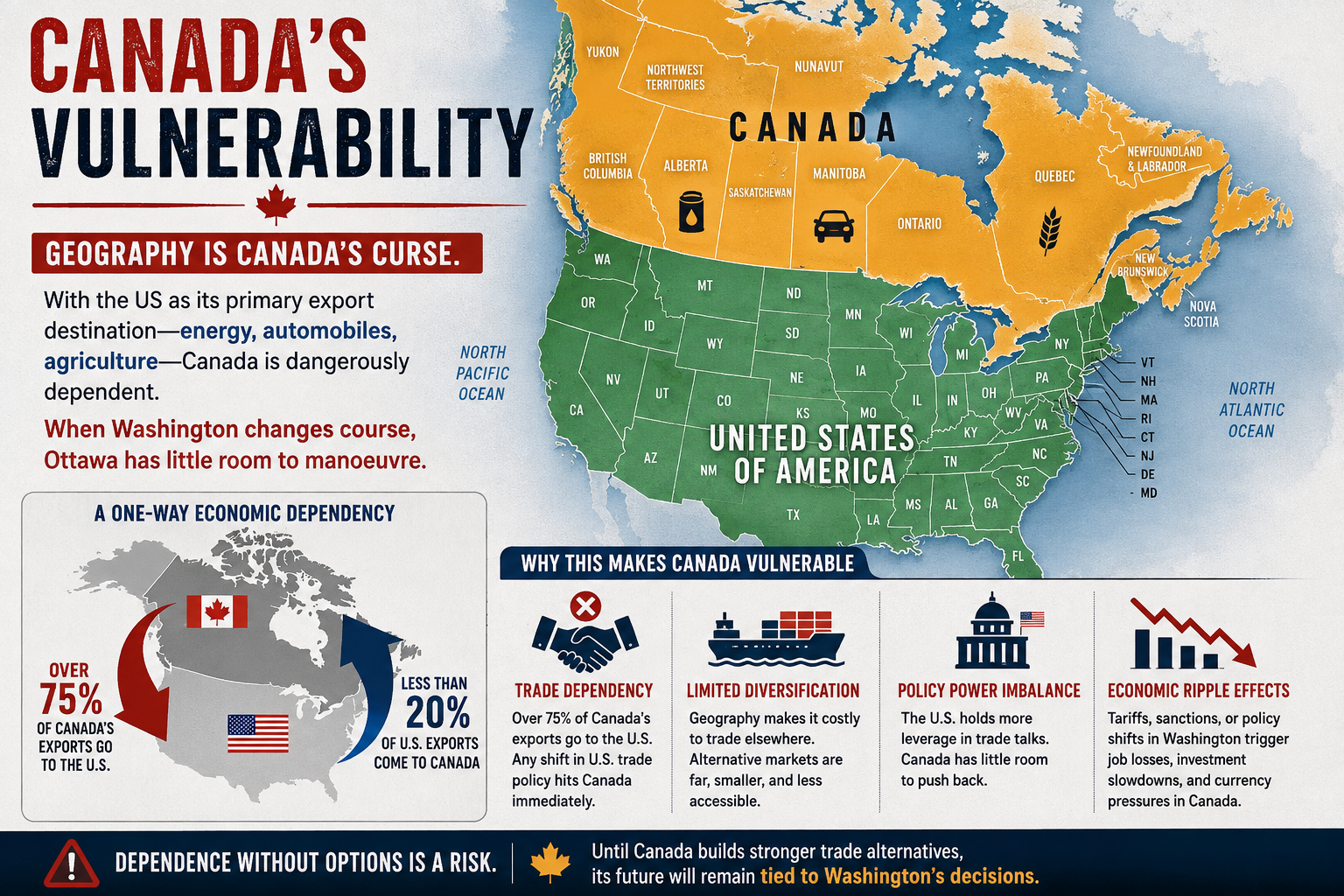
But Canada is now pursuing diversification strategies: strengthening ties with Europe, ASEAN, and the Indo-Pacific. The goal isn’t to abandon the US market but to reduce reliance on it.
⚠️ Tariff Ripple: Industries in Chaos
1. 🚗 The Auto Industry Nightmare
The auto sector illustrates the chaos. Car components often cross the Canada–US border multiple times before final assembly. A $100 part could balloon to $500 after repeated tariff hits. This threatens not just Canadian manufacturers but also American consumers and industries.
2. 🧱 Construction Chaos
Imagine a Canadian cement manufacturer exporting to the US. A $200 shipment now costs $300 after tariffs. Builders in Chicago or Detroit face soaring project costs, forcing delays and layoffs, a ripple effect that hits both economies hard.
3. 🧀 Dairy Dilemma
Canadian cheese and milk producers, once major suppliers to US supermarkets, now struggle to stay competitive. A 50% tariff means a $10 cheese block costs $15 in the US, pushing American retailers to switch suppliers and hurting Canadian farmers.
4. ⚙️ Steel Shockwave
Steel beams used in US skyscrapers often originate in Canada. With tariffs, a $1 million steel order now costs $1.5 million. American construction firms either absorb the loss or pass it on to consumers, inflating housing and infrastructure costs.
5. 🧊 Energy Entanglement
Canada’s oil and gas exports to the US face new hurdles. Tariffs on refined petroleum products raise fuel prices across North America, while Canadian producers lose billions in potential revenue.
6. 💻 Electronics Ripple
Canadian-made components for US electronics, from circuit boards to appliance parts, now face steep tariffs. A $50 part becomes $75, squeezing margins for US tech firms and raising consumer prices.
Each of these examples reinforces how deeply intertwined the two economies are, and how tariffs can turn integration into instability overnight.
What It Means for India
Here lies the silver lining. As Canada looks for alternative markets, India emerges as a natural partner. Opportunities include:
Agriculture & Pulses: Canada’s surplus can meet India’s demand.
Critical Minerals: Rare earths vital for EVs and batteries.
Pharmaceuticals & Energy: Expanding cooperation in sectors where India is rapidly growing.
For India, this trade war could open doors to strategic supply diversification and stronger bilateral ties.
🚨 The Bigger Picture
This isn’t just a Canada–US spat. It’s a warning to the world: overdependence on a single partner is economic suicide. Nations must diversify, or risk being strangled by power politics.
The Canada–US trade war is more than headlines; it’s a lesson in resilience, sovereignty, and strategy.
Endgame Insight
In the face of escalating tariffs, policymakers must act fast to diversify trade partners before the next crisis hits, while businesses brace for supply chain shocks and seek new markets to survive.
The rules are being rewritten; the real question is: Are you ready to adapt?
💡 What do you think - is India ready to seize this opportunity and step into Canada’s economic vacuum?
Written by
Ritvik DeshmukhDiscussion (0)
Sign in to join the discussion.
Loading comments…