
The Rise of a New Challenger
For years, the United States believed it held an unshakable lead in artificial intelligence. With giants like OpenAI, Google, Anthropic, and Meta pouring billions into frontier models, Washington assumed China could never catch up, especially under strict U.S. export bans on advanced AI chips.
But that assumption has been shattered. First came DeepSeek, a Chinese model that rivalled ChatGPT and Gemini at a fraction of the cost. Now, Beijing has delivered a second shock: Moonshot AI’s Kimi K3, a frontier‑level large language model that has stunned the global AI community.
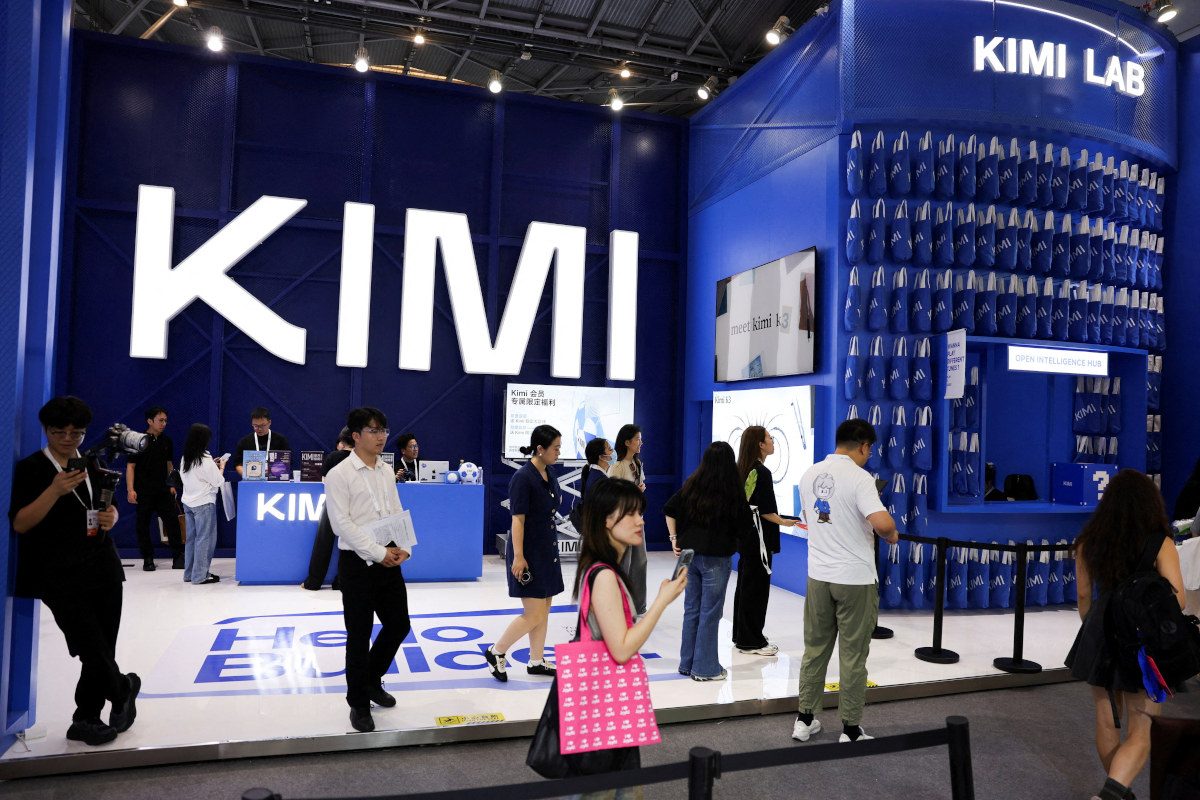
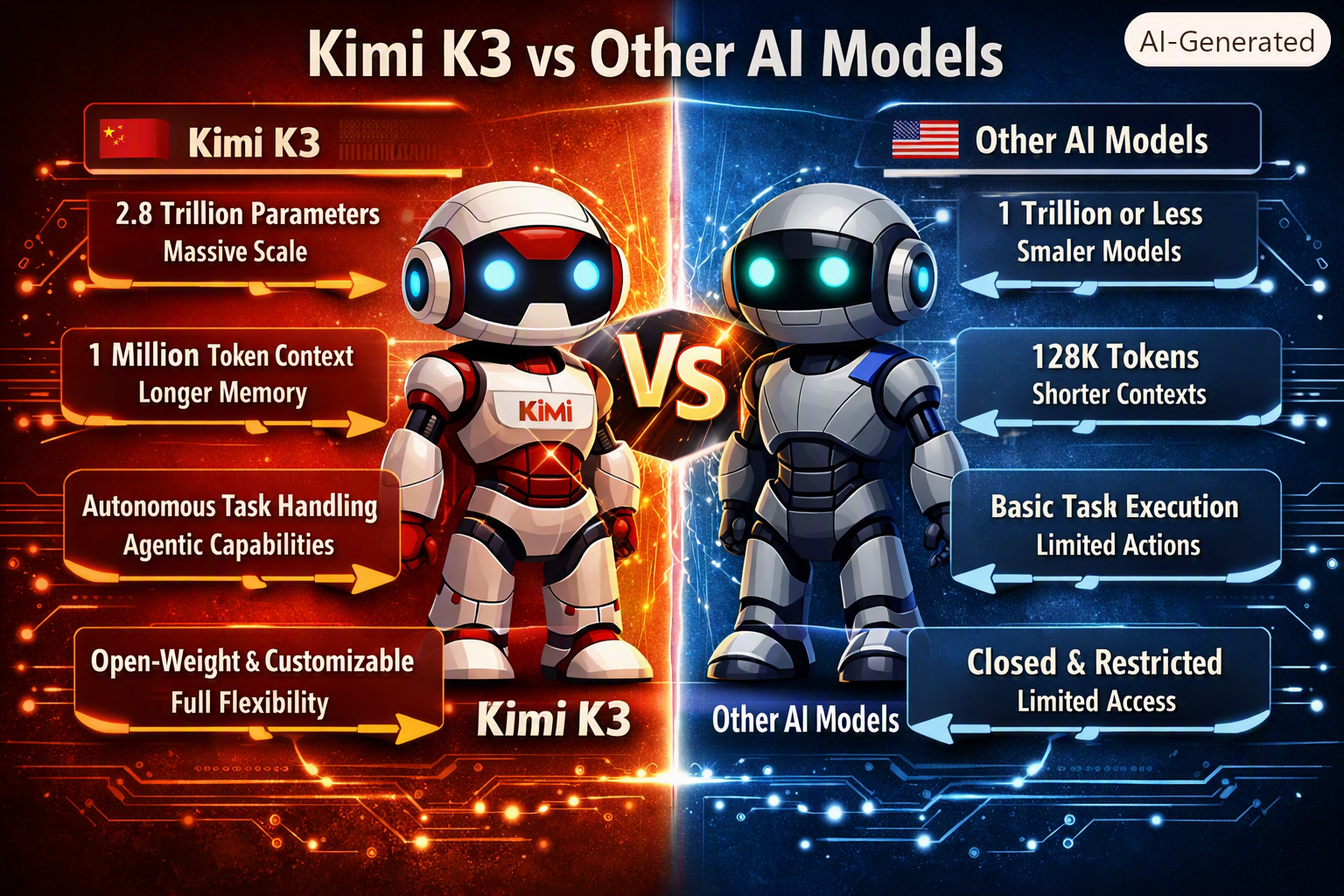
Moonshot AI revealed that Kimi K3 is the world’s first open‑source model to scale up to an astonishing 2.8 trillion parameters, paired with a one‑million‑token context window, allowing it to process entire books or datasets in a single stretch.
Why Is Kimi K3 a Breakthrough?

Moonshot AI, founded just three years ago in 2023, has achieved what many thought impossible:
Superior Coding Performance: Kimi K3 outperformed leading U.S. systems in modern coding benchmarks, proving strong reasoning and logic capabilities.
Agentic AI: Unlike traditional AI that executes single tasks, Kimi K3 can handle multi‑step workflows autonomously, from comparing flight prices to booking tickets and updating calendars.
Think of traditional AI like a helpful assistant who only does what you ask, step by step.
Example: You say “Book my flight to Delhi.” → It books the ticket, nothing more.
Now imagine Agentic AI as a proactive travel agent who handles the entire process for you:
It compares flight prices, picks the best seat, books the ticket, adds the trip to your calendar, and even sends you a reminder before you leave. That’s Agentic AI — it doesn’t just follow instructions, it plans, reasons, and executes multi‑step tasks on its own.
Long Context Windows: It can process entire books, research papers, or massive documents without losing memory, a leap beyond most current systems.
Open‑Weight Model: Unlike closed systems such as ChatGPT or Gemini, Kimi K3 is open‑weight, meaning universities, startups, and even small developers can download, customize, and innovate without paying massive fees.
This openness is critical. As NVIDIA’s CEO Jensen Huang argued, closed models slow innovation, while open models democratize AI development.
Most popular AI systems today (like ChatGPT or Gemini) are closed models. You can use them, but you can’t see how they work inside or change them.
An open‑weight model is different; it’s like open‑source software.
Example: Imagine Microsoft invented the internet but said: “Only we can build websites.” Innovation would crawl.
Instead, because the web was open, anyone could build websites, from students to startups, and that’s why the internet exploded with creativity.
Similarly, with open‑weight AI models, universities, startups, and even individual developers can download, customize, and innovate without paying huge fees. This openness accelerates progress and democratizes AI.
Opening Up the AI Stack
When unveiling Kimi K3, Moonshot AI didn’t just talk about the model; it threw open the doors to the technology behind it. The team announced that they were releasing key components of their system, including high‑speed attention kernels, a Mixture‑of‑Experts (MoE) communication framework, and the infrastructure designed to support large‑scale agent environments. This move signaled a commitment to transparency and collaboration rarely seen in frontier AI development.
Performance at the Frontier
At launch, Kimi K3 demonstrated frontier‑level capabilities across Moonshot’s internal evaluation benchmarks. While it hadn’t yet surpassed ultra‑advanced systems like Anthropic’s Claude Fable 5 or OpenAI’s GPT 5.6 Sol, its performance placed it firmly among the world’s most sophisticated open models, a remarkable feat for a startup barely three years old.
The Cold War Parallel
The AI race today mirrors the Cold War space race. Back then, it was rockets, satellites, and nuclear weapons. Today, it’s AI, quantum computing, semiconductors, robotics, and biotechnology. Whoever dominates AI will control:
Future economic growth.
Defense systems and cybersecurity.
Scientific research and digital economies.
China’s rapid rise has rattled Washington, not just economically but strategically.
Why the U.S. Is Worried?
Economic Leadership: AI is the backbone of future industries. If China matches U.S. speed, America’s advantage erodes.
Semiconductor Shock: NVIDIA and other chipmakers thrived because frontier AI demanded advanced GPUs. But if China proves it can innovate without them, U.S. semiconductor dominance is at risk.
National Security: AI powers missile guidance, drone swarms, and cyber defense. Losing leadership here is a direct security threat.
How China Did It Without U.S. Chips?
Despite bans, China advanced through:
Algorithmic Innovation: More efficient training methods instead of relying solely on hardware clusters.
Software Optimization: Improving memory efficiency and distributed training with available tools.
Indigenous Hardware: Expanding domestic semiconductor manufacturing to reduce foreign dependence.
Talent Pipeline: Producing massive numbers of AI engineers and researchers annually.
Government Support: Treating AI as a national priority with heavy state investment.
Final Verdict: China’s AI Gambit
Moonshot AI’s Kimi K3 is more than just another model; it’s a geopolitical shockwave. By proving that frontier AI can be built with fewer resources, China has challenged America’s technological supremacy and opened the door to a new era of open, democratized AI innovation.
Written by
Ritvik DeshmukhDiscussion (0)
Sign in to join the discussion.
Loading comments…