
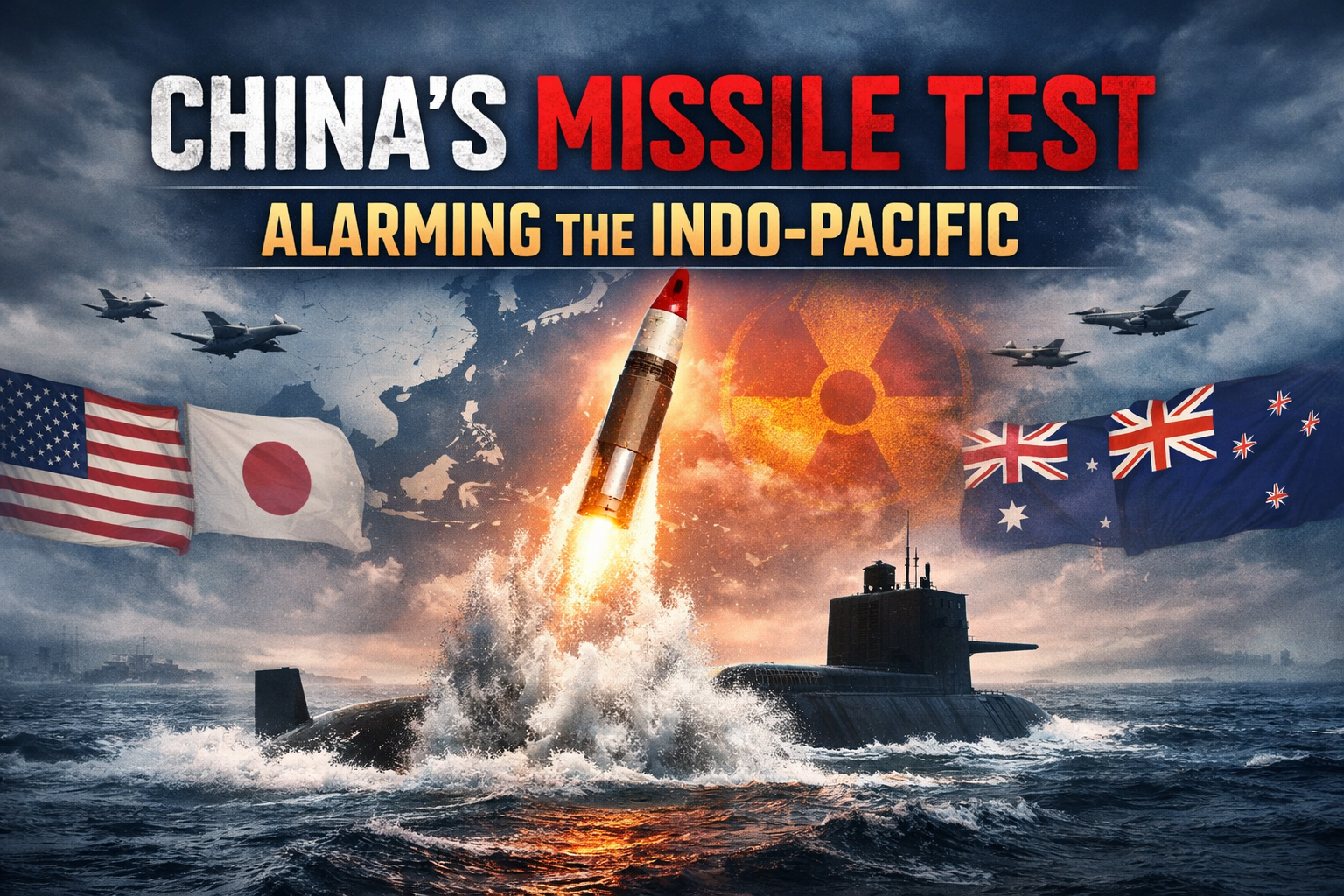
China has once again flexed its military muscle—this time beneath the waves. In a recent show of force, Beijing successfully tested a ballistic missile launched from a submarine, sending ripples of concern across the Indo-Pacific. From Washington to Canberra, the move has triggered strategic unease, raising urgent questions about regional security, deterrence, and the shifting balance of power in one of the world’s most contested maritime zones.
This test isn’t just about military technology—it’s about signaling. And the message is loud and clear: China is ready to project power in ways that could reshape the future of the Indo-Pacific.
China’s July 2026 submarine-launched ballistic missile (SLBM) test has rattled the Indo-Pacific, alarming nations like Australia, Japan, New Zealand, and the U.S.
The test showcased Beijing’s growing nuclear deterrent capabilities, marking the first time China publicly acknowledged such a launch.
Background of the Test
Date & Time: July 6, 2026, at 12:01 pm local time.
Platform: A nuclear-powered submarine of the PLA Navy.
Missile: Believed to be either the JL-2 or the newer JL-3, capable of intercontinental range.
Payload: Dummy warhead (non-nuclear).
Trajectory: Flew southeast over the Pacific, splashing down near Nauru and Tuvalu, about 7,000 km away.
Global Reactions
Australia: Called the test “destabilizing” and inconsistent with Pacific leaders’ vision of an “Ocean of Peace.”
New Zealand: Labeled it “unwelcome and concerning,” urging regional partners to resist normalization of such tests.
Japan: Expressed serious concern, warning of intensifying Chinese military activity.
United States: Monitored the launch closely, urging China to engage in arms control talks.
China’s Position: Framed the test as a routine military drill, insisting it was safe, professional, and not directed at any country.
Strategic Significance
Public Acknowledgment: This was China’s first publicly confirmed SLBM test, signaling a shift in transparency and strategic messaging.
Nuclear Triad Strengthening: Demonstrates China’s ability to conduct reliable counterstrikes from submarines, enhancing survivability of its nuclear deterrent.
Regional Impact: Raises concerns about the erosion of nuclear weapons-free zones in the South Pacific, particularly under the Treaty of Rarotonga.
Geopolitical Timing: The test coincided with Australia and Fiji signing a new defense pact, amplifying its political resonance.
Key Takeaways
China’s recent submarine-launched ballistic missile (SLBM) test has stirred waves across the Indo-Pacific. Believed to be either the JL‑2 or the more advanced JL‑3, the missile demonstrated an estimated range of 7,000–8,000 km, though it carried only a dummy warhead rather than a nuclear payload. Beijing framed the launch as a routine drill, signaling a shift toward greater transparency in its military exercises.
Yet, the regional response was anything but calm—Australia, New Zealand, Japan, and the United States all voiced alarm over the implications. Strategically, the test reinforces China’s nuclear triad, bolstering its deterrence capabilities while raising fresh challenges for South Pacific security treaties and regional stability.
Risks & Implications
Security Concerns: Regional powers fear destabilization and escalation of military competition.
Arms Control Pressure: The U.S. and allies may push harder for China to join formal arms-control frameworks.
Strategic Balance: China’s growing SLBM capability could alter deterrence dynamics, especially vis-à-vis U.S. bases in Guam and Hawaii.
Overview
China’s July 2026 submarine missile test was not just a military drill—it was a strategic signal. By publicly acknowledging the launch, Beijing showcased its advancing nuclear deterrent, unnerving Indo-Pacific neighbors and raising fresh questions about the future of regional stability.
Written by
Bhavana SharmaDiscussion (0)
Sign in to join the discussion.
Loading comments…