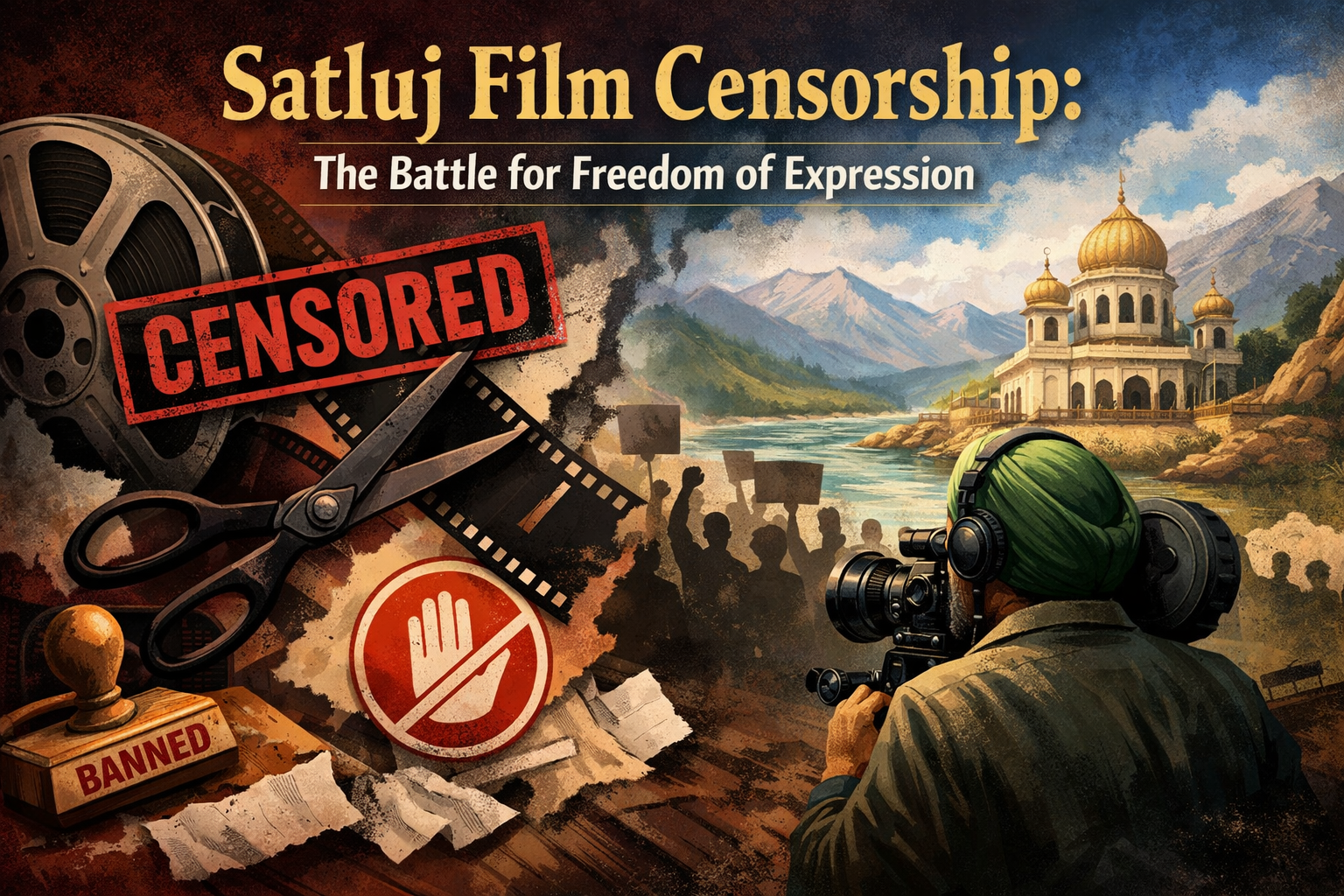
The Indian entertainment industry is no stranger to censorship rows, but what just went down with Diljit Dosanjh’s latest biographical drama, Satluj, has sent shockwaves through the entire country.
After a grueling three-year battle with the Central Board of Film Certification (CBFC), the film finally made its way to the OTT platform Zee5 on July 3rd, proudly boasting an uncut version. Film critics and early viewers were already calling it a masterpiece; praise was pouring in, and the makers felt their long-standing struggle had finally paid off.
Then, overnight, the curtains were abruptly brought down.
Zee5 issued a sudden, cryptic announcement: The movie has been pulled down and is no longer available to stream in India.
The Sudden Blackout: Why Was Satluj Pulled?
The sudden removal of Satluj has ignited a fierce nationwide debate on creative freedom and historical erasure. Interestingly, there has been no official notification or ban issued by the Government of India.
In their official statement, Zee5 acknowledged the overwhelming audience response and stated they "stand behind the film." However, citing vague "current developments", they pulled the movie from the Indian market while hinting that they are exploring legal avenues to bring it back.
Whether this is a temporary setback or a permanent blackout remains to be seen, but the leading man himself, Diljit Dosanjh, broke his silence by posting a powerful clip of his character delivering a defiant dialogue:
"I challenge the darkness. Wherever possible, I will continue to spread the light."
From Ghallughara to Satluj: A Title Drenched in Blood
To truly understand why this movie faces such immense resistance, one has to look at its evolution. The film wasn't always called Satluj.
Original Title: Ghallughara ➔ Changed to: Punjab 95 ➔ Released as: Satluj
· Ghallughara: The original title refers to historic periods of mass persecution and carnage in Sikh history.
· Punjab 95: Changed to soften the political blowback, focusing on the climactic year of the story.
· Satluj: The final title under which it briefly saw the light of day.
The CBFC demanded dozens of cuts over three years, primarily because the film targets one of the most volatile and sensitive eras of modern Indian history: The Punjab Militancy Period (1980s–1990s). Diljit Dosanjh had reportedly drawn a hard line, stating he wouldn't even promote the film if a single cut was made, leading to the ultimate decision to bypass theaters for an uncut OTT release.
The Dark History: Who Was Jaswant Singh Khalra?
Satluj is not mere fiction; it is a hard-hitting biographical account of Jaswant Singh Khalra, one of India’s most revered human rights activists.
Originally an ordinary bank officer, Khalra’s life shifted drastically when desperate Sikh families began approaching him with harrowing tales of their sons, husbands, and brothers vanishing into thin air after being picked up by the police.
The Discovery of Secret Cremations
Instead of relying on hearsay, Khalra launched a meticulous, data-driven investigation. He went deep into the archives of the Amritsar Municipal Corporation, analyzing cremation registries and municipal death records. What he found was horrifying:
· The M.C. Records: Thousands of bodies had been brought in by the police and cremated secretly under the label of "unidentified" or "unclaimed."
· The Scale: While Khalra documented around 2,000 suspicious cremations in Amritsar alone, broader human rights groups estimate that over 25,000 illegal cremations took place across the state of Punjab. Later, independent investigations by the CBI confirmed over 2,000 such illegal cremations in the Tarn Taran district alone.
By exposing official documents, death records, and witness testimonies, Khalra turned local whispers into an undeniable, evidence-based global headline, drawing international media and human rights organizations' attention to the severe state excesses in Punjab.
The Trap of the 1980s: A Complex Legacy
The movie's backdrop highlights a highly complex era. Following the economic shifts of the Green Revolution, Punjab faced rising youth unemployment and regional inequalities, which ultimately fed into the Khalistan movement-a demand by certain militant factions for a sovereign Sikh state.
What followed was a dark decade of violence: political assassinations, bombings, and the tragic 1984 Operation Blue Star, where the Indian Army entered the Golden Temple complex to flush out militants. The collateral damage and subsequent assassination of Prime Minister Indira Gandhi triggered the horrific 1984 Anti-Sikh Riots, leaving thousands dead and a community deeply alienated.
By the mid-1990s, the Punjab Police successfully crushed the insurgency through aggressive counter-terrorism operations, an achievement heralded as a major internal security success. However, as Khalra’s work revealed, this peace came at a catastrophic cost to human rights, characterized by extrajudicial killings, custodial torture, and forced disappearances.
The Ultimate Sacrifice
Jaswant Singh Khalra paid the ultimate price for his pursuit of truth. On September 6, 1995, while washing his car outside his home, he was abducted by police officials in broad daylight. He was never seen again.
A subsequent landmark CBI investigation revealed that Khalra was illegally detained, tortured, and murdered. In a rare victory for accountability, several high-ranking Punjab Police officials were later convicted and sentenced to life imprisonment by the Supreme Court.
The Digital Battleground: What Happens Next?
The removal of Satluj shines a harsh spotlight on how digital content is governed in India, particularly under the Information Technology Rules of 2021. While OTT platforms initially offered a sanctuary for stories too raw for traditional cinema, increasing regulatory scrutiny has left platforms walking a tightrope.
Satluj attempted to tell a story of data, records, and a man who wanted to give names back to the nameless dead. As the legal battle unfolds behind the scenes, Satluj’s empty streaming page of stands as a silent testament to a history that India is still not ready to look in the eye.
What are your thoughts on the sudden removal of Satluj? Does a country grow stronger by confronting its past, or are some historical wounds too deep to reopen? Let us know in the comments below.
Written by
Ritvik DeshmukhDiscussion (0)
Sign in to join the discussion.
Loading comments…