
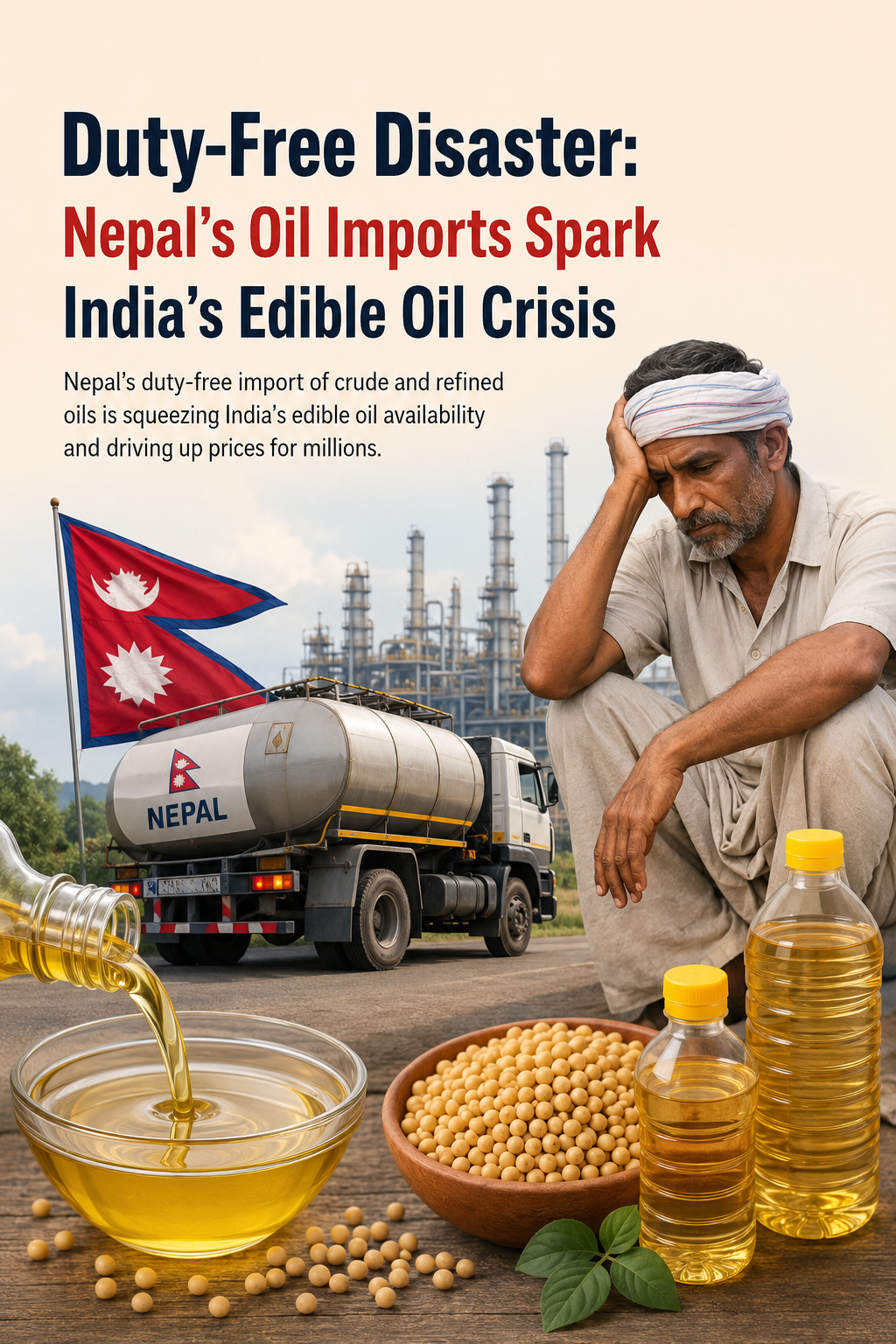
A Crisis Brewing in India’s Kitchens
India’s edible oil industry is sounding the alarm. Domestic refiners and farmers are pleading with the government to act as duty‑free refined edible oil from Nepal floods the Indian market. What looks like a trade convenience is fast becoming a structural threat to India’s long‑term food security.
Preferential Trade Loophole Exposed
The Indian Vegetable Oil Producers’ Association (IVPA) has warned Commerce Minister Piyush Goyal that the surge in duty‑free refined edible oil imports from Nepal is undermining India’s tariff policy and crippling domestic competitiveness. IVPA President Sudharkar Desai stressed that this preferential treatment has triggered a sharp rise in refined soybean and palm oil inflows, leaving India’s edible oil value chain increasingly vulnerable.
The Numbers Tell the Story
In 2023, India imported 47,000 tonnes of edible oil from Nepal.
By 2025, that figure skyrocketed to over 800,000 tonnes, a 17‑fold increase.
In just the first five months of 2026, imports already touched 300,000 tonnes.
This surge is not just a statistic; it represents billions in lost revenue, collapsing margins for Indian refiners, and falling demand for oilseed farmers.
The Tariff Trap: Why Nepal Has the Edge?
India’s import policy is designed to encourage domestic refining:
Crude edible oil imports are subject to a 16.5% duty.
Refined edible oil imports are subject to a 35-36% duty.
But under the SAFTA (South Asian Free Trade Area) agreement, refined edible oil from Nepal enters India at 0% duty. Nepal imports crude oil from Indonesia, Malaysia, Brazil, and Argentina, refines it locally, and then ships it duty‑free to India. This tariff arbitrage has become a loophole that undermines India’s refiners.
The Domino Effect: Who Gets Hurt?
Domestic Refiners: Lose business as refining shifts outside India.
Farmers: Mustard and soybean growers in states like Madhya Pradesh, Maharashtra, and Rajasthan face collapsing demand.
Government Revenue: Annual losses of ₹2,000-2,500 crore from missed duties and taxes.
Employment & Industry: Refining, packaging, logistics, and GST collections all take a hit.
Policy Dilemma: Protect Industry or Honor Treaties?
India faces a tough balancing act:
Protect domestic industry and farmers.
Keep consumer prices affordable.
Honor international commitments under SAFTA.
In 2021, India temporarily reduced the duty differential to curb Nepal’s advantage. The question now: Will the government act again, or will Nepal’s refined oil continue to flood the market unchecked?
The Bigger Picture
India consumes 24-25 million tonnes of edible oil annually but produces only 40% domestically. With dependence on imports already high, unchecked duty‑free refined oil threatens India’s vision of self‑reliance under the National Mission on Edible Oils.
Closing Insight
What looks like a trade loophole is in fact a ticking time bomb for India’s edible oil ecosystem. Unless policymakers intervene, Nepal’s duty‑free refined oil could redefine the foundations of India’s food security, farmer livelihoods, and industrial growth.
Written by
Devansh KaulDiscussion (0)
Sign in to join the discussion.
Loading comments…