

A Historic Shift in Social Security
For decades, the mandatory EPF coverage wage ceiling remained unchanged at ₹15,000. Now, with the Finance Ministry’s approval, this ceiling is set to rise to ₹25,000, most likely effective from April 1, 2027 once the Cabinet gives its nod.
This move will bring millions of additional workers, sales executives, retail staff, delivery agents, security guards, and receptionists under the umbrella of retirement savings, pensions, and insurance benefits.
What is EPFO, Why It Matters and How Contributions Work
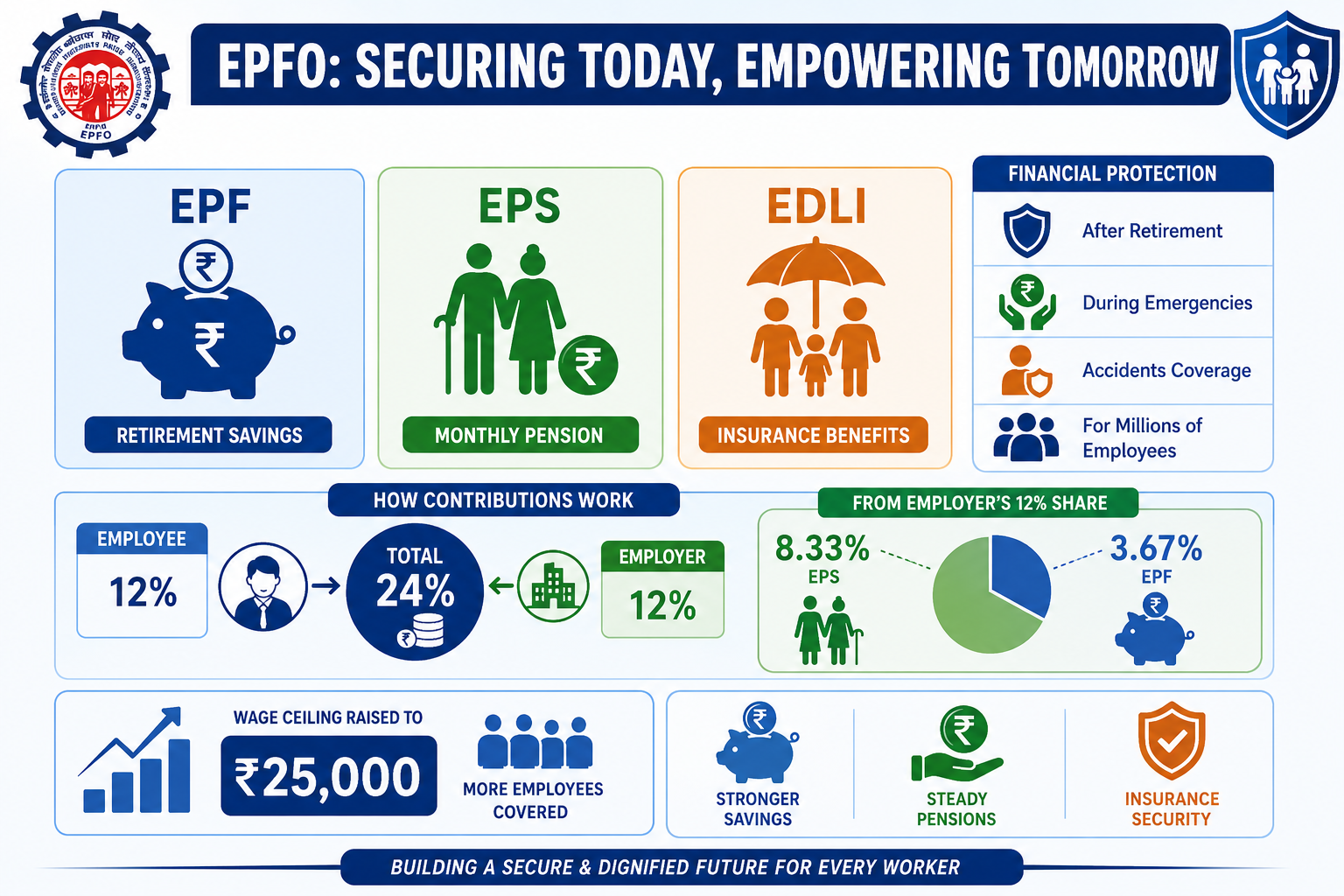
The Employees’ Provident Fund Organisation (EPFO), India’s largest social security body under the Ministry of Labour & Employment, safeguards workers through three key schemes: EPF for retirement savings, EPS for monthly pensions, and EDLI for insurance benefits. Together, they provide financial protection after retirement, during emergencies, or in case of unforeseen accidents. Contributions are shared equally: employees put in 12% of their salary, while employers match this with another 12%. From the employer’s share, 8.33% is directed to EPS for pensions, and the remainder flows into EPF, building a robust retirement corpus. With the wage ceiling now raised to ₹25,000, millions of employees will be compulsorily covered, ensuring stronger savings, steady pensions, and insurance security for the future.
Why the Change Now?
Inflation has made ₹15,000 a modest salary in today’s economy.
Entry‑level wages in manufacturing, e‑commerce, and logistics often range between ₹18,000–₹25,000.
Millions of workers earning in this bracket were missing out on EPF benefits due to the outdated ceiling.
By raising the limit, the government aims to expand social security coverage, strengthen household savings, and reduce old‑age poverty.
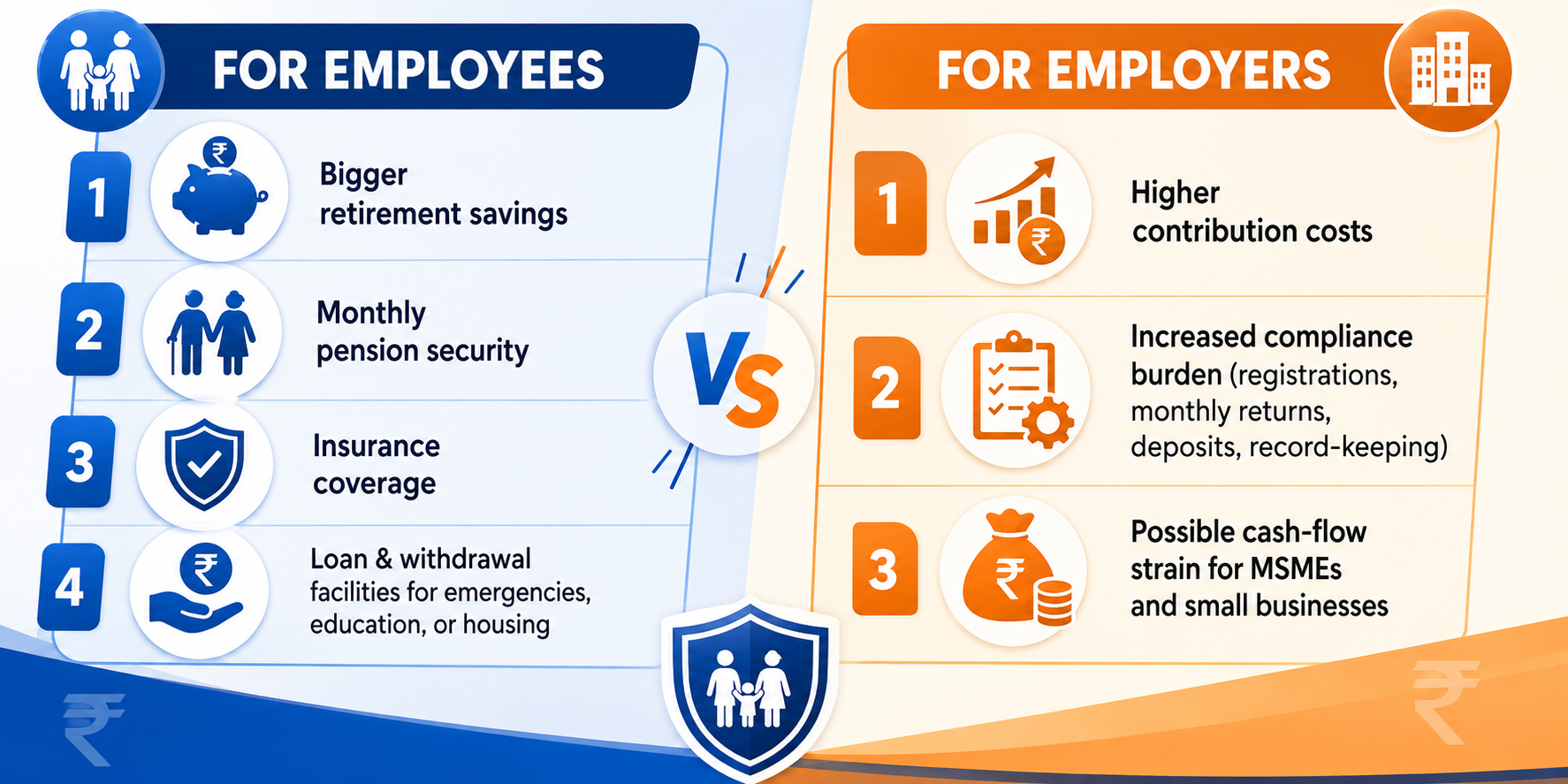
Benefits vs Challenges
EPF vs EPS vs NPS – Know the Difference
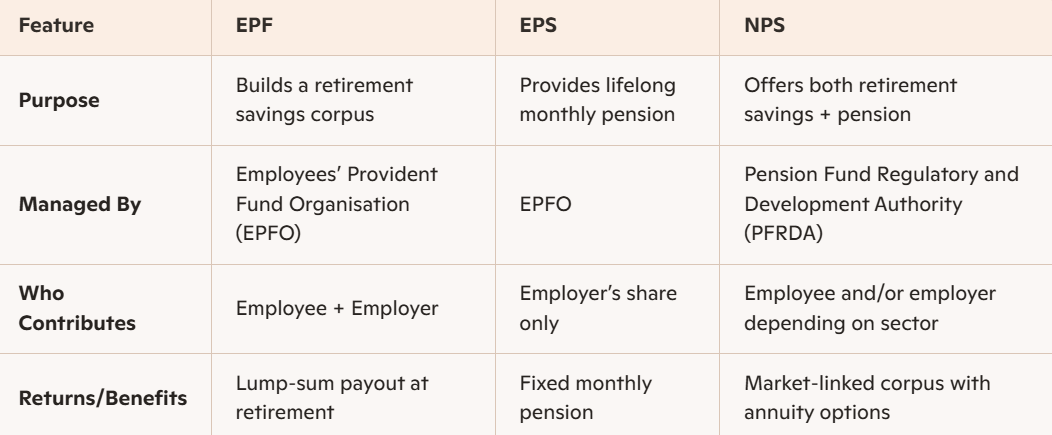
Together, these form the backbone of India’s evolving social security system.
EPF Rules Get a 2026 Makeover
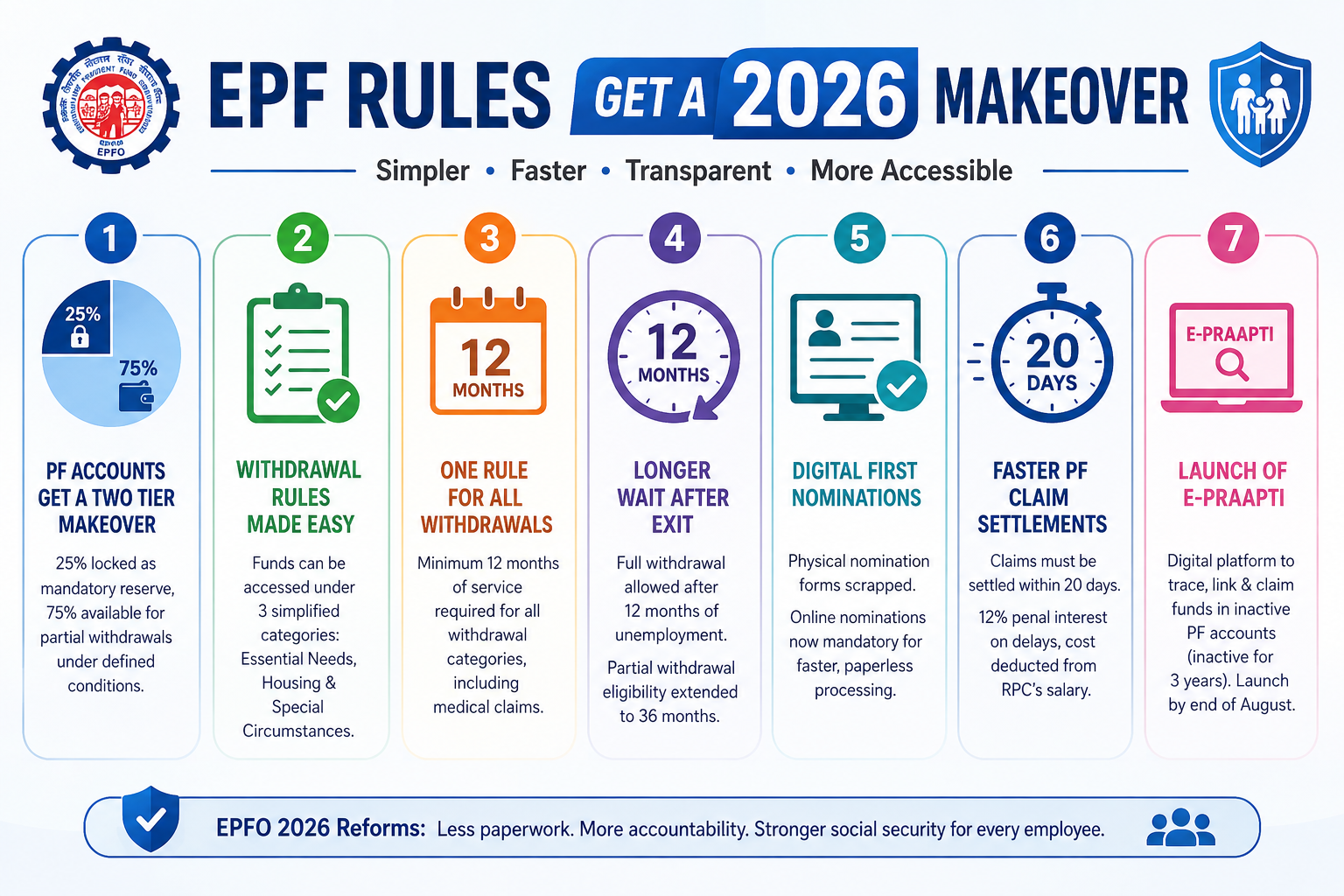
The Employees’ Provident Fund Organisation (EPFO) has rolled out sweeping updates across the EPF, EPS, and EDLI schemes. These reforms are designed to cut red tape, simplify withdrawal processes, digitize operations, and strengthen transparency, making India’s social security system more accessible and accountable than ever.
1. PF Accounts Get a Two‑Tier Makeover
Under the revamped structure, every subscriber’s PF account will be split into two distinct portions. One‑quarter of the corpus will be locked in as a mandatory reserve, while the remaining three‑quarters can be tapped for partial withdrawals, but only under the specific conditions laid out in the Scheme.
2. Withdrawal Rules Made Easy
EPFO has streamlined the process by cutting down the clutter of multiple withdrawal categories. Now, members can access their funds under just three simplified umbrellas: essential needs, housing, and special circumstances. This overhaul makes partial withdrawals far more straightforward and less confusing for subscribers.
3. One Rule for All Withdrawals
The 2026 framework introduces a single service requirement across categories. No matter the purpose, including medical claims members must now complete at least 12 months of service before becoming eligible to withdraw from their PF account. This replaces the earlier system of varied waiting periods for different withdrawal types.
4. Longer Wait After Exit
The timeline for full withdrawals has been tightened. Previously, members could claim their entire PF balance after just two months of unemployment. Under the new rules, a 12‑month waiting period applies before full withdrawal is allowed. Partial withdrawals remain possible, but the eligibility window has been stretched to 36 months, making the process more structured and deliberate.
5. Digital‑First Nominations
In a decisive move toward paperless processes, EPFO has scrapped physical nomination forms. From now on, online nominations are officially recognized, cutting down paperwork and ensuring faster, smoother processing for both members and employers.
6. Faster PF Claim Settlements
Claim timelines have been tightened; PF claims must now be settled within 20 days. To enforce accountability, EPFO will pay a 12% penal interest on delays without valid reasons, with the cost directly deducted from the salary of the concerned Regional PF Commissioner. This change is designed to push quicker settlements and safeguard members’ rights.
7. Launch of E-PRAAPTI: Relief for Lost PF Accounts
EPFO subscribers struggling with old or inactive accounts may soon breathe easy. By the end of August, the organisation plans to roll out E‑PRAAPTI, a digital platform designed to help members trace, link, and claim funds stuck in dormant PF accounts.
An account is marked inoperative if no contributions are made for three consecutive years. According to reports, EPFO is currently testing a back‑end software upgrade to build a stable national database before the official launch. This digital push aims to streamline access and reduce long‑standing hassles.
The Bigger Picture
This wage ceiling hike is part of broader labour reforms, digital EPF withdrawals, e‑Shram portal, universal account numbers, all aimed at formalizing employment and strengthening worker welfare.
Are you ready for the new EPF era? If your salary falls between ₹15,000–₹25,000, this change could transform your financial future.
Share this update with your colleagues, and let’s spark a conversation: Will higher contributions today be worth the stronger retirement tomorrow?
Written by
Aditya KulshreshthaDiscussion (0)
Sign in to join the discussion.
Loading comments…