
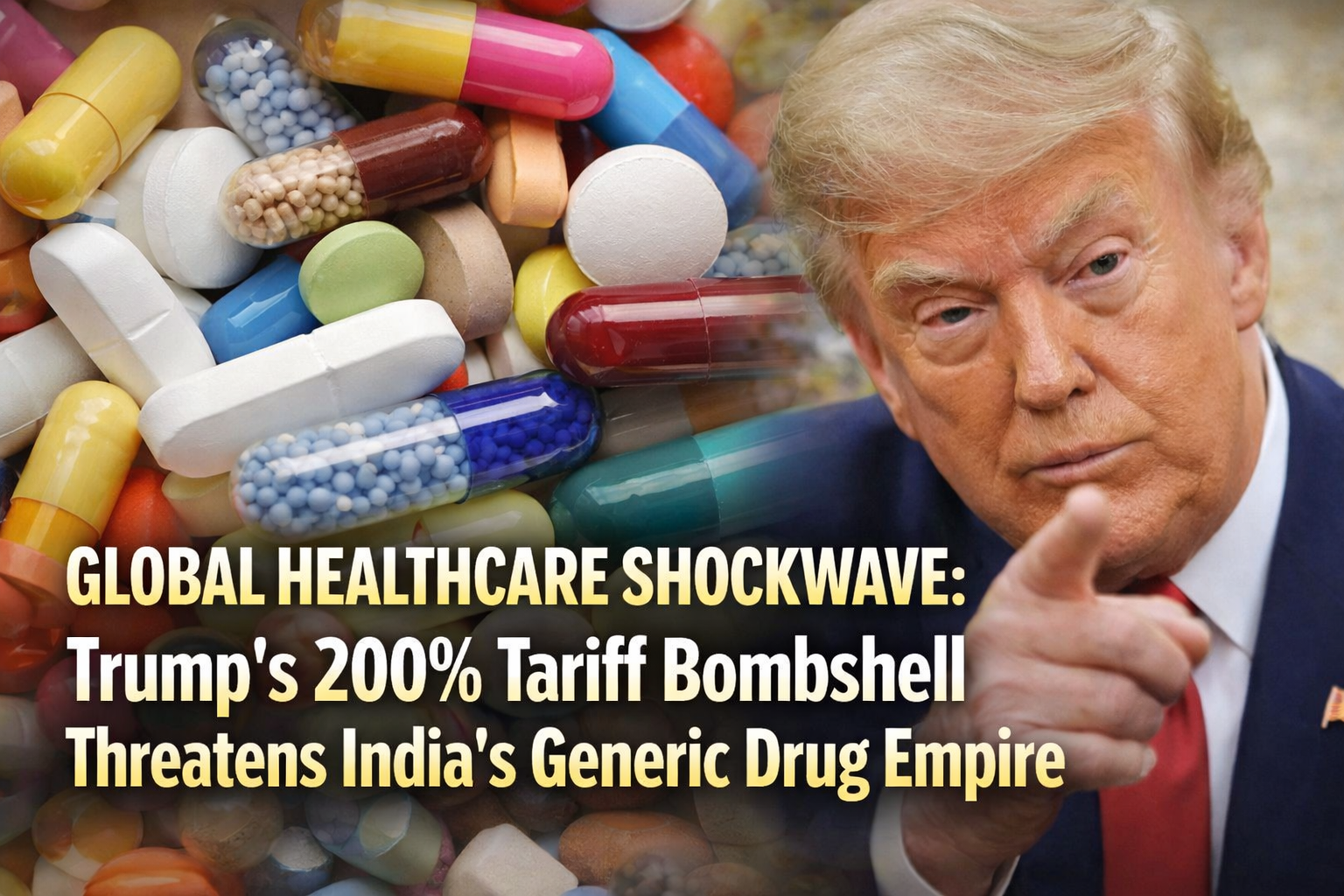
America’s “Pharmacy of the World” Under Fire
Donald Trump has announced one of the most consequential trade policy decisions in recent years, a move that could shake the foundations of the global pharmaceutical industry. For now, imported generic medicines will remain duty‑free until July 2028, but after that, the U.S. plans to impose 100% tariffs, followed by a staggering 200% tariff indefinitely.
This decision directly targets India, the world’s leading supplier of affordable generics, and threatens to disrupt both global healthcare costs and India-U.S. trade relations.
Why Target Generics?
Trump’s administration argues that America has become dangerously dependent on foreign suppliers, especially India and China, for critical pharmaceutical ingredients and medicines. The COVID‑19 pandemic exposed vulnerabilities in the global medical supply chain, with shortages of active pharmaceutical ingredients (APIs) and essential drugs.
“Dependence on foreign suppliers poses a national security risk,” Trump declared, framing the move as part of his America First policy.
By imposing tariffs, the U.S. hopes to boost domestic manufacturing capacity, create jobs, and reduce reliance on imports.
The Two‑Year Window: A Strategic Pause
Why wait until 2028?
The U.S. currently lacks sufficient pharmaceutical manufacturing capacity. Building plants, securing FDA approvals, and scaling production takes years. Immediate tariffs could trigger shortages and skyrocket healthcare costs, already a major concern for American households.
The two‑year grace period is designed to give U.S. companies time to invest, expand, and prepare before the tariffs hit.
India’s Role as the “Pharmacy of the World”
India dominates the global generics market thanks to:
Thousands of manufacturing units with low production costs.
Strong chemical manufacturing capabilities.
Regulatory expertise, with many plants FDA‑approved.
A vast export network supplying medicines to over 200 countries.
Generic drugs account for the majority of prescriptions in the U.S., keeping healthcare affordable. India’s exports, particularly to America, are among its highest‑value manufacturing exports.
If tariffs go into effect, Indian pharmaceutical companies could face severe losses, and stock market reactions have already shown declines in major pharma firms.
Fallout for India-U.S. Relations
This policy could deepen trade tensions between the two nations. India may challenge the move at the World Trade Organization (WTO), but with the WTO’s dispute panels weakened, success is uncertain.
Meanwhile, Indian companies face tough choices:
Shift manufacturing to the U.S. to bypass tariffs.
Diversify exports to Europe, Africa, Latin America, and ASEAN markets.
Strengthen value chains to remain competitive globally.
The Bigger Picture
Trump’s tariff gamble is not just about economics; it’s about geopolitics, healthcare security, and industrial strategy. For India, the world’s pharmacy, this is a direct hit on one of its most powerful export sectors. For the U.S., it’s a high‑stakes bet that domestic capacity can rise fast enough to avoid a healthcare crisis.
The next two years will determine whether this policy reshapes the pharmaceutical landscape or backfires with devastating consequences.
The Global Pharma Shockwave
Trump’s 200% tariff threat could transform medicine from a global commodity into a geopolitical weapon. The world’s pharmacy is on notice, and the countdown to 2028 has already begun.
Written by
Aarav VashishtDiscussion (0)
Sign in to join the discussion.
Loading comments…