
Government’s Big Message to TV Channels: Broadcast Responsibly or Face Action
In a significant move that could reshape the way television news is presented in India, the Ministry of Information and Broadcasting (MIB) has issued a fresh advisory on October 21, 2026, to private TV channels, urging them to avoid content that could be considered anti-national, communal, inflammatory, or misleading.
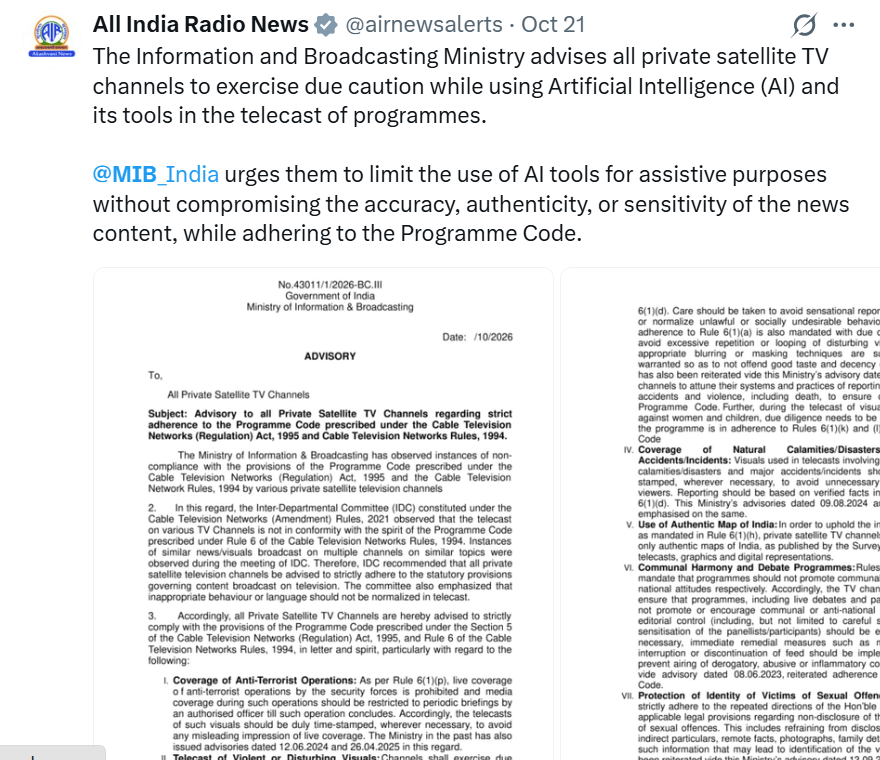
The advisory also focuses on the growing use of Artificial Intelligence (AI) in news broadcasting, warning channels against using AI-generated content in ways that distort facts, spread misinformation, or confuse viewers.
While government advisories are not new, this latest communication has drawn attention because it highlights several serious concerns that authorities believe are increasingly appearing in television news coverage and debate programs.
Why Has the Government Issued This Advisory?
According to the government, monitoring authorities and inter-departmental committees found recurring issues in television broadcasts. These concerns range from sensationalized crime reporting and divisive debates to inaccurate maps and AI-generated misinformation.
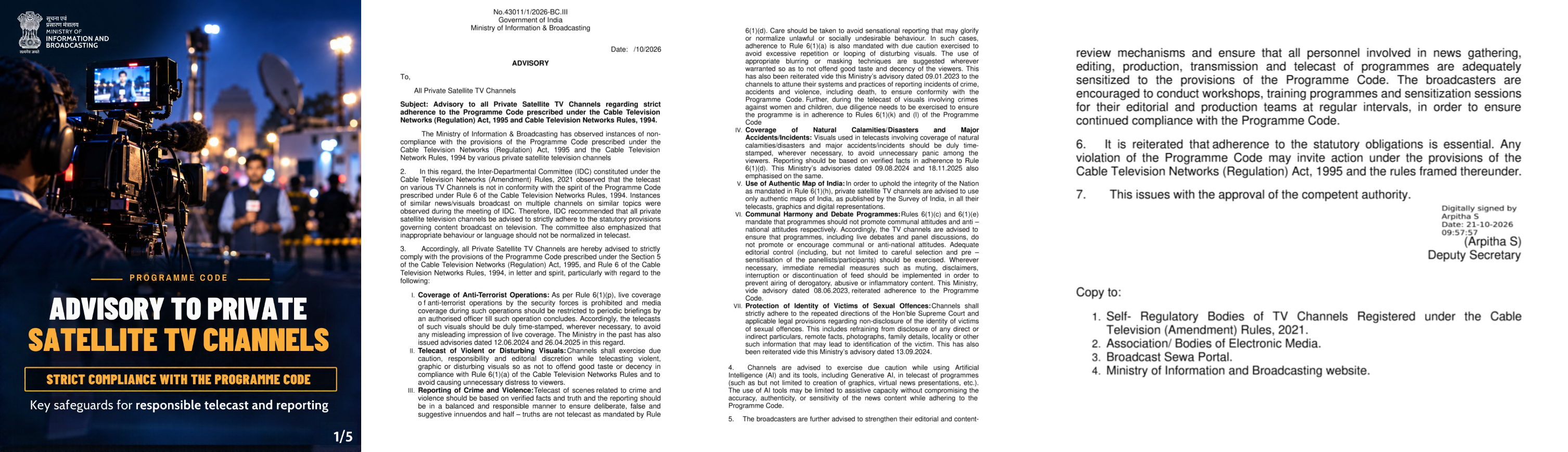
The advisory is essentially a reminder that broadcasters must follow existing laws and program codes designed to protect national security, public order, and social harmony.
Authorities have identified eight major areas of concern that TV channels need to address immediately.
1. Coverage of Anti-Terror Operations: National Security Comes First
One of the biggest concerns relates to live coverage of anti-terror and security operations.
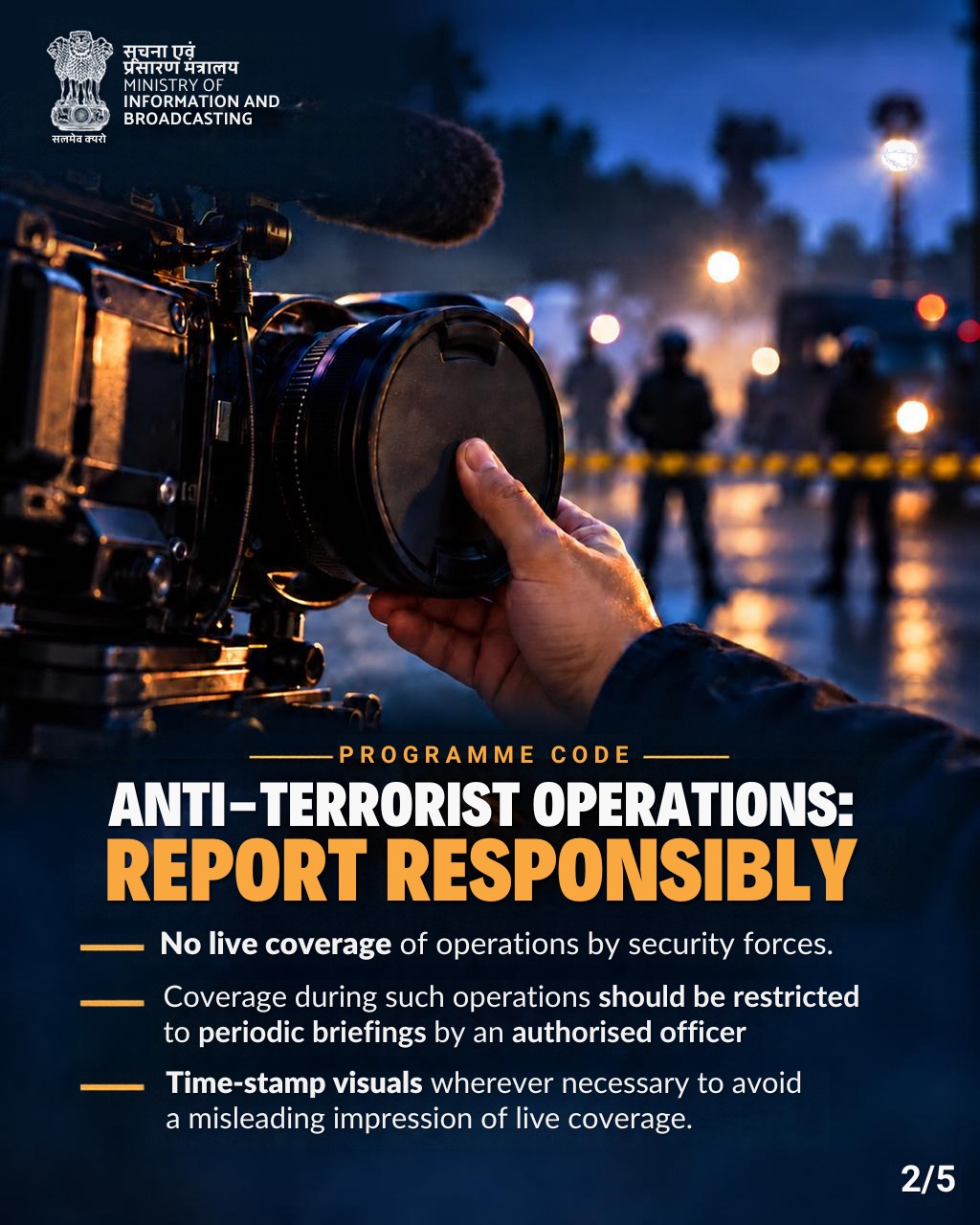
The government has warned channels against broadcasting real-time information that could reveal the location, strategy, or movement of security forces while an operation is underway
Such disclosures can potentially compromise ongoing missions and even endanger the lives of military personnel.
The advisory clarifies that broadcasters should rely only on information officially released by authorized government spokespersons during active operations. Detailed reporting can be carried out once the operation has concluded.
Lessons from the 26/11 Mumbai Attacks
The concern is not hypothetical. During the 2008 Mumbai terror attacks, extensive live television coverage sparked a major debate over media responsibility. Security experts and officials later raised concerns that real-time broadcasting may have provided information that could have been exploited by hostile elements.
That incident remains one of India's most cited examples of why sensitive security operations require careful media handling.
2. Stop Glorifying Crime and Violence
Another major focus of the advisory is the growing tendency to sensationalize crime. The government has urged channels not to glamorize unlawful behaviour or present criminal acts in a way that normalizes or encourages imitation.
Whether it is reckless driving, dangerous stunts, violent incidents, or criminal activities, broadcasters are expected to report facts responsibly rather than turning such incidents into entertainment spectacles.
The message is clear: news reporting should inform viewers, not celebrate unlawful conduct.
3. Communal Debates Under Scrutiny
Perhaps the most discussed aspect of the advisory relates to communal and religious debates frequently aired on television.
Indian news channels often host heated discussions on topics such as:
a) Hindu-Muslim relations
b) Religious conversions
c) Personal laws
d) Temple-mosque disputes
e) Communal violence
f) Identity-based political issues
The government has not banned discussions on these subjects. Instead, it has emphasized the need for restraint, civility, and responsible moderation.
The advisory warns against content that could inflame tensions, spread hostility between communities, or threaten public order.
Criticism Is Not Automatically “Anti-National”
An important distinction remains. Criticizing the government, political parties, public policies, or public officials does not automatically qualify as anti-national content.
The key concern is whether the content crosses legal boundaries, promotes hostility, encourages violence, or undermines national integrity.
As with many regulatory issues, interpretation can sometimes become contentious, making editorial judgment particularly important.
4. Government Raises Red Flag Over AI-Generated Content

The rapid rise of AI-generated images, videos, voice cloning, and digital recreations has created new challenges for news organizations. Recognizing this, the government has specifically warned broadcasters against misusing AI technologies.
Channels have been advised to:
a) Clearly label AI-generated content.
b) Verify the authenticity of sources.
c) Avoid altering facts through AI tools.
d) Prevent viewers from mistaking AI-generated visuals for real events.
This is especially relevant during breaking-news situations where AI-generated visuals of riots, terror attacks, disasters, or political events can spread rapidly and create confusion.
The Growing Threat of Deepfakes
Voice cloning and deepfake technology have become increasingly sophisticated. An AI-generated speech, image, or video can make it appear as though a public figure said or did something that never actually happened.
The government's position is straightforward: AI may be used as a visual aid, but it must never be used to manipulate reality or mislead audiences.
5. Incorrect Maps of India Could Invite Trouble
The advisory also addresses the repeated issue of inaccurate representations of India's territorial boundaries. Media organizations have been instructed to use only officially approved maps, particularly when depicting sensitive regions such as:
a) Jammu & Kashmir
b) Ladakh
c) Pakistan-occupied Kashmir (PoK)
d) Arunachal Pradesh
Incorrect maps, whether intentional or accidental, can lead to serious legal and diplomatic concerns.
The government has therefore advised broadcasters to rely on Survey of India-approved representations.
6. Protect the Identity of Sexual Offence Victims

The privacy of victims remains another key concern. Television channels have been reminded not to reveal identities or sensitive personal information relating to victims of sexual offences.
The advisory reinforces the importance of ethical journalism and victim protection, particularly in cases that attract intense media attention.
7. Stronger Editorial Oversight and Journalist Training
Finally, the government has emphasized the need for stronger editorial controls within news organizations. Unlike newspapers, where content often undergoes multiple layers of review before publication, live television presents unique challenges.

Reporters, anchors, and panellists can make controversial statements in real time, making editorial intervention difficult.
To address this, the advisory recommends:
a) Better newsroom supervision
b) Stronger editorial accountability
c) Enhanced journalist training
d) Improved compliance mechanisms
The goal is to reduce violations before they occur rather than relying solely on punishment afterward.
8. Responsible Reporting During Disasters and Emergencies
⚠️Facts First, Panic Later? Govt Warns Against Sensational Disaster Coverage
The government has advised TV channels to exercise caution while reporting natural disasters, accidents, and other major emergencies. Broadcasters have been asked to rely on verified information and avoid exaggerated or panic-inducing coverage that could create unnecessary fear among viewers.
What Law Gives the Government This Authority?
The advisory is rooted in India's existing broadcasting framework. Key legal provisions include:
1. Cable Television Networks Act, 1995
This law provides the legal framework governing television broadcasting in India. Two provisions are especially important:
a) Section 5: Requires channels to comply with the prescribed Program Code.
b) Section 16: Allows penalties for violations.
2. Cable Television Networks Rules, 1994
Rule 6 lays down the Program Code governing broadcast content. The code already contains provisions related to:
a) Good taste and decency
b) Attacks on religions and communities
c) Anti-national content
d) National integrity and security
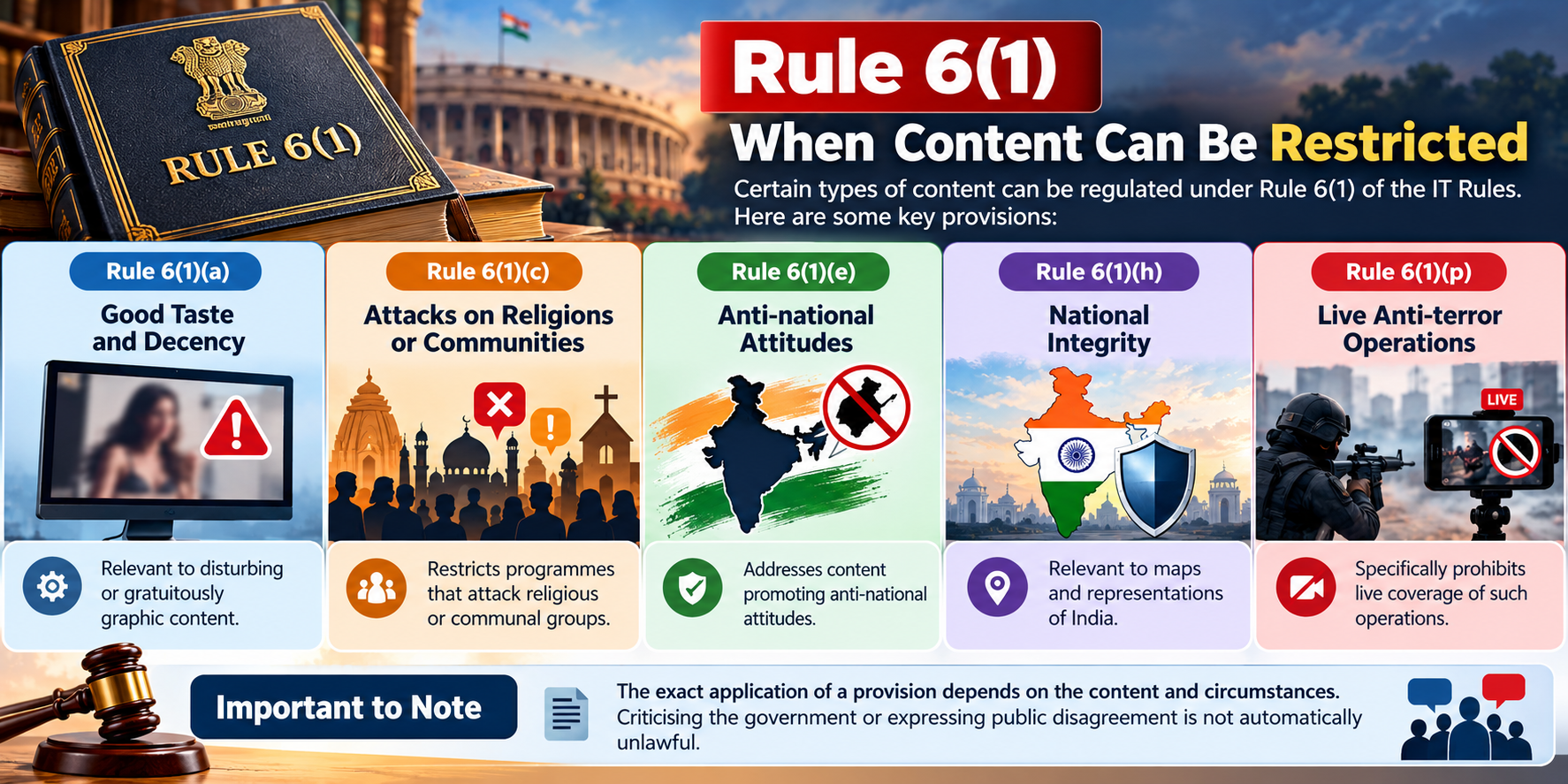
The latest advisory essentially reiterates these existing obligations rather than creating entirely new restrictions.
What Happens If a Channel Violates the Rules?
India follows a three-tier grievance and regulatory system.
Level 1: Broadcaster
Viewers can first file complaints directly with the channel responsible for the content.
Level 2: Self-Regulatory Bodies
If the issue remains unresolved, complaints can be escalated to industry self-regulatory organizations.
Level 3: Government Oversight
The matter can ultimately reach government authorities, including inter-departmental committees that examine violations and recommend action.
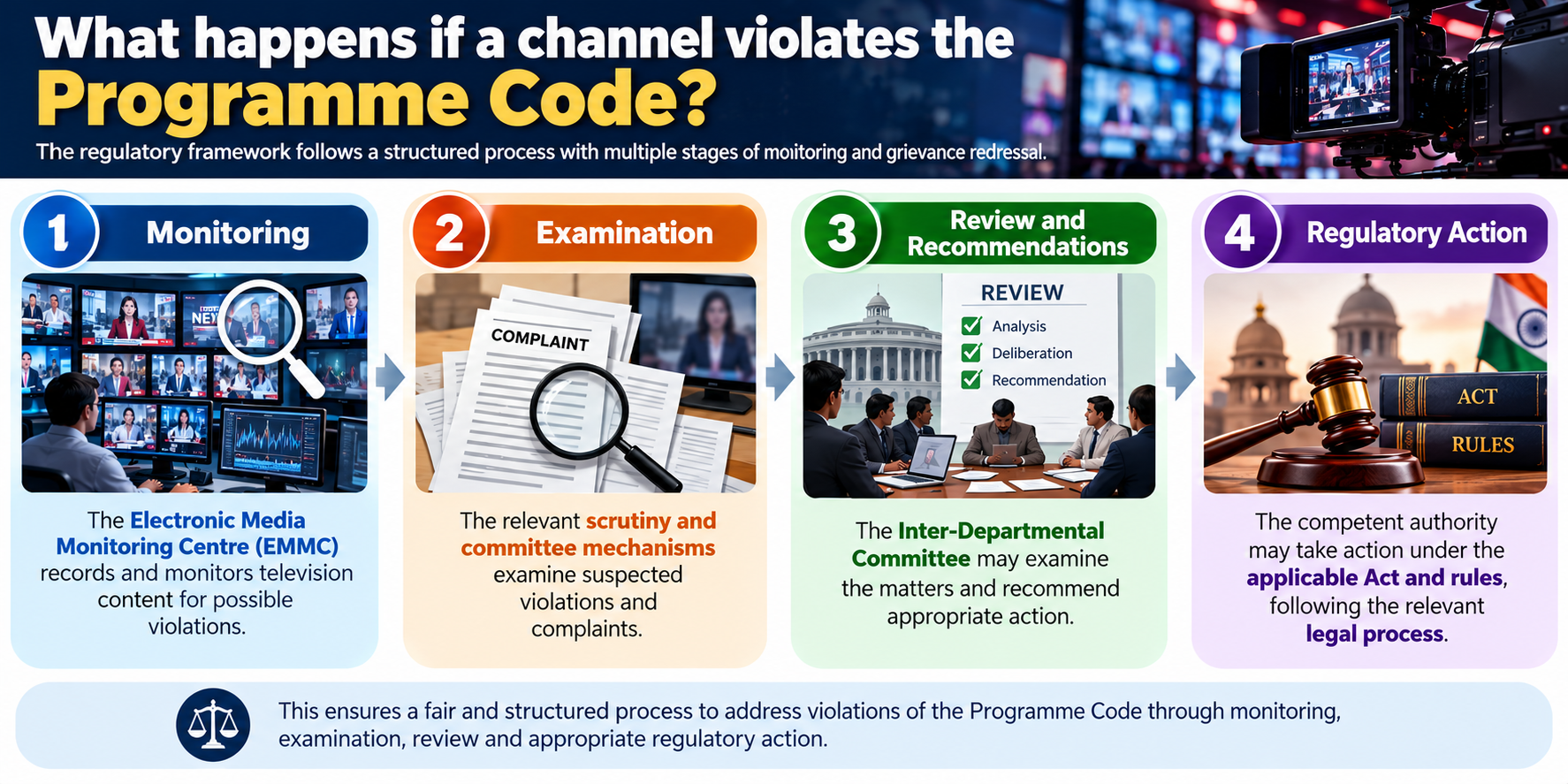
The Electronic Media Monitoring Centre (EMMC) also continuously monitors television broadcasts for potential breaches.
Depending on the severity of the violation, authorities may issue warnings, order corrective measures, or initiate stronger legal actions under applicable laws and regulations.
Final Take: A New Era of Accountability for TV News?
The government's latest advisory signals a growing push for responsible broadcasting in an era dominated by polarization, viral misinformation, and AI-generated content.
Supporters argue that stricter compliance is necessary to protect national security, social harmony, and factual reporting. Media freedom advocates, journalists' associations, and some legal experts, however, may raise concerns about interpretation, editorial independence, and maintaining the balance between regulation and freedom of expression.
What is clear is that India's television news industry is entering a period of heightened scrutiny, where how information is presented may become just as important as the information itself.
👉 What Do You Think?
Should the government take stricter action against channels that air inflammatory debates, AI-generated misinformation, or potentially anti-national content? Or does stronger regulation risk limiting media freedom?
Share your views in the comments below and stay tuned for more updates on media regulation, digital governance, AI policy, and national affairs.
Written by
Devansh KaulDiscussion (0)
Sign in to join the discussion.
Loading comments…