
For over a century, IBM has been the ultimate symbol of corporate stability; the prestigious, unshakeable bedrock of the global tech industry. But yesterday, the unthinkable happened. In a brutal, historic session at the New York Stock Exchange, IBM suffered its worst single-day stock crash in 58 years, wiping out a staggering $70 billion in market value almost overnight.
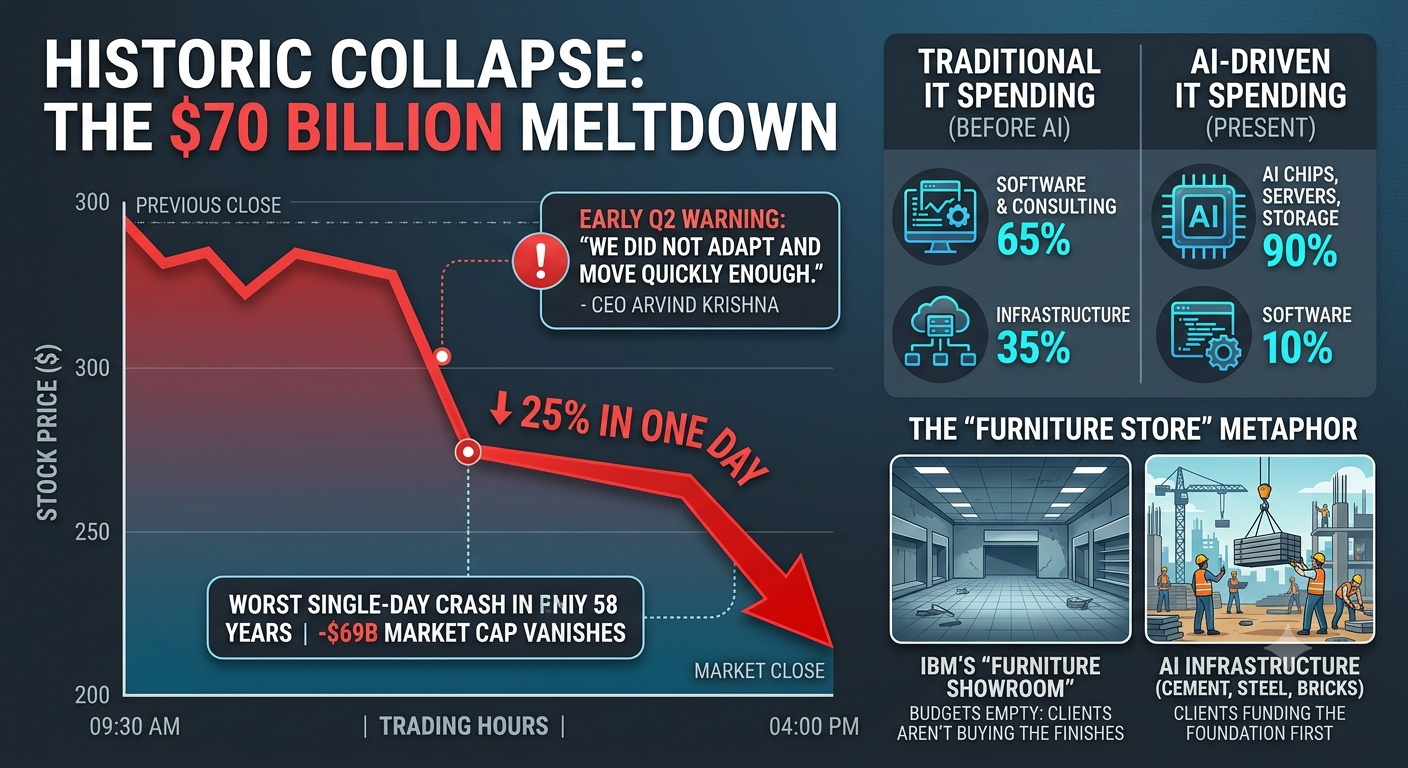
Shares plummeted by a jaw-dropping 25% in a single day, a catastrophic decline not seen since 1968.
The most chilling part? It wasn’t just a bad quarter. In an act of brutal honesty that sent shockwaves through Wall Street, IBM’s own CEO, Arvind Krishna, admitted to the failure:
"We faltered. We did not adapt and move quickly enough."
So, how did a tech giant that survives on multi-billion-dollar government and enterprise contracts collapse so violently in 24 hours?
The Trigger: The Warning Before the Storm
Typically, companies wait for their official earnings call to break bad news, hoping a positive future outlook will soften the blow. IBM took a different, far more alarming route. They released preliminary financial results ahead of schedule, effectively warning investors that the incoming numbers were going to be grim.
Stagnant Revenue: IBM projected revenue at $17.2 billion, representing a microscopic 1% growth.
Infrastructure Collapse: Revenue from their core infrastructure business plummeted by 7%.
Delayed Deals: Massive enterprise contracts with major corporations had suddenly stalled or been delayed.
Investors didn’t just worry; they panicked. A mass sell-off triggered immediately, but the panic wasn't just about a temporary dip in profits. It was the realization of a terrifying new reality: The global IT spending landscape has fundamentally changed, and IBM was left holding the wrong playbook.
The AI Revolution: Why Everyone Stopped Buying "IBM’s high-end tech showroom"
To understand why IBM crashed, you have to look at how Generative AI has violently rewired corporate budgets.
IBM doesn't sell smartphones like Apple or GPUs like Nvidia. They sell enterprise software, IT consulting, hybrid cloud solutions, and mainframes to banks, airlines, and governments. Historically, a corporation's IT budget was highly predictable:
Software & Consulting: ~65%
Infrastructure & Hardware's: ~35%
IBM made its fortune by dominating that massive 65% of the software and consulting pie. But Generative AI changed the rules of the game.
Today, companies are starving for raw computing power to run massive AI models like ChatGPT. They don't want to buy software yet; they need the underlying infrastructure first. Corporate budgets have completely flipped to hardware hoarding:
Traditional IT Budget Split
Current AI-Driven IT Budget Split
Software (40%)
AI GPU Chips (40%)
IT Consulting (25%)
AI Servers (25%)
Infrastructure (20%)
Data Storage (15%)
Other tech (15%)
Software (Only 10%)
The Real Estate Analogy
Think of it this way: Imagine you are building a brand-new house. IBM assumed you were ready to buy luxury furniture, curtains, and home decor (Enterprise Software & Consulting). Instead, because of the AI boom, you realized you needed to spend every single penny of your budget on cement, steel, bricks, and a massive foundation (GPUs, Servers, and Storage).
Because companies are spending all their cash on the foundation, IBM’s “furniture store" is empty.
The Supply Chain Panic and the Cyber Security Trap
Making matters worse is a classic case of FOMO (Fear of Missing Out) in the corporate world. Because AI hardware (like Nvidia GPUs and high-speed storage) is in such short supply, companies are terrified that prices will skyrocket in the future. As a result, they are aggressively front-loading their budgets; buying years' worth of hardware today, leaving absolutely zero budget left for traditional software upgrades.
Additionally, as AI becomes more powerful, cyberattacks are becoming hyper-sophisticated. The small sliver of budget that isn't going toward hardware is being diverted into emergency cybersecurity defenses, further starving IBM's core business segments.
The AI Value Chain: Who Wins and Who Loses?
The AI boom isn’t lifting all boats equally. The AI ecosystem operates on a distinct food chain, and right now, only the top layer is feasting.
TOP OF THE CHAIN
▲ Semiconductor & GPU Manufacturers (Nvidia, AMD) - WINNING BIG
▲ AI Server & Storage Makers (Dell, Supermicro) - WINNING BIG
▲ Cloud Infrastructure Giants (Microsoft Azure, AWS) - WINNING
▼ Foundational AI Models (OpenAI, Anthropic) - COMPETITIVE
▼ Enterprise Software & IT Consulting (IBM, TCS, Infosys) - UNDER SEVERE PRESSURE
BOTTOM OF THE CHAIN
Right now, wealth is concentrated entirely at the top of the chain. Traditional IT software and consulting giants including Indian tech powerhouses like TCS and Infosys, which have also seen massive pressure on their valuations, are stuck at the bottom, waiting for the AI benefits to trickle down.
Is This the End of Big Blue?
Does a 25% crash mean IBM is dead? Not necessarily. IBM is investing heavily in its own enterprise AI platform (Watsonx). The issue isn't their vision; it’s their timing and execution.
IBM misjudged how fast their customers would pivot their wallets toward hardware. While the tech titan will likely evolve and survive once the world finishes building its AI infrastructure and returns to buying software, this historic crash serves as a brutal warning to the tech world:
In the era of Artificial Intelligence, it doesn't matter if you are 115 years old; if you don't move at lightning speed, the market will leave you behind.
Written by
Ritvik DeshmukhDiscussion (0)
Sign in to join the discussion.
Loading comments…