
Why Is India Rethinking Imports?
For decades, India leaned on low‑cost imports to fuel growth, from China’s cheap electronics to Europe’s advanced machinery. But global shocks like COVID‑19, the Russia‑Ukraine war, Red Sea disruptions, and U.S.–Iran tensions exposed a dangerous truth: when supply chains collapse, affordability means nothing.
India realized that economic resilience and national security demand more than just cheap imports. The new industrial policy marks a historic pivot from cost efficiency to self‑reliance.
India’s Import Reality Check: Numbers That Tell the Story
India’s appetite for global goods remains massive, $775 billion worth of imports in FY2025‑26 alone. But here’s the twist: a government review suggests that nearly $398 billion of these imports could be replaced by domestic manufacturing, unlocking huge opportunities for local industry.
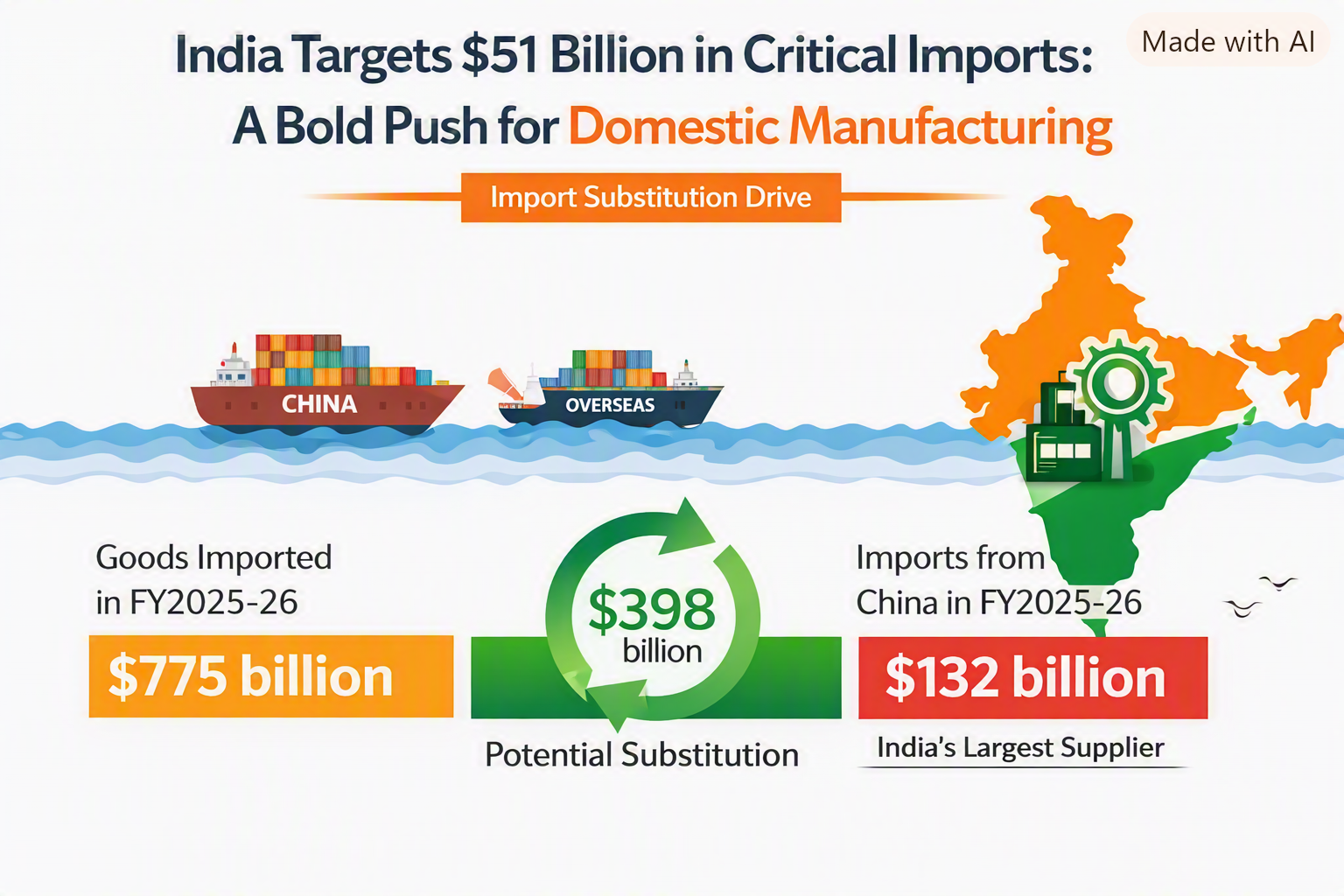
China continues to dominate India’s import basket, supplying close to $132 billion worth of goods, making it the single largest source of imports. This heavy reliance underscores why India’s new self‑reliance push is more than just policy - it’s a necessity.
The $51 Billion Problem
The government has identified 100 critical imported products worth $51 billion annually, ranging from semiconductors and solar equipment to industrial chemicals and EV components. These are items that India can manufacture domestically but has not, due to high costs, fragmented supply chains, and technological gaps.
Beyond these 100 items, experts estimate that India has the potential to replace up to $398 billion worth of imports with domestic production.
Key Sectors in Focus
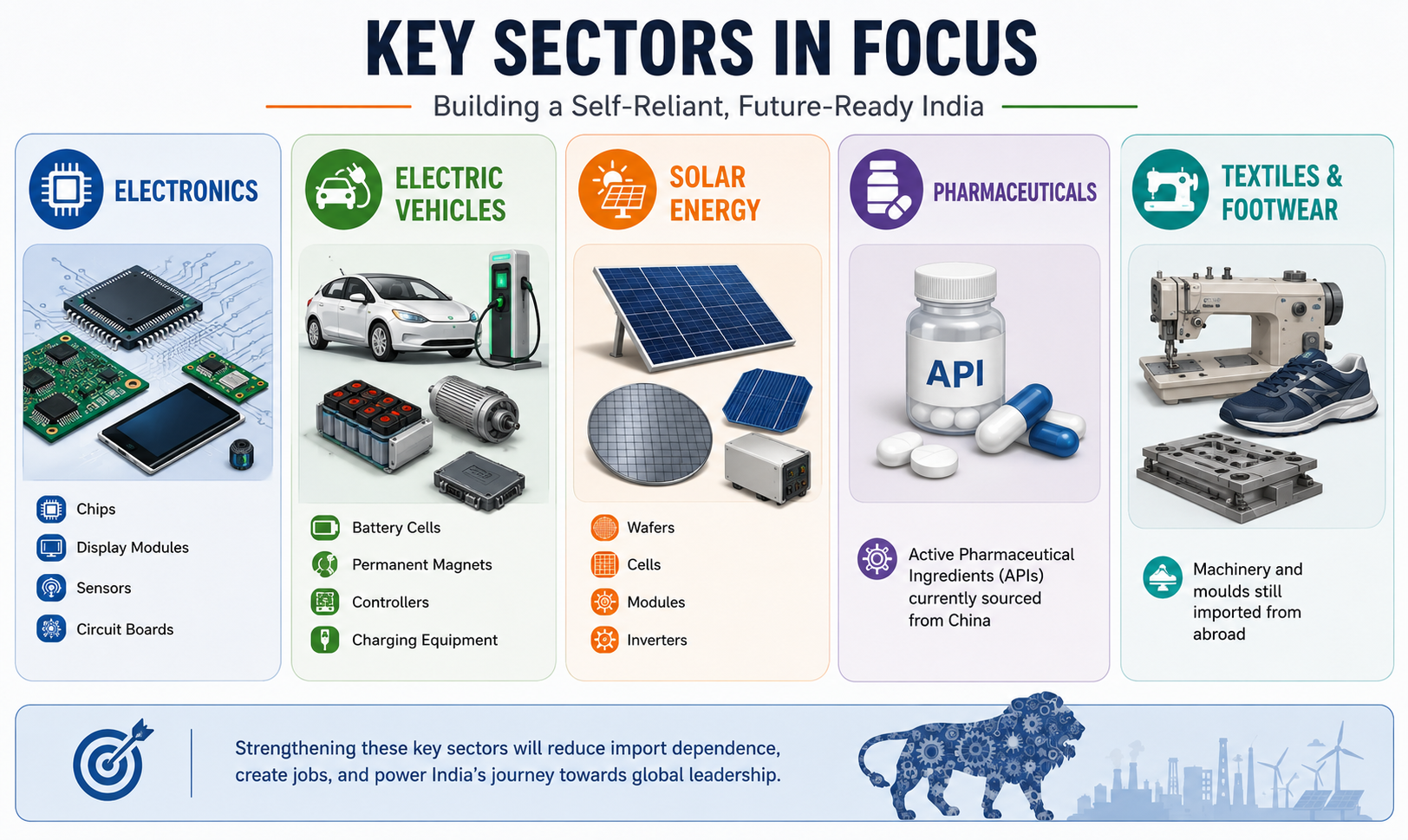
Electronics: Chips, display modules, sensors, and circuit boards.
Electric Vehicles: Battery cells, permanent magnets, controllers, charging equipment.
Solar Energy: Wafers, cells, modules, inverters.
Pharmaceuticals: Active Pharmaceutical Ingredients (APIs) currently sourced from China.
Textiles & Footwear: Machinery and moulds still imported from abroad.
How India Plans to Deliver
India’s blueprint for industrial transformation is both ambitious and strategic, combining incentives, global alliances, and infrastructure upgrades to turn policy into production.
Production‑Linked Incentive (PLI) Schemes: Subsidies tied to manufacturing output.
Global Tech Partnerships: Joint ventures with South Korea, Taiwan, Germany, and Italy.
Government Procurement: Assured orders to reduce risk for domestic producers.
Industrial Corridors: Delhi–Mumbai, Chennai–Bengaluru, and PM Gati Shakti projects to cut logistics costs.
Ease of Doing Business: Streamlined approvals and infrastructure upgrades.
The Payoff
India’s import substitution drive promises more than policy shifts; it’s set to deliver jobs, secure supply chains, and strengthen the nation’s economic backbone while aligning industrial growth with national security.
Massive Job Creation across manufacturing, transport, warehousing, and packaging.
Reduced Trade Deficit and stronger foreign exchange reserves.
Supply Chain Security for defense, telecom, and energy sectors.
Industrial Growth & National Security hand‑in‑hand.
The Challenges Ahead
India’s march toward self‑reliance is ambitious, but the road is strewn with hurdles, from matching global prices and bridging skill gaps to scaling infrastructure and securing access to cutting‑edge technology.
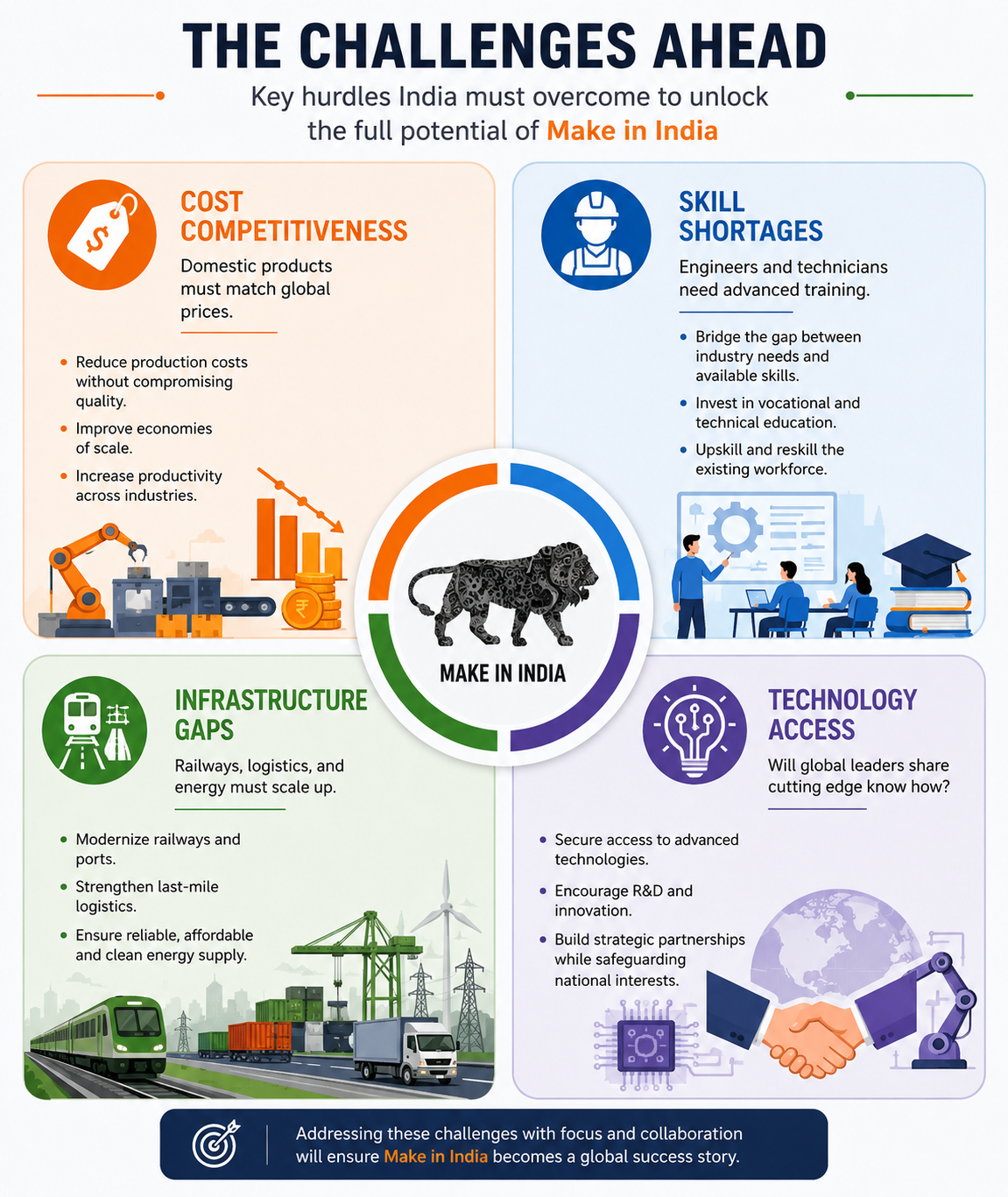
Cost Competitiveness: Domestic products must match global prices.
Skill Shortages: Engineers and technicians need advanced training.
Infrastructure Gaps: Railways, logistics, and energy must scale up.
Technology Access: Will global leaders share cutting‑edge know‑how?
A Global Trend
India isn’t alone. The U.S. Chips and Science Act, the Inflation Reduction Act, and Europe’s push for clean energy show that nations worldwide are racing to secure supply chains and reduce dependence on imports.
India’s $51 billion import substitution drive isn’t just policy; it’s a national mission. The question is: Will India seize this moment to become a true manufacturing powerhouse?
What do you think? Can India overcome cost and skill barriers to lead the next industrial revolution? Share your thoughts, join the debate, and let’s shape the future together!
Written by
Vedant BhardwajDiscussion (0)
Sign in to join the discussion.
Loading comments…