
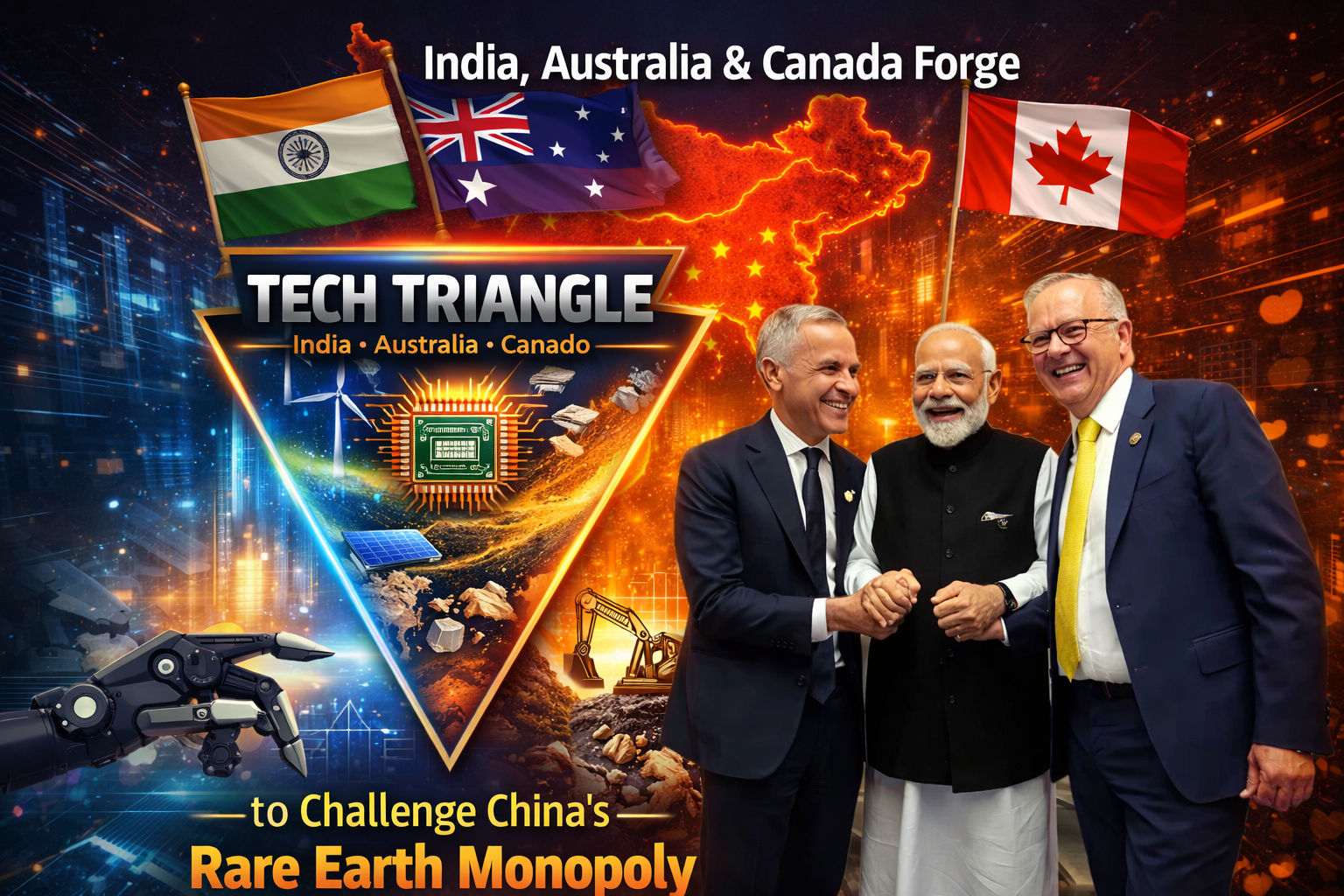
In a world where China has long sought to dominate rare earths and critical minerals, a new alliance is rewriting the rules of global technology and resource security. Enter the ACITI Partnership - the Australia‑Canada‑India Technology & Innovation Partnership-popularly dubbed the Tech Triangle, ensuring the world isn’t dependent on a single nation for these critical resources.
First announced in 2025 and now formally operationalized through a Memorandum of Understanding, this trilateral initiative is more than just another agreement. It is a strategic framework designed to secure access to critical minerals, strengthen semiconductor supply chains, accelerate AI innovation, and expand cooperation in green energy, defense technologies, and space.
Why This Partnership Matters
The global economy has been shaken by disruptions: COVID‑19 exposed fragile supply chains, the Russia‑Ukraine war rattled energy markets, and U.S.–China technological rivalry highlighted the risks of over‑dependence on a single supplier. China’s repeated restrictions on rare earth exports have left nations scrambling for alternatives. The Tech Triangle is a direct response—ensuring resilience, diversification, and shared innovation.
Strengths of Each Partner
· India brings scale, digital innovation, and a booming startup ecosystem. With the world’s largest digital public infrastructure (UPI, Aadhaar) and expanding semiconductor manufacturing, India is the hub of software talent and digital transformation.
· Australia contributes vast reserves of lithium, cobalt, nickel, uranium, and rare earth elements—making it one of the most resource‑rich nations globally.
· Canada adds world‑class AI research, advanced semiconductor expertise, clean tech, aerospace innovation, and mining technologies.
Together, these strengths create a synergy: India drives manufacturing and digital innovation, Australia secures raw mineral supply, and Canada provides cutting‑edge research and governance frameworks.
AI as the Cornerstone
Artificial Intelligence is the beating heart of this partnership. Modern AI requires not just software expertise but also massive data centers, GPUs, advanced semiconductors, reliable electricity, and cooling systems. India contributes engineers and digital infrastructure, Canada leads in AI research and responsible frameworks, while Australia ensures the mineral backbone for hardware.
Beyond Minerals: Strategic Impact
· Semiconductors: Joint efforts in silicon, gallium, and germanium will boost India’s chip industry.
· Defense & Security: Collaboration in cyber security, quantum technologies, and maritime security strengthens the Indo‑Pacific architecture.
· Clean Energy: With Australia and Canada as major uranium producers, India’s nuclear energy program gains long‑term fuel security.
The Bigger Picture
The ACITI Partnership complements India’s broader strategy—Make in India, Atmanirbhar Bharat, and digital economy goals - while reinforcing its role as a trusted technology partner. Though China’s name is never directly mentioned, the intent is clear: this alliance challenges Beijing’s monopoly and builds a more balanced global order.
Of course, challenges remain - high mining costs, environmental concerns, and limited refining capacity outside dominant producers. Yet, with sustainable investment and shared innovation, the Tech Triangle could reshape the future of technology and resource security.
Written by
Bhavana SharmaDiscussion (0)
Sign in to join the discussion.
Loading comments…