
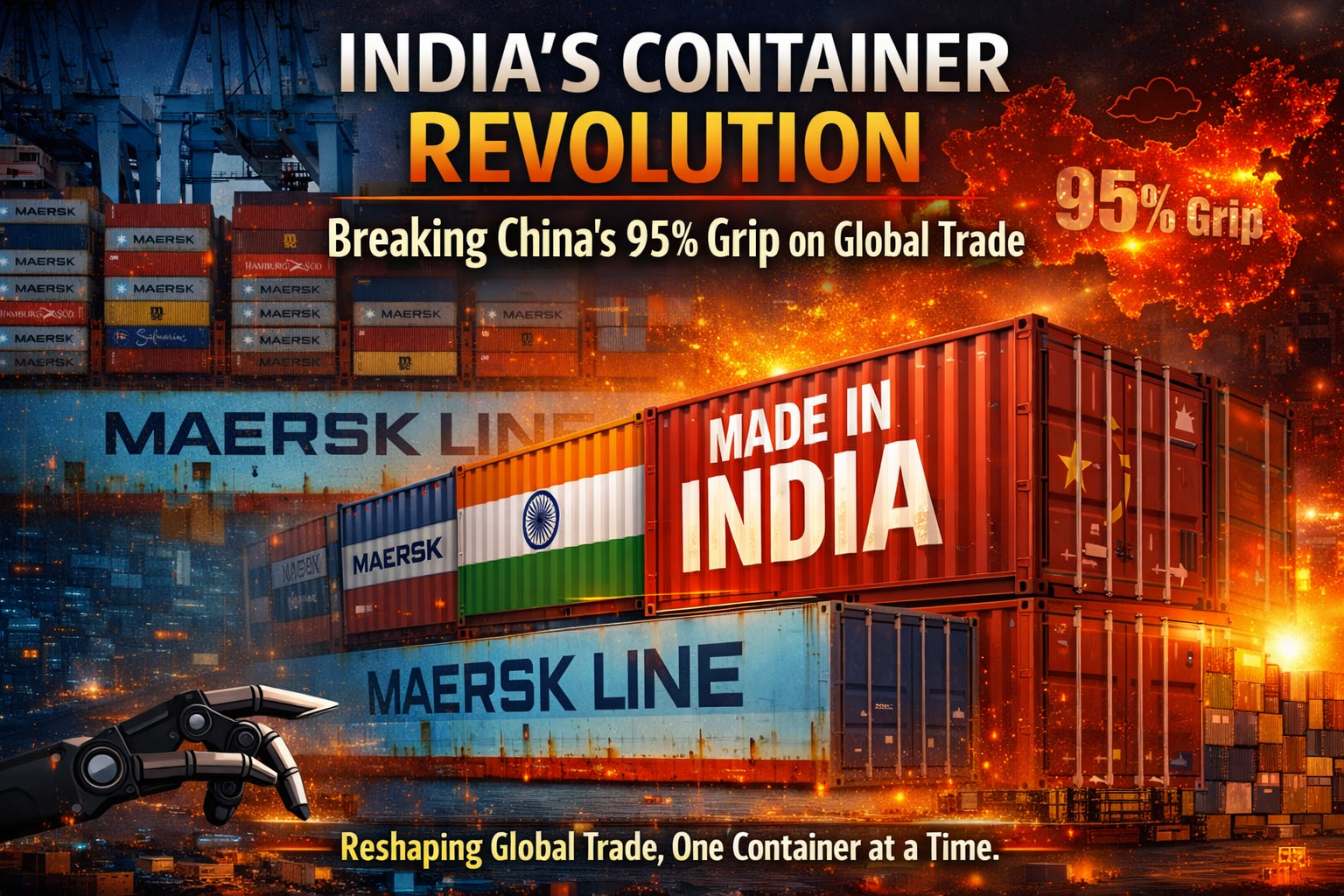
When people talk about international trade, they usually focus on what’s being exchanged—phones, raw materials, machinery, or luxury goods. But few notice the silent backbone of global commerce: containers.
For decades, one of the most essential products driving global trade remained invisible to most people’s eyes — shipping containers. These standardized steel boxes quietly move millions of goods every single day across oceans, railways, and highways. Yet, few realize that China manufactures nearly 95–96% of the world’s containers, giving it near‑total control over this critical backbone of international commerce.
Now, India has taken a bold step to change that narrative—rolling out its first locally manufactured export container, marking the beginning of a new era in trade independence and industrial capability.
Despite being one of the world’s largest trading nations, India never produced its own containers — until the COVID‑19 pandemic exposed the fragility of global supply chains. When China’s factories shut down, container supply collapsed, and global trade nearly came to a standstill. The crisis revealed a harsh truth: economic security and supply chain resilience depend not just on goods, but on the very boxes that carry them.
The Power of Standardization
Shipping containers revolutionized logistics. Before their invention, goods were loaded individually — bags, barrels, boxes — taking days or even weeks to load and unload ships. Theft, damage, and delays were rampant. Containerization changed everything: it standardized transport, reduced costs, improved efficiency, and transformed global trade forever. Economists call it one of the greatest innovations in modern commerce.
How China Built Its Monopoly?
China’s dominance stems from massive manufacturing scale, government subsidies, tax incentives, and a strong steel industry producing Corten steel — the corrosion‑resistant metal used in containers. Its integrated ecosystem of steel mills, component suppliers, paint manufacturers, and logistics hubs keeps costs low and efficiency high. Companies like China International Marine Containers (CIMC) and Dong Fang International Container control most of the global market.
In India’s Awakening
India’s container industry lagged due to high production costs, limited technology, and lack of policy focus. But the pandemic changed everything. Under Atmanirbhar Bharat and Make in India, the government began supporting domestic container manufacturing through PLI schemes, subsidies, and infrastructure initiatives like PM Gati Shakti. The goal: reduce dependence on imports, strengthen supply chain resilience, and create jobs.
A major breakthrough came when Maersk, one of the world’s largest shipping and logistics companies, partnered with Indian manufacturers -validating India’s product quality and global standards. Maersk has already placed orders for 1,000 India‑made containers, signaling confidence in India’s growing industrial capability.
Challenges Ahead
India’s journey has just begun. Chinese producers still operate at enormous scale, with decades of experience and integrated supply chains. India faces hurdles in the availability of specialized steel, component ecosystems, and production scale. But the momentum is undeniable - India is positioning itself as a credible alternative in global container manufacturing.
The Geopolitical Significance
This shift isn’t just industrial; it’s strategic. The pandemic taught the world not to rely solely on one country for essential goods. India’s entry into container manufacturing offers nations a new choice - a resilient, democratic alternative to China’s monopoly.
While India isn’t replacing China yet, it’s building the foundation for a more balanced global trade ecosystem — one container at a time.
Written by
Bhavana SharmaDiscussion (0)
Sign in to join the discussion.
Loading comments…