
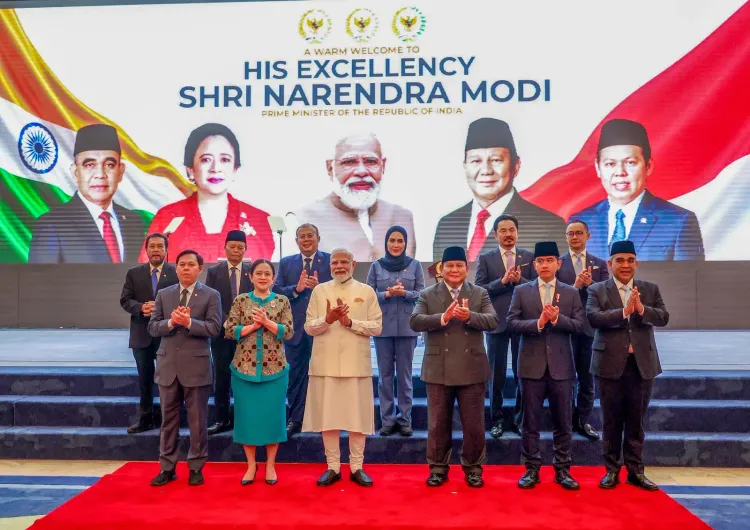
India and Indonesia have entered a new era of bilateral cooperation with the signing of 20 landmark agreements during Prime Minister Narendra Modi’s visit to Indonesia, marking a new “Golden Chapter” in their strategic partnership.
These agreements cover a wide range of sectors, including defence, maritime security, critical minerals, artificial intelligence, digital payments, healthcare, education, agriculture, and the blue economy.
More than just routine diplomatic engagements, these agreements signal a shift from traditional bilateral relations to a comprehensive strategic partnership. At a time when the Indo-Pacific region is becoming increasingly important in global geopolitics, closer India-Indonesia ties are expected to strengthen regional stability, economic growth, and security.
Why Indonesia Matters to India
Indonesia is India’s largest strategic partner in Southeast Asia and the largest economy among ASEAN nations. Its geographical position makes it one of the world’s most significant maritime countries.
Spread across more than 17,000 islands, Indonesia stretches nearly 5,000 kilometres from east to west, connecting the Indian Ocean with the Pacific Ocean. This strategic location gives Indonesia immense influence over some of the world’s busiest sea routes.
A Maritime Power at the Heart of Global Trade
Several globally important maritime chokepoints pass through Indonesian waters:
• Strait of Malacca
• Sunda Strait
• Lombok Strait
• Makassar Strait
Nearly one-third of global oil shipments pass through these sea lanes. India’s trade with East Asia, energy imports, and maritime commerce also rely heavily on these routes. As a result, maintaining strong cooperation with Indonesia directly contributes to India’s maritime security and economic interests.
Indonesia: India’s Gateway to ASEAN
Indonesia plays a leading role within ASEAN because it is:
• The largest economy in Southeast Asia.
• The most populous ASEAN nation.
• A member of the G20.
• The world’s largest Muslim-majority country.
A stronger partnership with Indonesia naturally enhances India’s engagement with the entire ASEAN region, supporting India’s Act East Policy and its Indo-Pacific strategy.
Historical and Cultural Connections
India and Indonesia share centuries-old cultural and civilizational links.
Ancient Indian traders introduced Hinduism, Buddhism, Sanskrit, and Indian art to the Indonesian archipelago. Even today, these influences remain visible across the country.
The island of Bali continues to preserve many Hindu traditions, while stories from the Ramayana and Mahabharata remain deeply embedded in Indonesian culture. Several Indonesian names are derived from Sanskrit, and temples reflecting Indian architectural influence can still be found throughout the country.
These shared historical ties provide a strong cultural foundation for today’s strategic partnership.
Why Were These Agreements Signed Now?
The timing of these agreements reflects changing geopolitical realities.
Countering Regional Security Challenges
China has significantly expanded its influence in the Indo-Pacific through:
• The Belt and Road Initiative (BRI)
• Increased naval deployments
• Aggressive actions in the South China Sea
• Strategic investments across Southeast Asia
India and Indonesia aim to promote a free, open, and rules-based Indo-Pacific by strengthening their partnership.
Building Secure Supply Chains
Recent global disruptions have highlighted the need for reliable supply chains for:
• Critical minerals
• Semiconductors
• Electric vehicle batteries
• Advanced manufacturing
Indonesia possesses abundant natural resources, while India offers manufacturing capabilities and technological expertise. Together, both countries can reduce dependence on limited suppliers and build more resilient supply chains.
Key Landmark Agreements
- BrahMos Missile Agreement
One of the most significant announcements was Indonesia’s decision to procure two batteries of the BrahMos supersonic cruise missile system from India.
Developed jointly by India and Russia, BrahMos is among the world’s fastest operational supersonic cruise missiles. It can be launched from land, sea, or air platforms and is capable of highly accurate precision strikes.
For Indonesia, the acquisition strengthens:
• Coastal defence
• Anti-ship warfare capability
• Maritime deterrence
For India, it represents another major success in defence exports under the “Make in India” initiative, following the earlier BrahMos deal with the Philippines.
- Astra Air-to-Air Missile Export
Indonesia is also set to become the first country to import India’s Astra beyond-visual-range air-to-air missile.
The Astra missile can engage enemy aircraft at distances ranging from approximately 80 to 110 kilometres and travels at nearly 4.5 times the speed of sound.
Since Indonesia operates Sukhoi fighter aircraft, integrating Astra missiles into its fleet will significantly enhance its aerial combat capability.
This agreement demonstrates that India’s defence exports are expanding beyond a single missile system and showcases the country’s growing indigenous defence manufacturing capabilities.
- Maritime Security Cooperation
Given their close maritime proximity, India and Indonesia agreed to deepen cooperation in:
• Maritime domain awareness
• Search and rescue operations
• Anti-piracy initiatives
• Disaster relief operations
• Maritime surveillance
The Andaman and Nicobar Islands lie close to Indonesia’s Aceh Province, making coordinated maritime security especially valuable for safeguarding the strategically important Strait of Malacca.
- Development of Sabang Port
Another important agreement focuses on developing Sabang Port, located near the northern tip of Indonesia.
Because of its proximity to India’s Andaman and Nicobar Islands, Sabang can become:
• A logistics hub
• A refuelling station
• A disaster relief centre
• A strategic maritime support facility
The project also complements India’s infrastructure development plans in the Andaman and Nicobar Islands.
- Critical Minerals: The Foundation of Future Technologies
Critical minerals have become indispensable in today’s technology-driven world. Minerals such as nickel, cobalt, lithium, graphite, and rare earth elements are essential for manufacturing electric vehicle (EV) batteries, semiconductors, renewable energy equipment, and advanced electronics.
Indonesia occupies a strategically important position in the global supply chain because it possesses:
• The world’s largest nickel reserves
• Significant deposits of cobalt
• Large reserves of bauxite
• Tin and copper resources
A stronger partnership with Indonesia would provide India with more secure access to these vital raw materials. This is especially important as India expands its electric mobility, renewable energy, and electronics manufacturing sectors.
- Strengthening Rare Earth Supply Chains
Rare earth elements are another critical component of modern technologies, ranging from smartphones and wind turbines to defense equipment and semiconductors.
Currently, China dominates the global processing of rare earth minerals. By working closely with Indonesia, India can diversify its sourcing and processing capabilities, reducing dependence on a single supplier and strengthening supply chain resilience.
- Building a Semiconductor Ecosystem
Critical minerals and rare earth elements form the backbone of semiconductor manufacturing.
Indonesia possesses abundant upstream resources such as mineral reserves and mining infrastructure. India, on the other hand, is investing heavily in semiconductor manufacturing and electronics production.
By combining Indonesia’s natural resources with India’s manufacturing ambitions, both countries can create a more secure and resilient semiconductor ecosystem.
- Collaboration in Artificial Intelligence
Artificial Intelligence (AI) has emerged as a transformative technology across sectors including healthcare, agriculture, manufacturing, and public services.
Recognizing its growing importance, India and Indonesia have agreed to collaborate in AI research and development. Joint initiatives could accelerate innovation, improve productivity, and create new opportunities for businesses and researchers in both countries.
- Expanding Digital Payments Through UPI
India’s Unified Payments Interface (UPI) has become one of the world’s most successful digital payment systems.
Both countries aim to promote UPI-based payment integration, making digital transactions easier for Indian tourists and businesses operating in Indonesia, particularly in popular destinations such as Bali. Greater fintech cooperation could also encourage financial inclusion and digital commerce.
- Education and Academic Partnerships
Educational cooperation is another important pillar of the partnership.
The Indian Institute of Management (IIM) Bangalore is establishing a campus in Indonesia, which is expected to strengthen academic collaboration through:
• Faculty exchange programmes
• Executive education and training
• Management education
• Research partnerships
This initiative will also enhance India’s educational outreach across Southeast Asia.
- Healthcare Cooperation
India’s pharmaceutical industry is globally recognized for producing affordable, high-quality medicines.
Greater collaboration with Indonesia’s healthcare system can improve access to pharmaceuticals, strengthen healthcare infrastructure, and support public health initiatives in both countries.
- Agricultural Innovation and Food Security
Agriculture remains a priority for both India and Indonesia.
The partnership aims to promote:
• Agricultural technology
• Sustainable farming practices
• Knowledge sharing
• Food security initiatives
By exchanging expertise and modern farming techniques, both countries can improve agricultural productivity and resilience.
- Developing the Blue Economy
The Blue Economy focuses on the sustainable use of ocean resources for economic growth.
India and Indonesia plan to cooperate in areas such as:
• Fisheries
• Marine biotechnology
• Coastal tourism
• Sustainable marine resource management
Given that both nations possess extensive coastlines, collaboration in this sector offers significant economic potential.
- Cooperation in Space Technology
India has made remarkable progress in space technology and satellite applications.
Indonesia is expected to benefit from Indian expertise in:
• Satellite applications
• Disaster monitoring
• Navigation systems
• Remote sensing
Such cooperation can improve disaster preparedness, environmental monitoring, and public infrastructure planning.
Challenges Ahead
While the partnership presents enormous opportunities, several challenges remain.
The success of these agreements will depend on timely implementation rather than announcements alone. Adequate financing for defence cooperation, infrastructure projects, and technology initiatives will be essential.
In addition, geopolitical competition could influence the pace of cooperation. China has significant economic and strategic interests in Indonesia and may seek to strengthen its own engagement in the region. As a result, India and Indonesia will need sustained political commitment, strategic planning, and long-term investment to realize the full potential of their partnership.
Conclusion
The India–Indonesia partnership extends far beyond traditional diplomacy. It represents a strategic collaboration focused on securing critical mineral supplies, strengthening semiconductor manufacturing, advancing artificial intelligence, expanding digital payments, improving education and healthcare, modernizing agriculture, developing the blue economy, and enhancing space cooperation.
If successfully implemented, these initiatives can strengthen regional stability, diversify global supply chains, and create lasting economic and technological benefits for both nations in the years ahead.
Written by
Bhavana SharmaDiscussion (0)
Sign in to join the discussion.
Loading comments…