
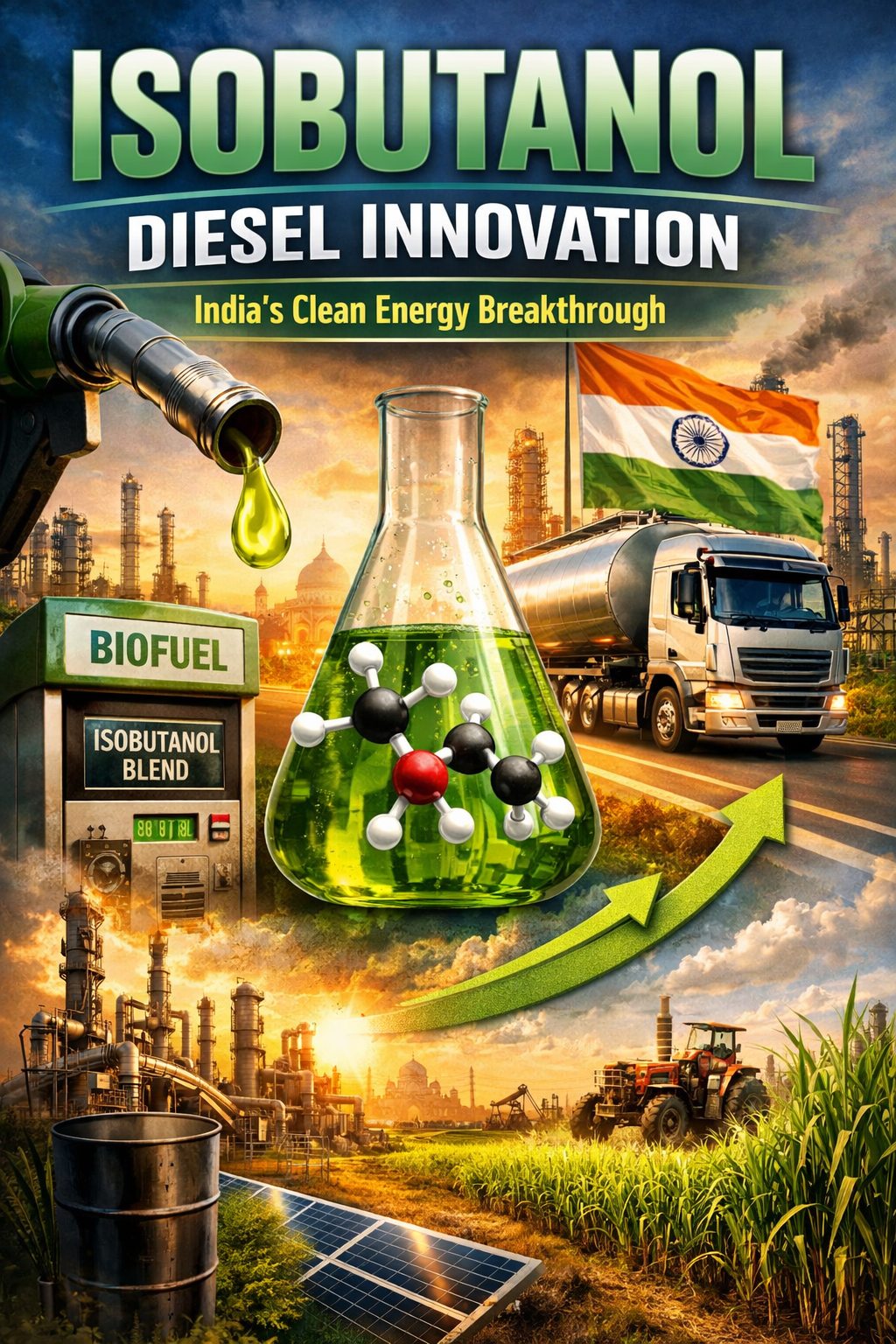
India, the world’s third‑largest consumer of crude oil, imports nearly 85% of its fuel needs - a dependency that has long strained its economy and exposed it to global price shocks. But a quiet revolution is underway, one that could redefine how India powers its engines and protects its environment.
After conquering ethanol‑blended petrol ahead of schedule, India is now turning its sights to bio‑diesel innovation, and the hero of this new chapter is a molecule called isobutanol.
From Ethanol to Isobutanol: The Science Behind the Shift
Ethanol blending helped India cut crude imports and support sugar mills and farmers, but when scientists tried mixing ethanol with diesel, the experiment failed. Why?
Ethanol is a polar molecule, while diesel is non‑polar—they simply don’t mix. The result was unstable fuel, corrosion, and engine damage.
Enter isobutanol, a higher alcohol with four carbon atoms (C₄H₁₀O). Unlike ethanol, it behaves more like diesel—stable, less moisture‑absorbing, and engine‑friendly. It can blend smoothly with diesel without separating or damaging injectors, making it a game‑changer for India’s biofuel ambitions.
Why Isobutanol Works Better?
· Higher Energy Density: Ethanol produces about 21 MJ/L, while isobutanol delivers 29 MJ/L—closer to diesel’s 36 MJ/L.
· Better Compatibility: It mixes well with diesel, stays stable, and requires minimal engine modification.
· Lower Corrosion & Moisture Absorption: Unlike ethanol, it doesn’t rust pipelines or absorb excessive water.
· Cleaner Combustion: Reduced smoke, carbon monoxide, and particulate emissions mean cleaner air and healthier cities.
India’s Pilot Project: A Step Toward Sustainable Diesel
Union Minister Nitin Gadkari recently confirmed successful pilot tests using 100% isobutanol and 100% ethanol in generator sets. The government now plans to introduce 15% isobutanol‑blended diesel, a realistic target that could drastically cut crude imports while boosting domestic agriculture and industry.
This initiative benefits multiple sectors:
· Agriculture: Sugar mills, biomass producers, and farmers gain new revenue streams.
· Automotive: Engine manufacturers and fuel system companies adapt to cleaner fuels.
· Energy & Chemical Industries: Refineries and blending facilities expand into biofuel production.
Challenges on the Road Ahead
Despite the promise, hurdles remain:
Feedstock Availability: Diverting food crops for fuel raises the “food vs. fuel” debate.
Production Cost: Isobutanol is currently costlier than diesel, though scaling up could reduce prices.
Infrastructure Needs: New storage tanks, blending facilities, and testing labs must be built.
Vehicle Compatibility: Older engines may require recalibration or upgrades to handle blended fuels.
The Big Picture
India’s biofuel journey is more than an energy transition—it’s a strategic leap toward self‑reliance. By harnessing agricultural waste and innovation, India can reduce its oil imports, empower farmers, and lead the world in sustainable fuel technology.
Closing Insight
The rise of isobutanol marks the dawn of a cleaner, smarter, and more independent India—where every drop of fuel tells a story of innovation and resilience.
The ethanol and isobutanol debate raging across India captures the tension between innovation and everyday reality. This clash isn’t just about fuel—it’s about trust. For India’s green energy transition to succeed, policy must balance sustainability goals with consumer confidence, ensuring that progress doesn’t come at the cost of performance and reliability.
Written by
Bhavana SharmaDiscussion (0)
Sign in to join the discussion.
Loading comments…