
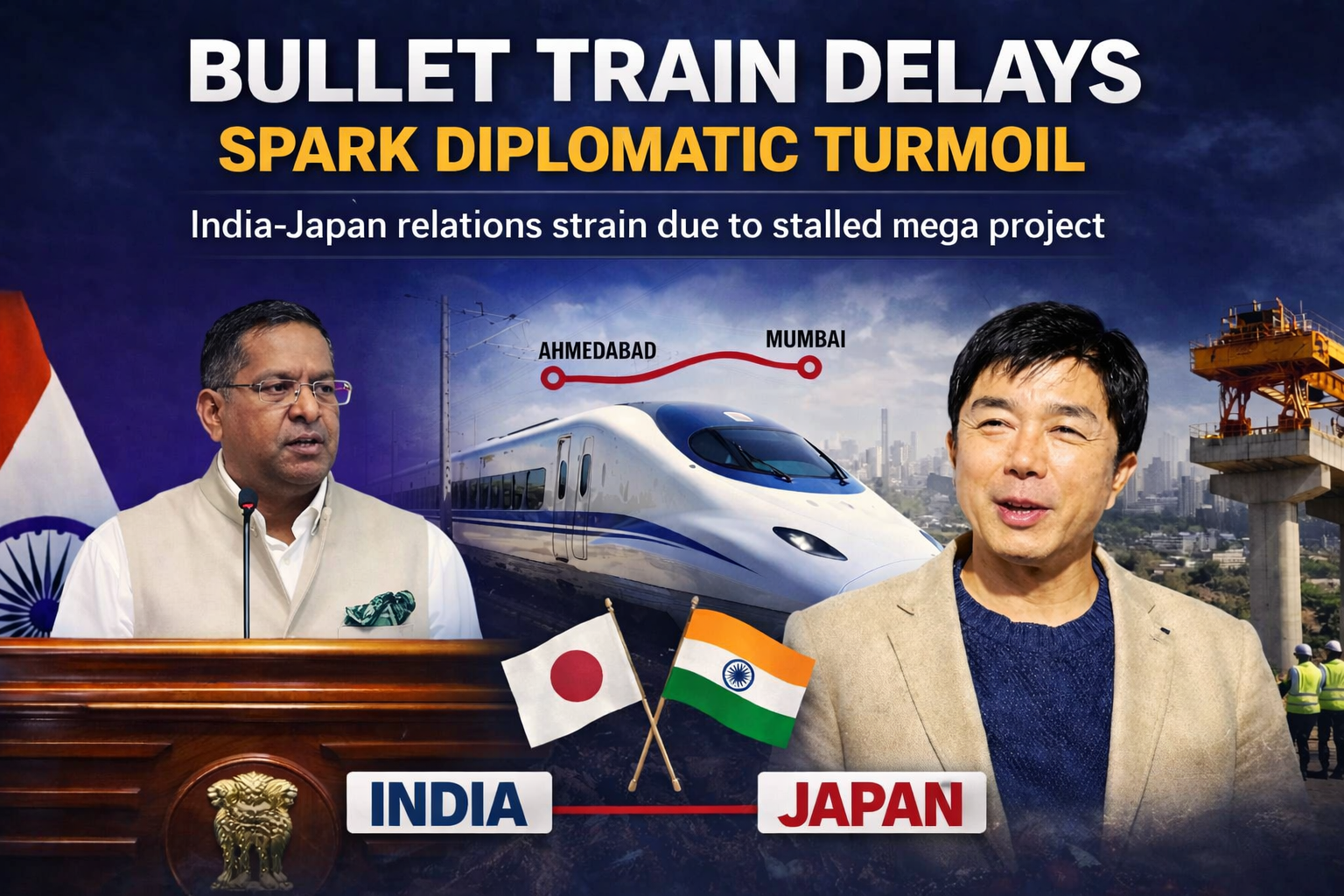
The Grand Promise
In 2015, India announced an ambitious project, a high‑speed bullet train connecting Ahmedabad to Mumbai. Backed by Japanese technology and financing, this was meant to be a symbol of modern India racing into the future. The inauguration in 2017 by Prime Minister Narendra Modi and Japan’s Shinzo Abe was celebrated as a historic milestone.
But fast forward to 2026, and the train is still nowhere to be seen.
The Controversy Ignites
Recently, Japan’s former Justice Minister Makihara openly criticized India, blaming delays on the “flip‑flop attitude” of Indian ministers. He claimed:
“Indian leaders kept changing terms, backing out of commitments, and slowing progress.”
This statement sparked political firestorms in India, with opposition leaders accusing the government of negligence and broken promises.
The Debt Dilemma
India borrowed ₹79,000 crore from Japan at a symbolic 1% interest rate (after 15 years). Initially, this looked like a sweet deal. But delays have doubled the project cost to nearly ₹2 lakh crore.
The question haunting policymakers: Will India ever earn enough from this project to repay the debt?
Why the Project Stalled?
Several roadblocks have derailed progress:
Land Acquisition Battles: Farmers in Gujarat and Maharashtra resisted giving up land.
COVID‑19 Pandemic: Construction halted during 2020–21.
Political & Bureaucratic Delays: Shifting priorities and lack of coordination slowed momentum.
Technology & Safety Disputes: Japan’s advanced signaling system was sidelined, raising eyebrows.
The Vision vs. Reality
Originally, the plan promised:
508 km track with 12 stations.
Travel time: 2 hours 7 minutes (express) or 3 hours (with stops).
Speed: 320 km/h.
Daily ridership: 17,900 passengers initially, projected to reach 92,000 by 2053.
Yet, as of 2026, not a single train has run. Officials now claim a partial launch may happen in 2027, but scepticism remains.
India-Japan Relations at Stake
Despite signing 129 bilateral agreements in July 2026, the bullet train project saw no progress. Japan, proud of its Shinkansen legacy, views India’s delays as damaging to credibility.
Opposition leaders in India argue this is not just about trains; it’s about trust, diplomacy, and India’s global image.
The Big Question: Boon or Burden?
Is the bullet train a futuristic leap or a financial trap?
Supporters say it will revolutionize travel, cut flight competition, and showcase India’s modernization.
Critics warn it’s an overpriced vanity project, draining resources without clear returns.
What India’s MEA Said?
India’s Ministry of External Affairs (MEA) quickly dismissed Hideki Makihara’s criticism, calling it just a “personal opinion” that doesn’t match the facts.
MEA spokesperson Randhir Jaiswal clarified that talks with Japan on the Mumbai–Ahmedabad bullet train are moving forward smoothly. He explained:
The first section of the track will open in 2027.
Japan’s new E10 series train is still being developed and will arrive in the early 2030s.
Until then, India will begin operations using its own high‑speed train.
Construction work is “rapidly progressing”, and the project is on track with the shared goal of launching as soon as possible.
In short: India says the project is not stalled; it’s just unfolding in phases, with both sides committed to making the bullet train a reality.
Conclusion: A Race Against Time
India’s bullet train was meant to be a symbol of speed and progress. Instead, it has become a symbol of delay and doubt. With costs soaring and trust shaken, the project now stands at a crossroads.
Will 2027 finally see the first bullet train speeding across Gujarat and Maharashtra, or will this remain India’s most expensive unfinished dream?
Written by
Samar PrakashDiscussion (0)
Sign in to join the discussion.
Loading comments…