

A Structural Shift in India’s Capital Markets
For decades, India’s stock market danced to the tune of foreign institutional investors (FIIs). When they poured money in, indices soared; when they pulled out, markets crashed. Think of the 2008 global financial crisis, the 2013 taper tantrum, or the COVID‑19 shock in 2020, each episode showed how vulnerable India was to foreign capital flows.
But now, history has been rewritten. For the first time, India’s mutual fund industry has surpassed foreign institutional investors (FIIs) in total assets under custody (AUC), marking a milestone signalling a deep structural transformation in the Indian economy.
What’s the Difference Between AUM and AUC?
Assets Under Management (AUM): The total value of investments managed by fund managers.
Assets Under Custody (AUC): The actual securities, equities, bonds, ETFs, safely held in custody accounts.

As of June 2026, mutual funds’ AUC crossed an astonishing ₹76 lakh crore, overtaking FIIs’ holdings. This isn’t just a statistical achievement; it’s proof that domestic savings are now powering India’s growth story.
Although mutual funds have made significant progress, FIIs still hold a larger share of the equity market. Their holdings shrank from about ₹78 lakh crore in September 2024 to ₹68.65 lakh crore in June 2026, a 12% fall. Mutual funds, on the other hand, surged 23.3% in equity assets, moving from ₹44.20 lakh crore to ₹54.50 lakh crore.
Equity assets of FIIs, at ₹68.65 lakh crore, still exceed mutual funds’ ₹54.50 lakh crore. However, the shrinking gap and the AUC crossover demonstrate the growing strength of India’s domestic investment base.
Why Did This Happen?
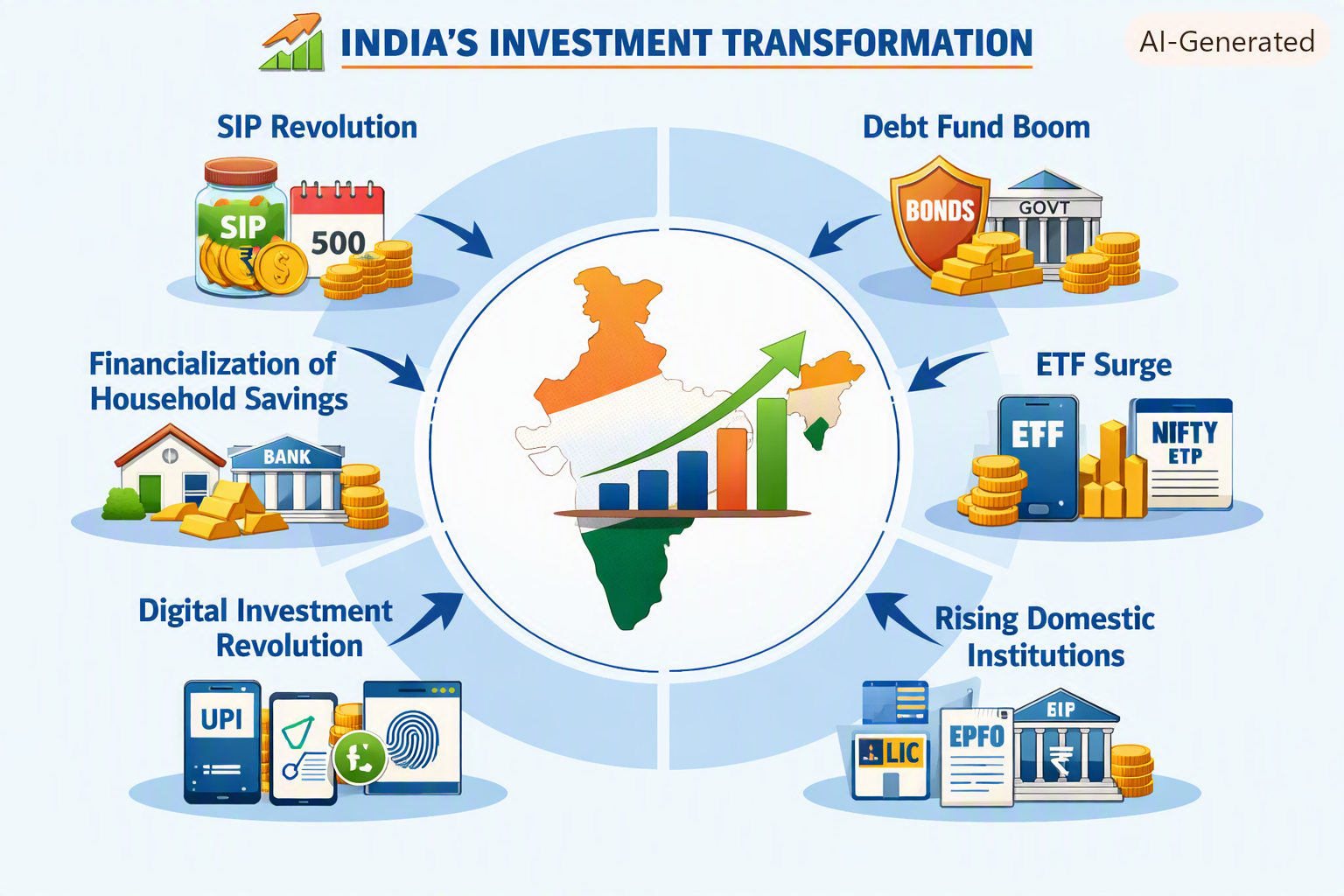
Several powerful trends converged to make this possible:
SIP Revolution: Systematic Investment Plans (SIPs) have democratized investing. Millions of Indians now invest ₹500, ₹1,000, or ₹5,000 monthly, creating a steady domestic capital inflow.
Financialization of Household Savings: Families are shifting wealth from gold, real estate, and fixed deposits into financial assets like mutual funds and stocks.
Debt Fund Boom: With the RBI allowing individuals to invest directly in government securities, debt mutual funds have seen explosive growth.
ETF Surge: Low‑cost, transparent exchange‑traded funds (ETFs), from Nifty ETFs to Gold ETFs, are attracting both retail and institutional investors.
Digital Investment Revolution: UPI, e‑KYC, and investment apps have made investing seamless, cutting down processes that once took weeks into minutes.
Rising Domestic Institutions: Insurance giants like LIC, pension funds like EPFO, and banks are channelling household savings into markets, strengthening domestic participation.
Why It Matters?
This milestone reflects a structural shift in India’s financial ecosystem:
Reduced Dependence on Foreign Capital: India is no longer at the mercy of FIIs’ inflows and outflows.
Greater Financial Stability: Domestic capital formation ensures resilience against global shocks.
Deeper Markets: With more local participation, India’s financial markets are becoming broader and more sophisticated.
Of course, FIIs remain important; they bring global expertise and invest heavily in blue‑chip companies. But the balance of power has shifted. India’s growth is now increasingly fueled by its own people’s savings.
The Big Picture
India’s mutual funds beating FIIs is more than a headline; it’s a symbol of confidence, maturity, and independence. The rise of SIPs, ETFs, and digital investing shows that India’s financial future is being written by its own citizens.
Domestic savings have become the backbone of India’s capital markets, ensuring that the next chapter of growth is not just imported, but homegrown.
Written by
Aarav VashishtDiscussion (0)
Sign in to join the discussion.
Loading comments…