
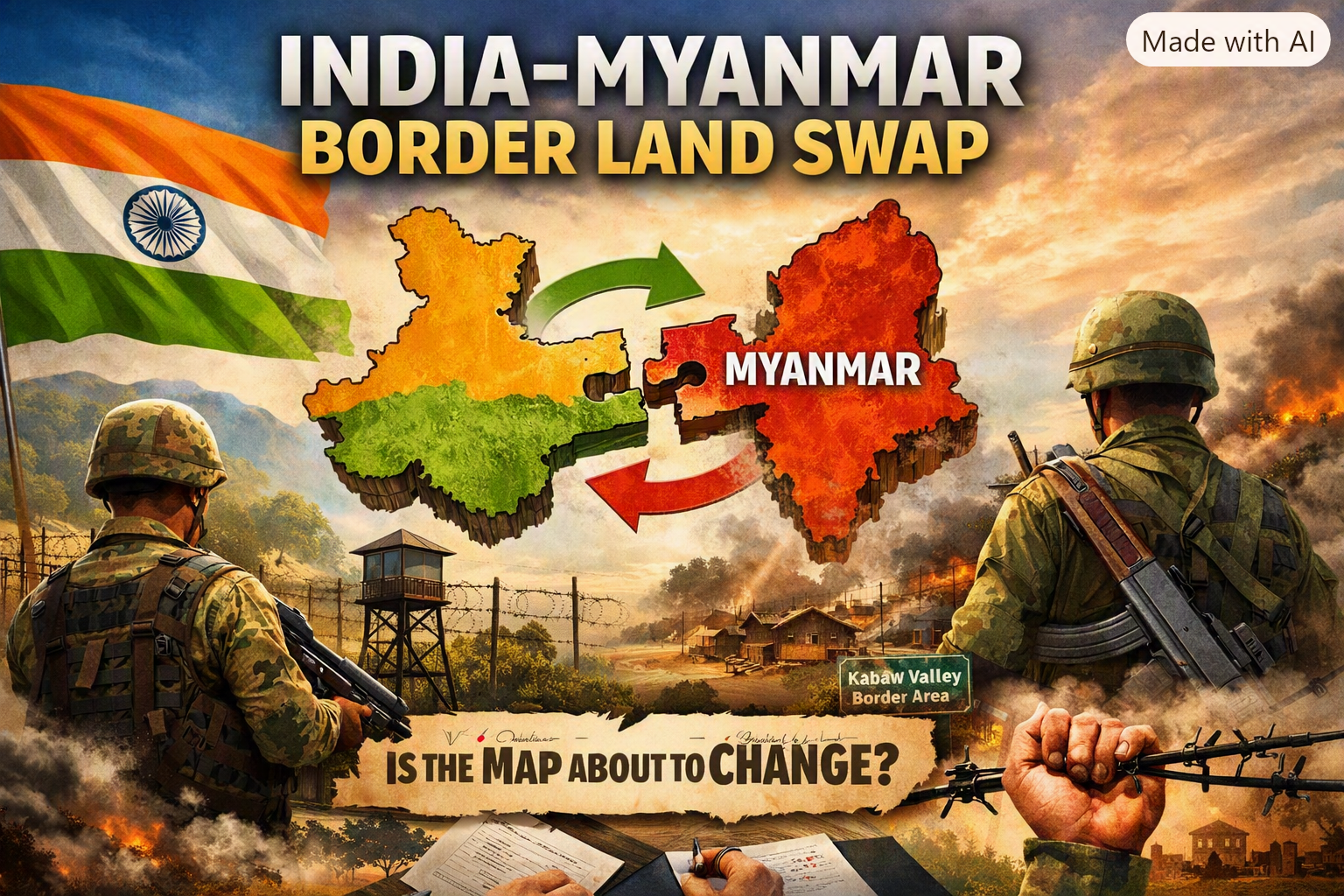
A Proposal That Could Redraw Boundaries
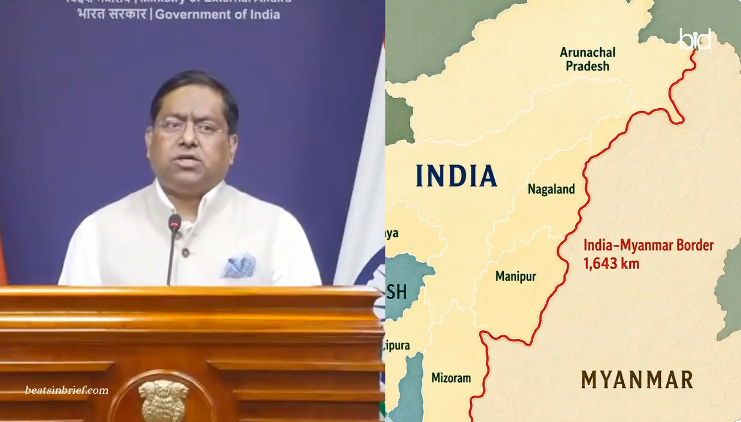
Recently, reports revealed that India and Myanmar are discussing a possible territorial adjustment, a land swap along the Manipur border to settle long‑pending boundary demarcation issues. The Ministry of External Affairs has acknowledged that talks are underway, though no final decision has been made. If implemented, this could alter small stretches of land near Boundary Pillars 65 to 68 in Manipur’s Chandel district, an area long left demarcated.
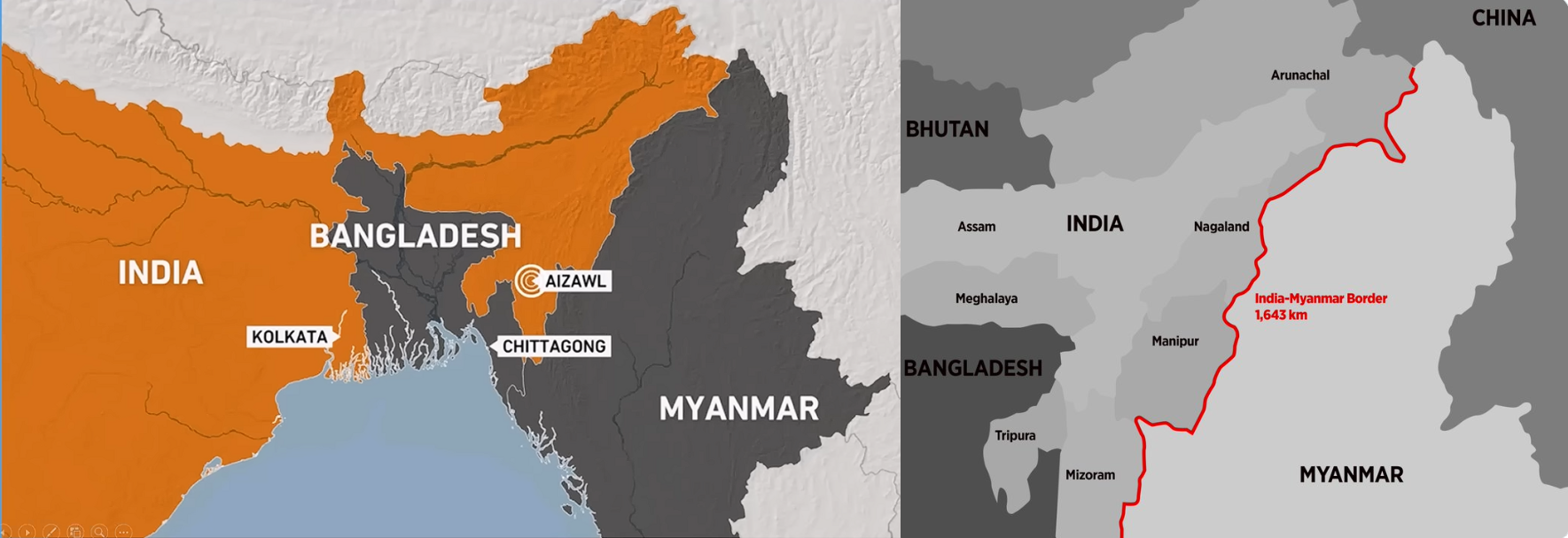
The proposal involves exchanging a small parcel of land (around 3.5 sq km) but carries strategic weight, as India is investing ₹31,000 crore to fence the border. Without clear demarcation, fencing cannot be completed, leaving gaps exploited by insurgents, smugglers, and illegal immigration.
Historically, Kabaw Valley has been politically sensitive, tied to Manipur’s past and the Treaty of Yandabo (1826). While sovereignty claims have long been settled in Myanmar’s favour, emotional ties in Manipur make the issue contentious.
From a security standpoint, however, a fully demarcated and fenced border would help India curb infiltration, restrict insurgent movement, and strengthen cross‑border coordination, making this small swap a big step in securing the Northeast.
The Historical Backdrop
The India–Myanmar border stretches 1,643 km across Arunachal Pradesh, Nagaland, Manipur, and Mizoram.
Its origins trace back to the Treaty of Yandabo (1826) after the Anglo‑Burmese War, later formalized when Burma separated from British India in 1937.
After independence (India in 1947, Burma in 1948), the administrative line became an international border.
Despite a 1967 agreement, 171 km of the frontier remains unsettled, largely due to mountainous terrain, dense forests, shifting rivers, and tribal settlements straddling both sides.
Why Now? Security Pressures Mount
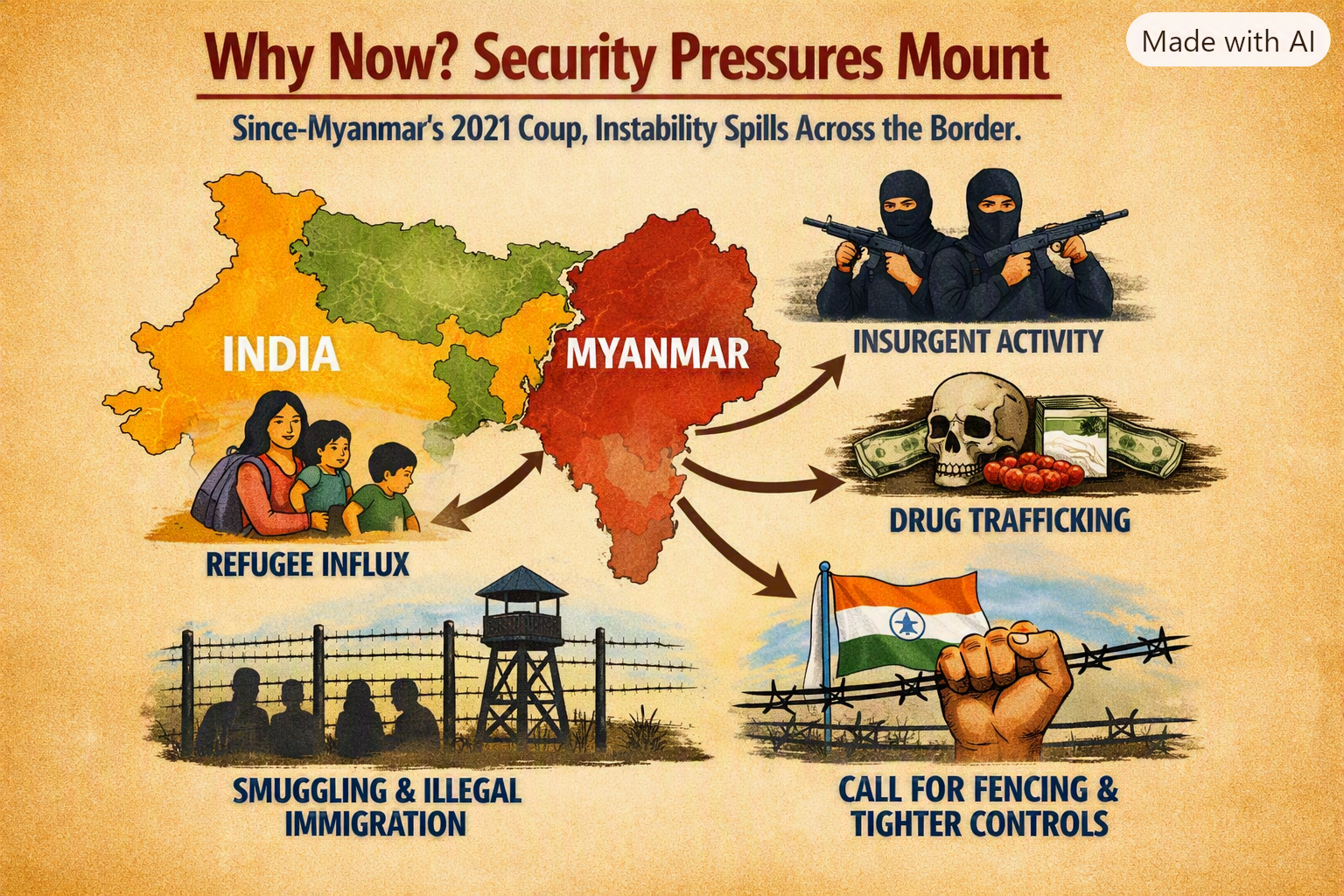
Since Myanmar’s military coup in 2021, instability has spilled over the border:
Refugee influx into India has raised demographic and resource concerns.
Insurgent groups exploit porous boundaries to move arms and fighters.
The Golden Triangle’s drug trade funnels narcotics into India.
Smuggling and illegal immigration have intensified, prompting New Delhi to push for fencing and stricter controls.
India’s Act East Policy also makes Myanmar strategically vital, with projects like the India‑Myanmar‑Thailand Trilateral Highway and the Kaladan Multimodal Transit Transport Project hinging on stable borders.
Local Opposition in Manipur
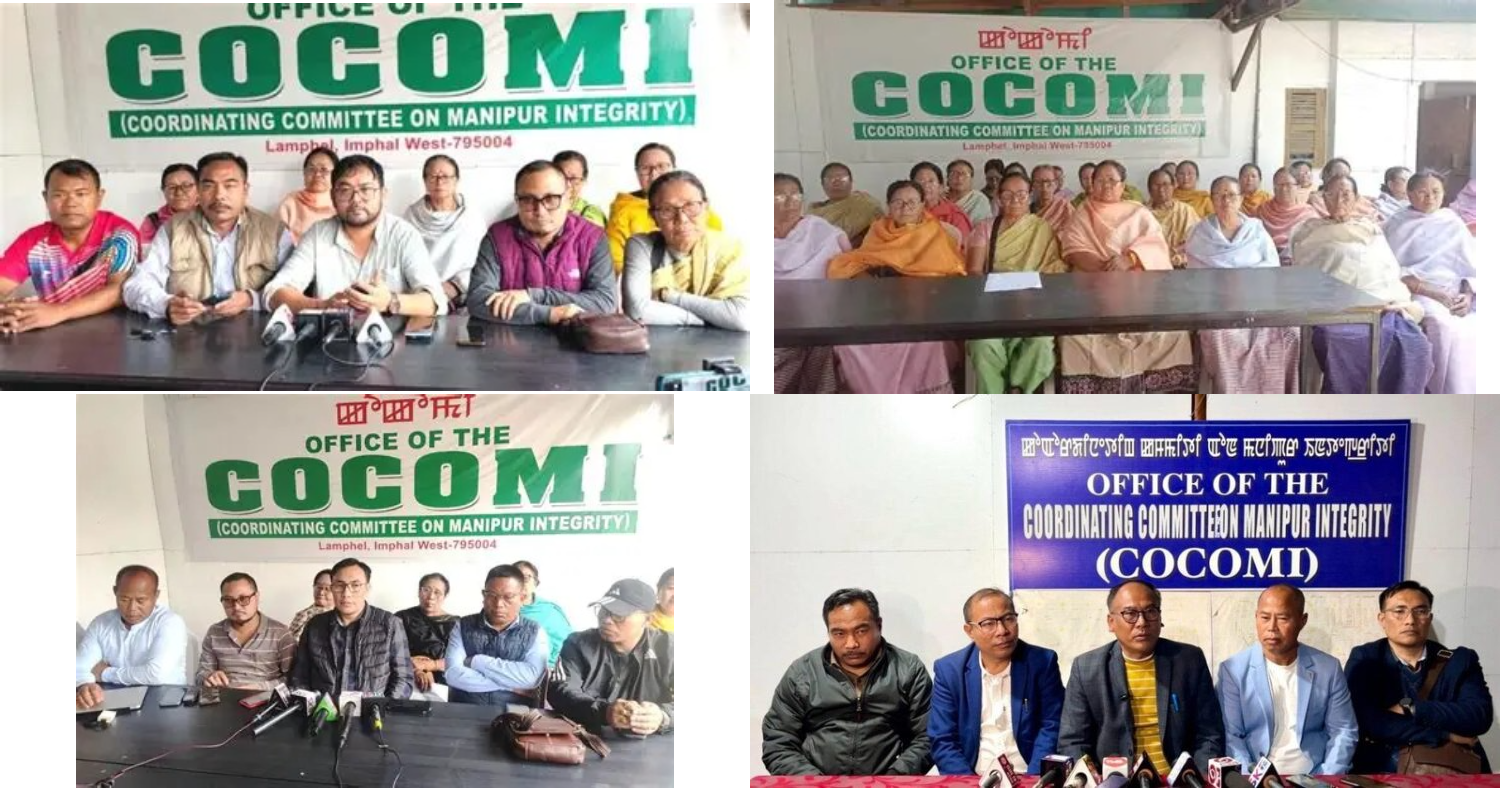
Groups such as the Coordinating Committee on Manipur Integrity (COCOMI) strongly oppose any land swap, insisting that “not an inch of Manipur’s territory” should be ceded. Emotional ties to areas like the Kabaw Valley, historically linked to the Manipur kingdom but left in Myanmar during colonial demarcation, fuel resistance and make the issue politically sensitive.
Lessons from Bangladesh
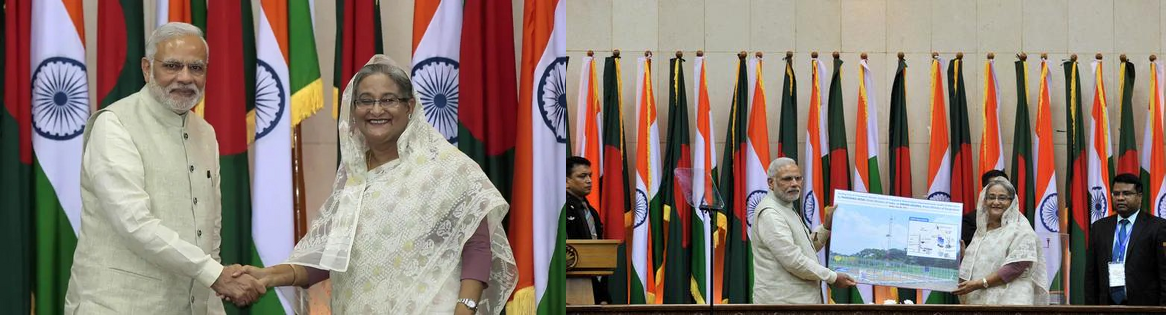
India has precedent: in 2015, the Land Boundary Agreement with Bangladesh successfully exchanged 162 enclaves, simplifying borders and easing tensions. Whether similar success can be achieved with Myanmar remains uncertain, especially given the volatile political climate and local opposition in Manipur.
India’s Northeast stands at a crossroads. Will pragmatic diplomacy prevail over emotional resistance? As talks continue, one thing is clear: border management is no longer just about lines on a map - it’s about security, identity, and India’s future in Southeast Asia.
👉Do you think India should prioritize national security and border fencing, or respect local sentiments tied to history and identity?
Written by
Ritvik DeshmukhDiscussion (0)
Sign in to join the discussion.
Loading comments…