

A Historic Shift in Policy
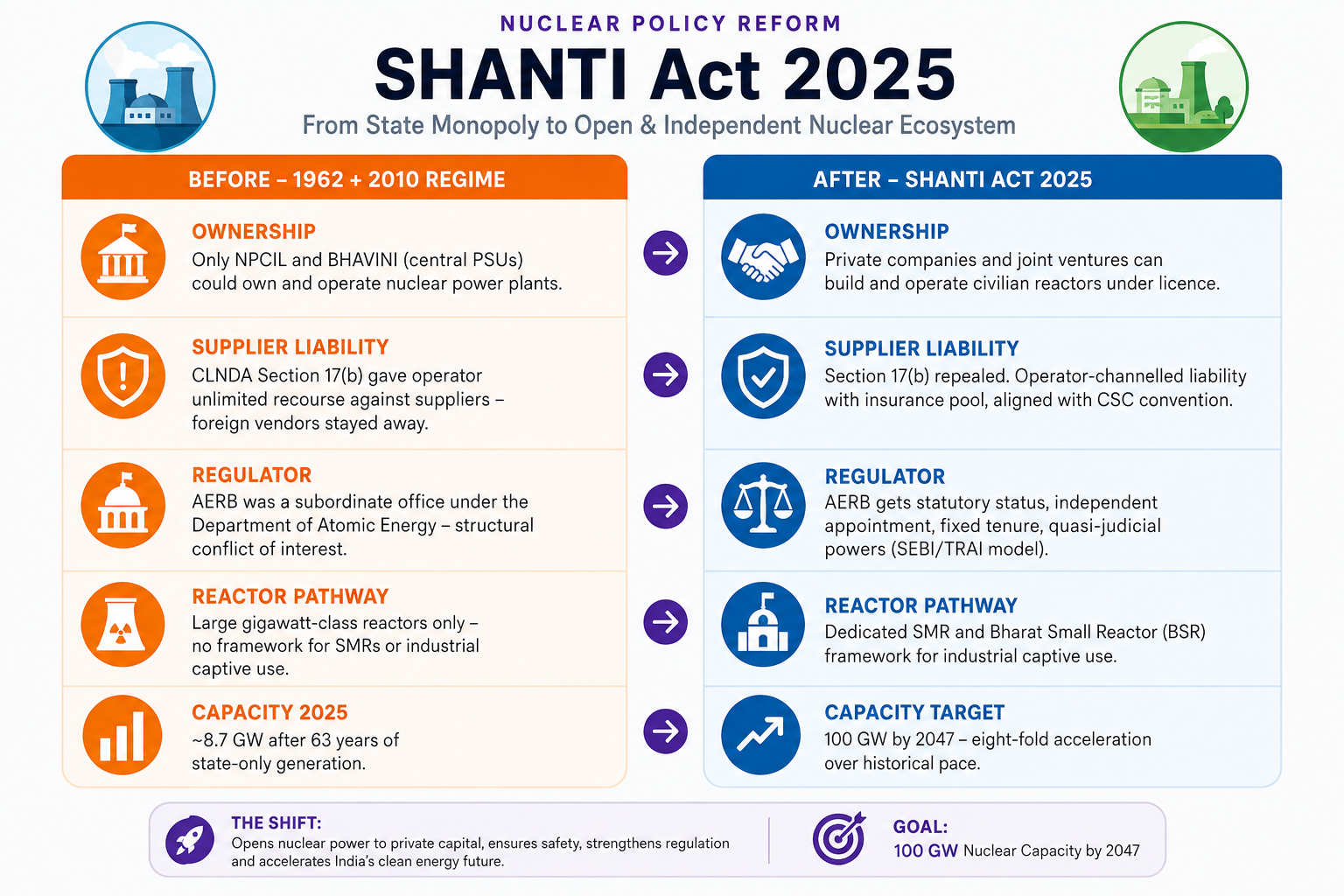
For decades, India’s nuclear energy sector was tightly controlled by the government under the Atomic Energy Act of 1962. Institutions like the Department of Atomic Energy (DAE), Nuclear Power Corporation of India Ltd. (NPCIL), Bharat Heavy Electricals Ltd. (BHEL), Atomic Energy Regulatory Board (AERB) and other government-controlled entities held exclusive authority. Earlier, private firms were confined to supplies and machinery; ownership of nuclear plants was off‑limits under the 1962 law.
Now, with the Shanti Act 2025 (Sustainable Harnessing and Advancement of Nuclear Energy for Transforming India), the rules have changed. For the first time, private and foreign participation will be allowed in nuclear power generation, under strict licensing and oversight.
The Shanti Act 2025 is designed to fast‑track nuclear growth; the framework blends private innovation with public oversight to secure India’s energy future.
It pushes India closer to its clean‑energy vision by cutting fossil-fuel reliance and advancing the 2070 net‑zero goal.
Why India Needs Private & Foreign Players
India’s nuclear capacity today is just 8 GW, far short of its ambitious target of 100 GW by 2047. Building reactors requires massive capital, advanced technology, insurance, financial risk management and specialized engineering- resources the government alone cannot provide.
Foreign partners bring proven designs and decades of operational experience. Countries like Russia, France, the US, South Korea, and Japan possess sophisticated reactor technologies that India hopes to leverage.
India’s Pressurized Heavy Water Reactor (PHWR) expertise is solid, but scaling fast demands a fusion of homegrown innovation, global tech, private investment, and local industry.
That’s exactly where the new framework steps in.
Proven Technology Only, No Experiments Allowed
The draft rules make one thing clear: India will not become a testing ground for unproven nuclear technology. Only reactors with a proven overseas operating record will be considered. This ensures safety, reliability and avoids risky experiments with untested designs.
Tight Oversight & Multi‑Stage Licensing
Participation doesn’t mean free rein. Every project must pass through multi‑stage regulatory approvals, from site evaluation to construction, commissioning, fuel loading, and operations. Even after a plant begins running, continuous inspections will be mandatory.
The Atomic Energy Regulatory Board (AERB) is being strengthened to ensure 24/7 safety monitoring, while the Department of Atomic Energy (DAE) will focus on policy and strategic administration.
Russia’s Edge in Small Modular Reactors
India is now prioritizing Small Modular Reactors (SMRs), compact, standardized units that can be deployed faster and at multiple sites. Russia, with its advanced SMR technology, stands to gain significantly.

India too is developing indigenous SMRs, with BARC already working on several designs. But foreign collaboration could accelerate deployment and help bridge the energy gap.
The Road Ahead
India’s nuclear liberalization is not about reckless privatization; it’s about strategic liberalization. By inviting private capital and foreign technology while retaining strict government oversight, India aims to balance growth with safety.
This bold move could redefine India’s energy future, but it also raises critical questions:
Can India manage foreign influence without compromising sovereignty?
Will safety standards keep pace with rapid expansion?
And most importantly, can nuclear power truly become the backbone of India’s clean energy ambitions?
India’s nuclear journey is entering uncharted territory. Stay informed, stay engaged, because the decisions made today will shape the nation’s energy security for generations.
👉 What’s your take? Should India trust foreign technology in its most sensitive sector, or double down on indigenous innovation? Share your thoughts below and join the debate!
Written by
Vedant BhardwajDiscussion (0)
Sign in to join the discussion.
Loading comments…