
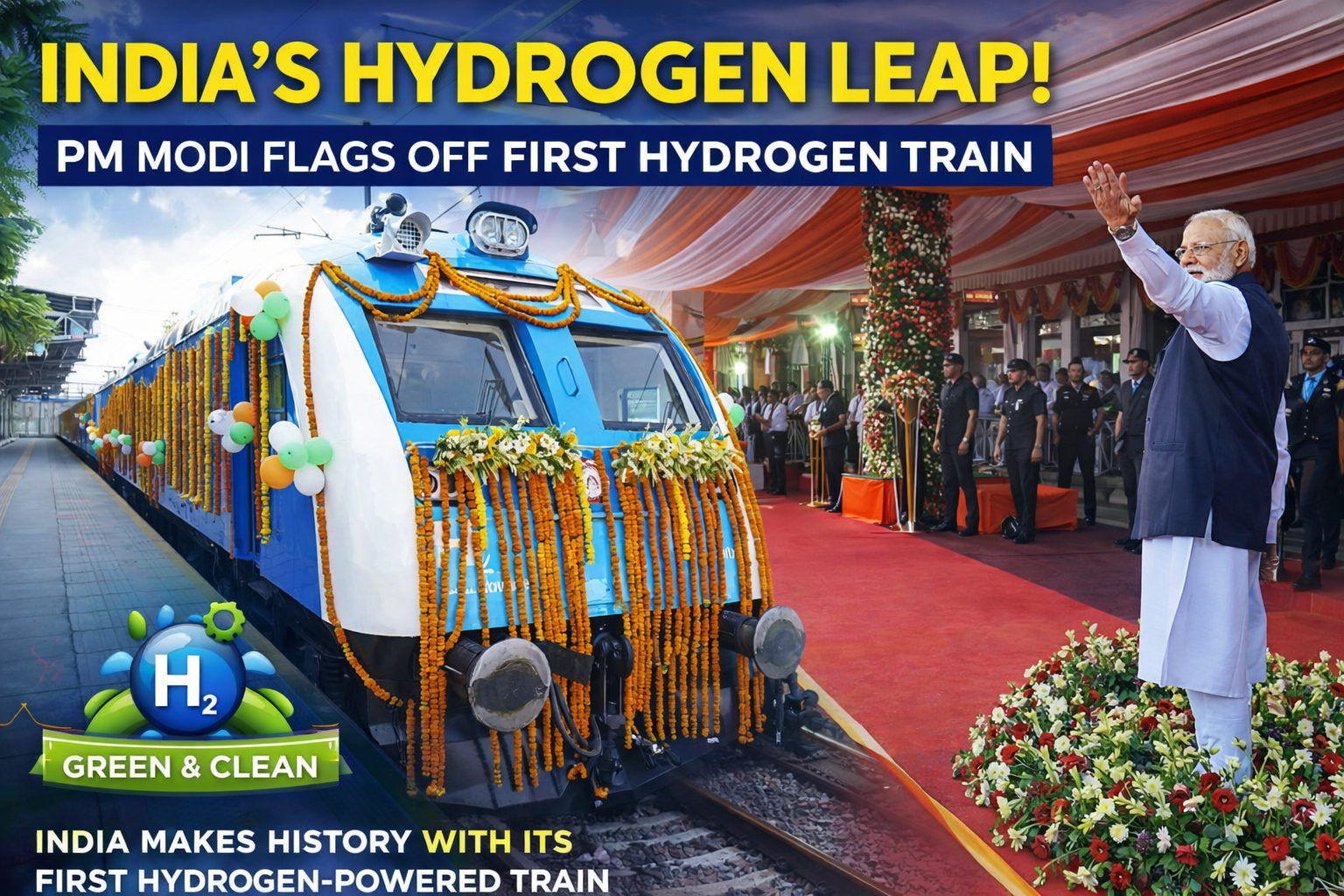
India has officially entered the future of railways. Prime Minister Narendra Modi today inaugurated the country’s first hydrogen‑powered train, placing India among a select group of nations capable of running clean, next‑generation rail technology.
This isn’t just another train launch; it’s a historic milestone. Hydrogen propulsion is set to become the fourth major source of railway power after steam, diesel, and electricity. Unlike conventional diesel engines, hydrogen trains don’t burn fuel directly. Instead, hydrogen is converted into electricity through fuel cells, which then power electric motors much like an advanced EV on rails.
Why Hydrogen Matters?
Cleanest alternative: Produces only water and heat as byproducts; no smoke, no pollution.
Ideal for tough terrains: Perfect for routes where electrification is difficult, costly, or impractical, such as hill railways, heritage lines, and remote sections.
Efficiency & safety: Fuel cells deliver higher efficiency, quieter operations, and lower maintenance compared to combustion engines.
Inside India’s Hydrogen Train
Route: Jind–Sonipat, Haryana (89 km stretch)
Coaches: 10 total, 2 hydrogen power cars plus 8 passenger coaches
Capacity: Seating for 682; overall capacity is 2,600 passengers
Power Output: 2400 kW combined
Speed: Initially 75 km/h, with scope to increase
Consumption: 300 kg hydrogen per day
Refueling Hub: India’s largest hydrogen refueling facility, built at Jind
The Technology
Fuel Cell Stack: Acts as the “engine,” where hydrogen reacts with oxygen (from atmospheric air) using a platinum catalyst.
Byproducts: Electricity (to run motors, lights, AC), water, and heat.
Battery Packs: Store extra electricity for acceleration, hill climbs, or sudden demand.
Safety Systems: Leak detectors, automatic shut‑off valves, and fire‑resistant high‑pressure tanks.
Green Hydrogen Mission
India aims to power these trains with green hydrogen produced via electrolysis using renewable energy, ensuring zero carbon emissions. This aligns with the National Green Hydrogen Mission, reinforcing India’s commitment to sustainable transport.
Challenges Ahead
High costs of hydrogen fuel cells and platinum catalysts.
Sophisticated infrastructure for production, storage, and transport.
Expensive green hydrogen compared to grey or blue alternatives.
Closing Track
With this launch, India has taken a bold step toward a cleaner, greener railway future. The hydrogen train is not just a technological marvel; it’s a symbol of India’s determination to lead in sustainable innovation.
Written by
Devansh KaulDiscussion (0)
Sign in to join the discussion.
Loading comments…