
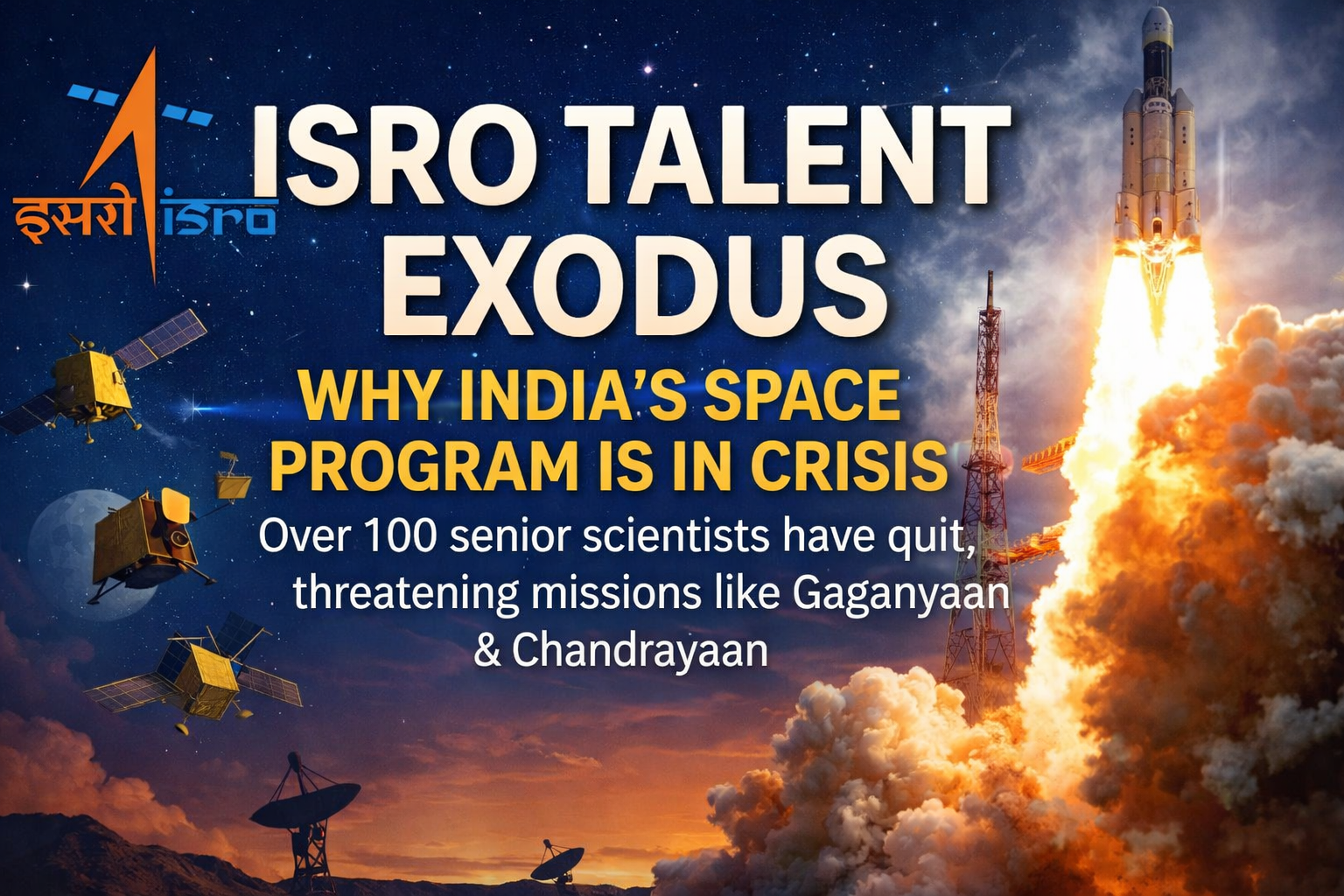
India’s premier space agency, ISRO, is facing what many are calling a silent crisis. Reports indicate that over 100 senior scientists and engineers have resigned or opted for early retirement, raising concerns about the future of flagship missions such as Gaganyaan (India’s first human spaceflight) and upcoming Chandrayaan projects.
Why This Matters?
It’s not just about numbers; it’s about quality and experience. ISRO’s strength lies in its seasoned experts: propulsion specialists, satellite designers, navigation engineers, and cryogenic engine veterans who have spent decades mastering complex systems. Their departure means a loss of institutional memory and knowledge that cannot simply be documented or replaced overnight.
“A navigation specialist who has guided spacecraft for decades knows the subtle anomalies in orbital paths that no simulation can predict.”
It shows how lived experience and intuition built over years of missions cannot simply be transferred to manuals or training programs.
Missions at Risk
Gaganyaan: Human-rated rockets demand flawless safety systems—fault detection, emergency abort mechanisms, life support, and re-entry recovery. Losing experts here directly threatens astronaut safety.
Chandrayaan & Beyond: Precision lunar and planetary missions rely on decades of accumulated expertise. Sudden exits could delay or derail timelines.
Why Are Scientists Leaving?
Several structural shifts explain the exodus:
Private Sector Boom: Startups such as Skyroot Aerospace, Agnikul Cosmos, Pixxel, and Dhruva Space offer higher salaries, stock options, and greater entrepreneurial freedom.
Career Progression Issues: Bureaucratic delays and limited autonomy frustrate talented minds.
Work Pressure: Tight deadlines and public expectations make ISRO missions high-stress environments.
Salary Gap: Despite perks, government pay lags far behind private packages worth crores.
Government’s Response
Alarmed by the resignations, the Department of Space has tightened exit norms.
Earlier, ISRO centers could approve resignations directly.
Now, Group A scientists working on critical missions need clearance from the Department of Space itself before leaving.
This move has sparked debate:
Government’s stance: National missions require continuity; sudden exits jeopardize projects.
Critics argue: When scientists feel trapped despite low salaries, restricted freedom, and stagnant growth, the passion for national service turns into quiet frustration.
Restricting exits may preserve continuity in the short term, but without addressing salaries, autonomy, and career growth, it only delays an inevitable talent drain.
A Global Parallel
India isn’t alone. NASA faced similar challenges when SpaceX lured talent with lucrative offers. The issue reflects a broader trend across semiconductors, AI, defense tech, and biotech, retaining top scientists is increasingly difficult in the face of private sector dynamism.
The Way Forward
Instead of restricting exits, experts suggest reforms:
Competitive compensation and scientific allowances
Faster promotions and mission-based incentives
Greater autonomy and industry partnerships
Endgame
ISRO’s challenge is not just about preventing a brain drain, but about ensuring that India’s brightest minds, whether in government or private ventures, continue to contribute to the nation’s space journey.
The question is: Will India adapt fast enough to retain its stars, or risk slowing its cosmic ambitions?
Written by
Ishaan TrivediDiscussion (0)
Sign in to join the discussion.
Loading comments…