
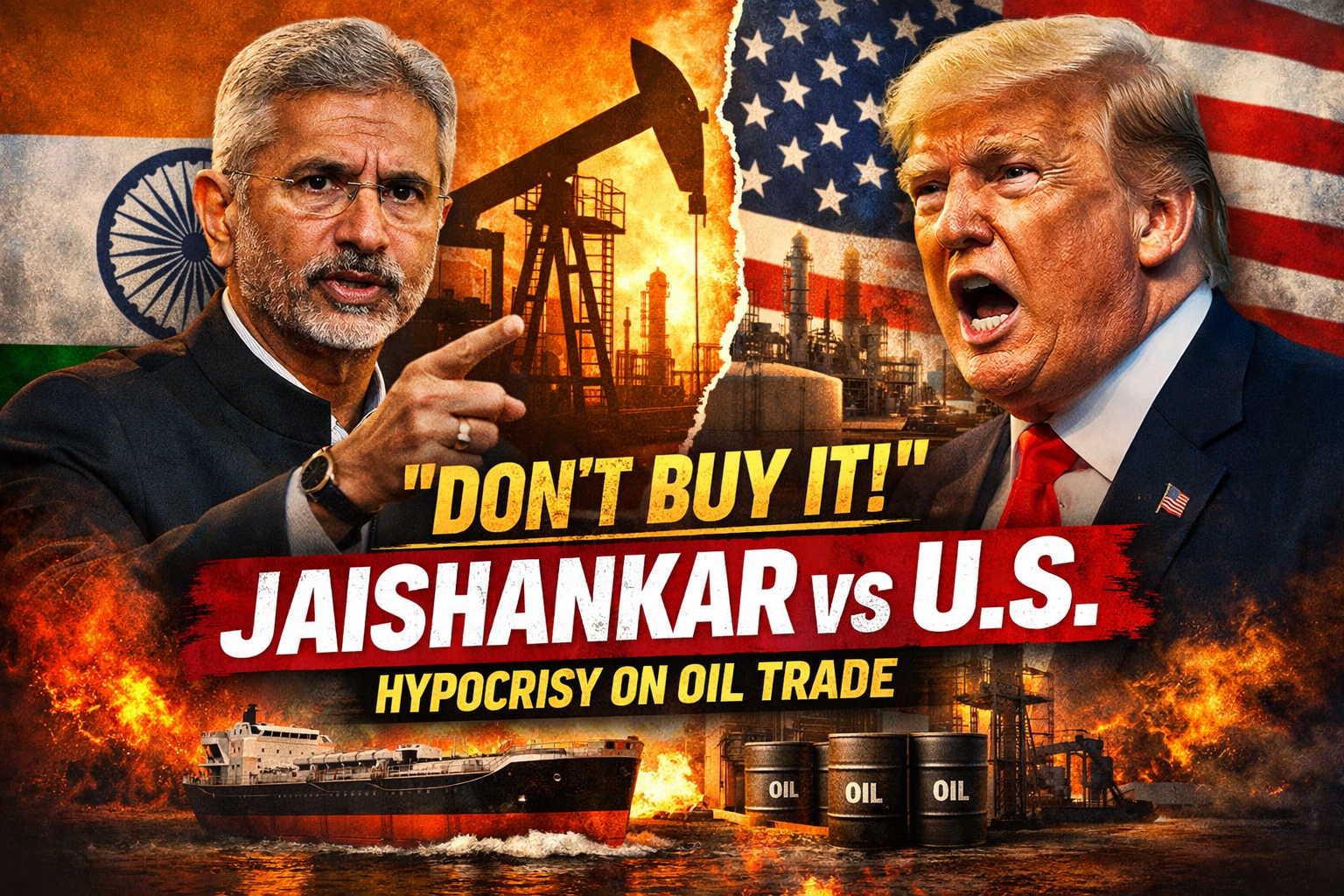
India Pushes Back Against Western Criticism
At the Economic Times summit in New Delhi, India’s External Affairs Minister S. Jaishankar didn’t mince words. He delivered a sharp rebuttal to U.S. and European concerns over India’s purchase of Russian crude oil. With Washington threatening fresh tariffs and sanctions, Jaishankar’s message was crystal clear: “If you don’t like it, don’t buy it.”
It was a rare moment of India speaking bluntly and confidently on the global stage.
He accused the West of hypocrisy, noting that while they criticize India for refining Russian oil, they continue to import those same refined products from India. “Nobody forces you to buy from us,” he said, dismantling the Western narrative in one stroke.
The Tariff Trap and Profit Accusations
India currently faces over 50% tariffs on its exports to the U.S. and Europe, among the highest in the world. Recently, the U.S. Treasury accused India of “profiting” by buying discounted Russian crude, refining it into petrol and diesel, and selling it back to Western markets.
Jaishankar countered that India’s energy policy is driven by necessity and autonomy. With 85% of India’s oil needs met through imports, the country will naturally buy from wherever it gets the best deal, be it Russia, Iraq, or any other supplier.
Strategic Autonomy and Refining Advantage
India has consistently emphasized strategic autonomy, refusing to outsource its energy policy to Washington or Moscow. Moreover, India enjoys a unique advantage: its refineries, especially Reliance and Nayara, are equipped to process Russian crude that many Western nations cannot. This makes India a refining hub, exporting aviation fuel, gasoline, and diesel worldwide.
Western Price Caps and India’s Defiance
Western nations imposed a $60 per barrel price cap on Russian oil, threatening to cut off insurance and shipping services if buyers paid more. Yet India continued to import within the cap, undermining Western attempts to choke Russia’s revenue. Now, Europe is pushing to lower the cap further to $47 per barrel, but India remains unfazed.
India’s Counterarguments: Hypocrisy Exposed
Jaishankar highlighted two powerful points:
China is the largest buyer of Russian crude, yet faces no similar criticism.
Europe itself remains Russia’s biggest LNG buyer, while the U.S. continues selective imports.
If the West truly objects, Jaishankar argued, they should stop buying refined fuel from India altogether.
Numbers Tell the Story
Before 2022, Russian oil accounted for barely 1% of India’s imports.
Today, it makes up around 35%.
In 2022–23, India exported petroleum products worth $97 billion, largely to Europe and the U.S.
Discounts have since shrunk, reducing exports to $63 billion in 2024–25.
Despite this, Europe has frequently been India’s largest buyer of refined fuel, ironically sustaining the very trade it criticizes.
Beyond Oil: The Red Line in Trade Talks
Jaishankar also drew a firm line in U.S.-India trade negotiations, citing that India will not compromise its farmers or dairy sector to please the U.S. He rejected demands to open India’s agriculture and dairy sectors, citing cultural and religious sensitivities.
“We cannot compromise our farmers or our traditions,” he declared, making it clear that India’s sovereignty extends beyond energy.
Pakistan Factor and U.S. Amnesia
When asked about America’s growing closeness with Pakistan, Jaishankar reminded the audience of history: Osama bin Laden, mastermind of 9/11, was found in Pakistan. Yet the U.S. repeatedly overlooks this reality, which he said shows a pattern of selective memory. His remark underscored the contradictions in Washington’s foreign policy.
Conclusion
Jaishankar’s uncompromising stance marks a turning point in India’s engagement with the West. By flipping the narrative, accusing the U.S. and Europe of hypocrisy, India has signalled that it will not bow to external pressure.
The message is loud and clear: India’s energy policy will be decided in Delhi, not Washington.
Written by
Bhavana SharmaDiscussion (0)
Sign in to join the discussion.
Loading comments…