
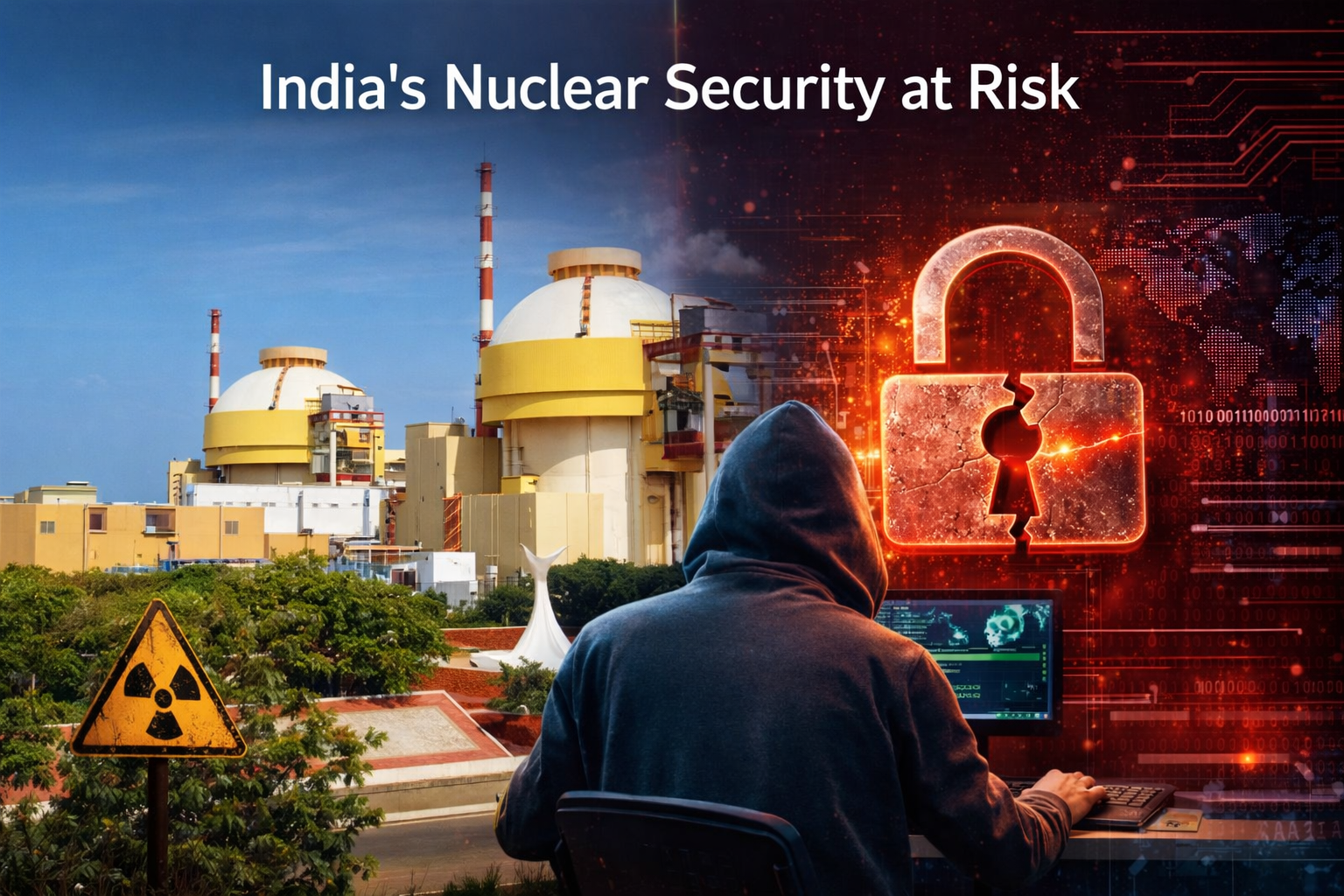
India’s nuclear energy ambitions have hit a serious roadblock. The Kudankulam Nuclear Power Plant (KNPP), one of Asia’s largest nuclear projects, has suffered a massive data breach, raising urgent questions about cybersecurity, supply chain vulnerabilities, and national security.
What Happened?
Reliance Infrastructure, contracted to safeguard data for Unit 3 and Unit 4 (currently under construction), was hacked.
Hackers stole 8.5 lakh files, including 19,000 documents directly linked to Kudankulam, amounting to 14.3 GB of sensitive data.
The stolen files include engineering blueprints, ventilation layouts, cooling system designs, vendor proposals, supplier lists, inspection reports, and internal meeting minutes.
Importantly, the core reactor technology data was not breached. But the theft of infrastructure and administrative files still poses a grave risk.
Why Is This Dangerous?
For instance, during the 2013 South Korean cyberattacks, hackers targeted contractors and stole blueprints of government buildings and defense facilities. Even though core military systems weren’t breached, the exposure of layout maps, access points, and security protocols created vulnerabilities that adversaries could exploit for physical or cyber sabotage.
Another example is the SolarWinds supply chain breach (2020), where attackers didn’t directly compromise U.S. government agencies but infiltrated through a contractor. This gave them visibility into internal networks and administrative systems, enabling espionage at scale.
These cases show that even non‑core data leaks can be weaponized. Infrastructure details, vendor lists, and inspection records may seem secondary, but in the wrong hands they become a roadmap for hostile actors.
Similarly, at Kudankulam, the stolen infrastructure data could help adversaries identify weak points, target suppliers, or disrupt construction and operations.
The Ransomware Angle
This wasn’t just a hack; it was a ransomware attack.
Hackers encrypted the stolen files and threatened to release them publicly unless paid.
The group behind the attack, World Leaks, is notorious for data extortion and publishing stolen files on the dark web.
While no ransom demand to the Indian government has been confirmed yet, the threat looms large.
Supply Chain Attack: The Weakest Link
Cybercriminals often bypass heavily fortified organizations by targeting their contractors and suppliers.
In this case, Reliance Infrastructure became the entry point.
Once attackers accessed Reliance’s systems, they gained visibility into supplier details, equipment providers, and subcontractors.
This opens the door to further attacks on individual vendors, amplifying the risk across the entire nuclear ecosystem.
Dark Web: The Underground Marketplace
The stolen data is reportedly being prepared for release on the dark web—a hidden layer of the internet where illegal activities thrive.
Think of it as a digital “black market” where stolen files, hacking tools, and illicit services are traded using cryptocurrency.
Once uploaded, the data could be accessed by hostile actors worldwide, magnifying the threat.
India’s Response
The Indian Computer Emergency Response Team (CERT‑In), under the Ministry of Electronics and IT, is investigating the breach. Their role includes:
· Issuing cyber advisories
· Malware analysis
· Coordinating incident response
Meanwhile, Kudankulam’s Unit 1 and Unit 2 (2,000 MW capacity) remain operational, while Unit 3 and Unit 4 (another 2,000 MW) are under construction. Further Plans include Unit 5 and Unit 6, which would raise total capacity to 6,000 MW, making KNPP one of Asia’s largest nuclear facilities.
Layers of Nuclear Security
Modern nuclear plants rely on three layers of protection:
Physical Security – multi‑layered fencing, armed guards, CCTV surveillance.
Cybersecurity – firewalls, network segmentation, intrusion detection.
Nuclear Safety – redundant cooling systems to prevent meltdown risks.
While the reactor core data remains safe, the breach of infrastructure files highlights the urgent need to strengthen contractor cybersecurity.
Beyond the Breach
The Kudankulam breach is more than a technical incident; it’s a national security warning. India’s nuclear future depends not only on advanced technology but also on robust cyber defenses across the entire supply chain.
This attack underscores a harsh reality: a chain is only as strong as its weakest link. And in the digital age, that link is often the contractor.
Written by
Devansh KaulDiscussion (0)
Sign in to join the discussion.
Loading comments…