
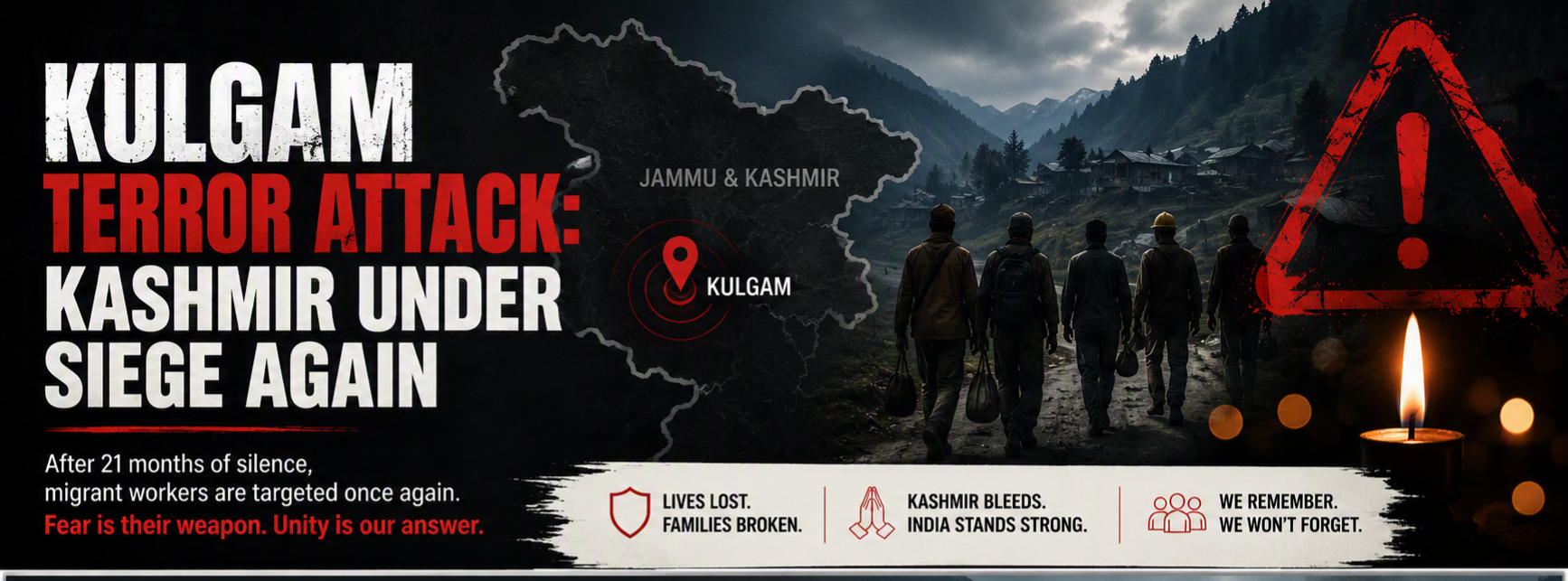
A Shocking Return of Violence
After nearly two years of relative calm, terror has once again cast its shadow over Jammu & Kashmir. In a chilling incident, two migrant labourers from Chhattisgarh were shot dead at close range in Kulgam district. This marks the first fatal targeted attack on non-local workers in 21 months, reigniting fears that militancy is far from over.
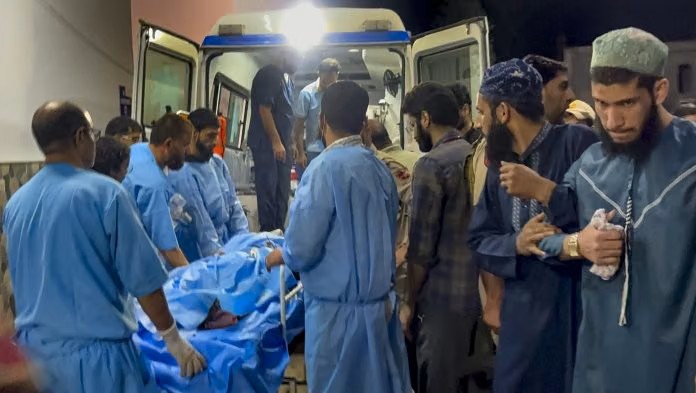
This is the first fatal targeted attack on migrant workers in Jammu & Kashmir in about 21 months; terrorists deliberately chose soft targets to send a message.
The latest wave of violence has unfolded even as the Amarnath Yatra is underway, casting a shadow over one of the region’s most significant annual pilgrimages.
Kulgam Killings Expose Kashmir’s Fragile Calm
On Friday evening, suspected militants opened fire in the Kelam area of south Kashmir’s Kulgam district, killing two migrant workers. The assault comes barely a week after a police officer was gunned down in Anantnag, highlighting a disturbing resurgence of targeted violence.
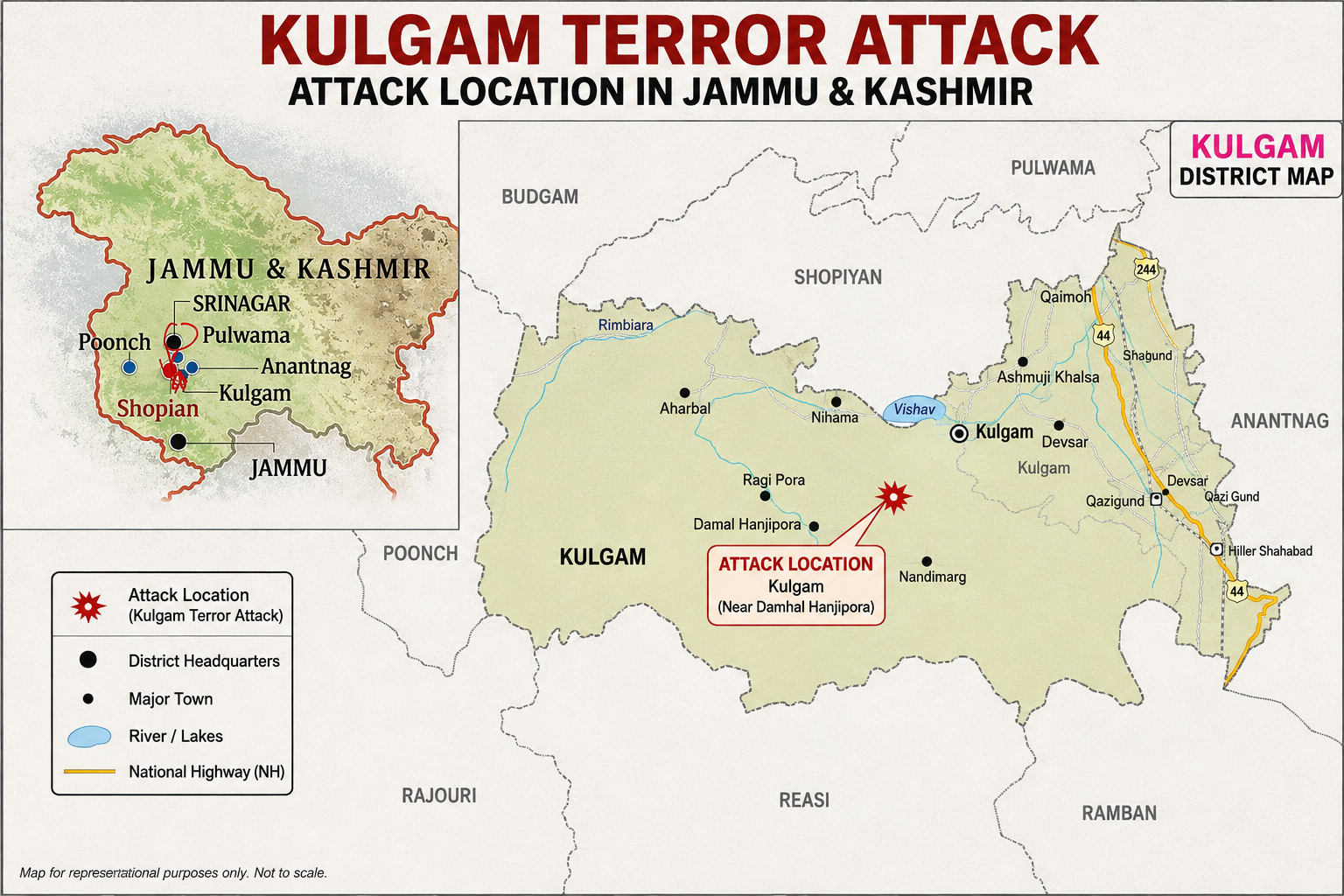
This is not the first time non-local labourers have been attacked. In 2024, Srinagar witnessed similar bloodshed when two workers from Punjab, Amritpal Singh and Rohit Masih, were shot dead in the Shaheed Gunj locality.
Reacting strongly to the latest killings, Jammu and Kashmir Lieutenant Governor Manoj Sinha condemned the act and instructed security agencies to intensify counter-terror operations.
Political voices also weighed in; PDP leader Mehbooba Mufti called the incident “unimaginably cruel,” while National Conference leader Omar Abdullah announced ₹10 lakh in compensation for the victims’ families.
The victims have been identified as Deepak Ratray (24) and Bopinder (28), both hailing from Chhattisgarh. The attack left them critically wounded; Deepak succumbed to his injuries before medical help could reach him, while Bopinder was rushed first to GMC Anantnag and later shifted to SKIMS Hospital in Soura. Despite intensive treatment, he too tragically lost his life.
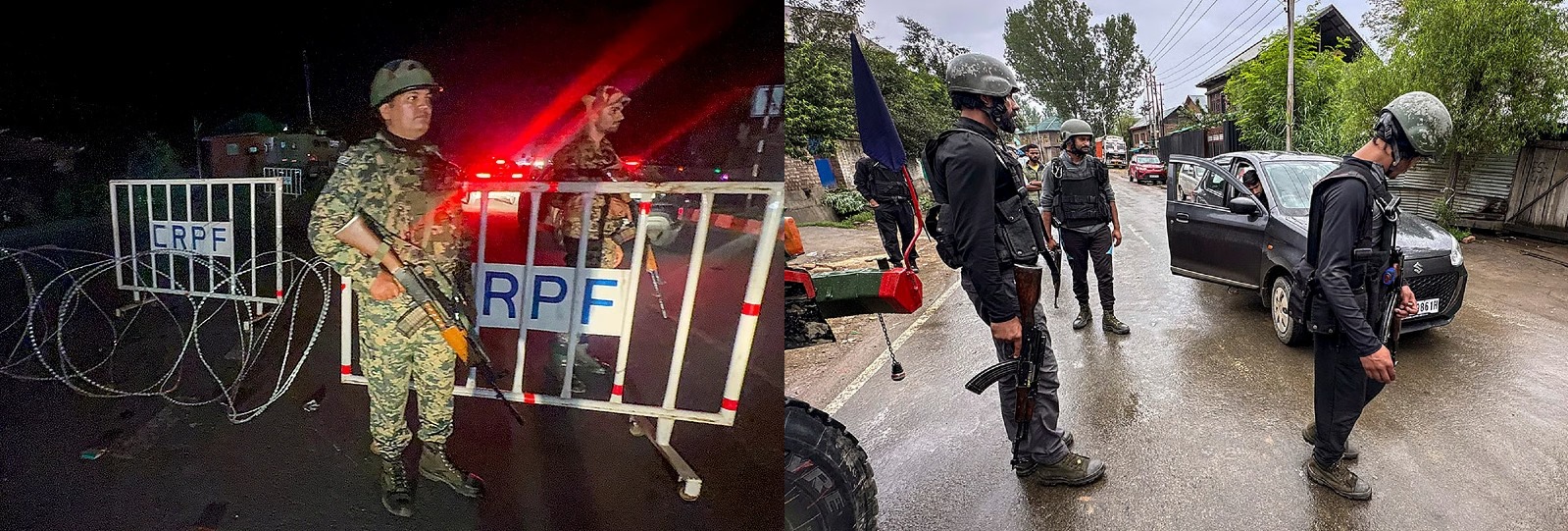
Security forces launched a massive cordon-and-search operation in Kulgam, intensifying efforts to track down the attackers behind the deadly strike.
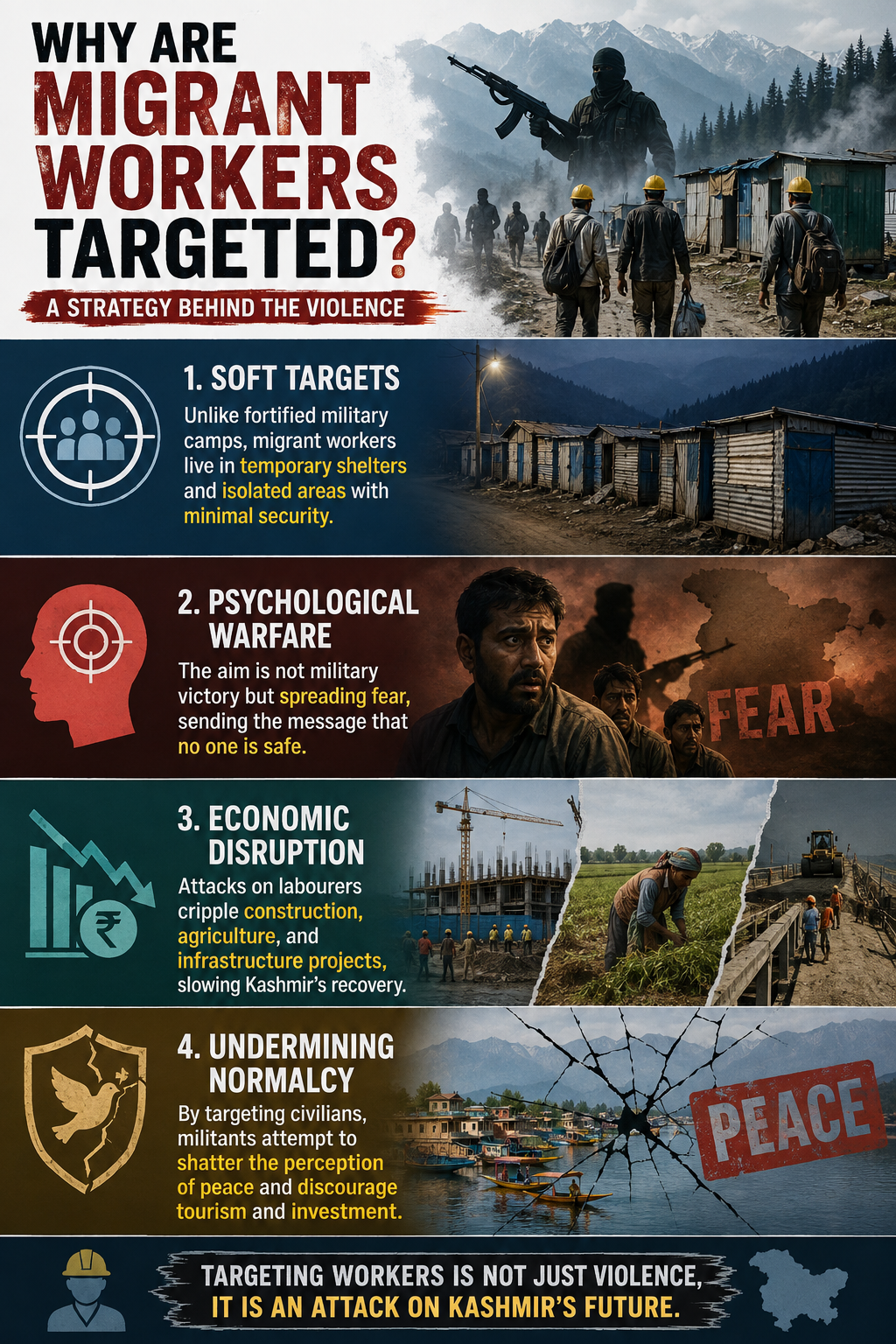
Why Are Migrant Workers Targeted?
Soft Targets: Unlike fortified military camps, migrant workers live in temporary shelters and isolated areas with minimal security.
Psychological Warfare: The aim is not military victory but spreading fear, sending the message that no one is safe.
Economic Disruption: Attacks on labourers cripple construction, agriculture, and infrastructure projects, slowing Kashmir’s recovery.
Undermining Normalcy: By targeting civilians, militants attempt to shatter the perception of peace and discourage tourism and investment.
The Larger Pattern of Terror
Attacks on Kashmiri Pandits to spread communal fear.
Targeting local politicians to weaken democratic participation.
Assaults on teachers and village defense guards to disrupt governance and local security.
Shift since 2019 (post-Article 370 abrogation): Militants moved from large-scale insurgency to civilian killings, hit-and-run tactics, and hybrid militancy.
The Security Challenge Ahead
Tracking these isolated attacks is extremely difficult. Hybrid militants, ordinary civilians who suddenly strike and vanish, make intelligence gathering harder. Protecting every brick kiln, orchard, and labour camp is nearly impossible, leaving thousands vulnerable.
These small but disproportionate attacks carry huge economic and psychological impact, undermining confidence and normalcy in Kashmir.
What This Means for India
National Security: Proof that militant networks remain capable of striking at will.
Economic Fallout: Construction delays, agricultural losses, and rising costs.
Global Attention: Civilian killings draw international media coverage, damaging India’s narrative of stability in Kashmir.
The Bottom Line
This attack is not just about two lives lost; it’s a calculated strike against Kashmir’s fragile peace, its economy, and India’s efforts to normalize the region. Terrorism here has evolved, but its goal remains the same: fear, disruption, and instability.
Peace in Kashmir requires not just military action but social and political solutions. What do you think - is Kashmir heading back into a cycle of fear, or can India’s counter-terror strategy hold the line?
Written by
Niranjan MehtaDiscussion (0)
Sign in to join the discussion.
Loading comments…