
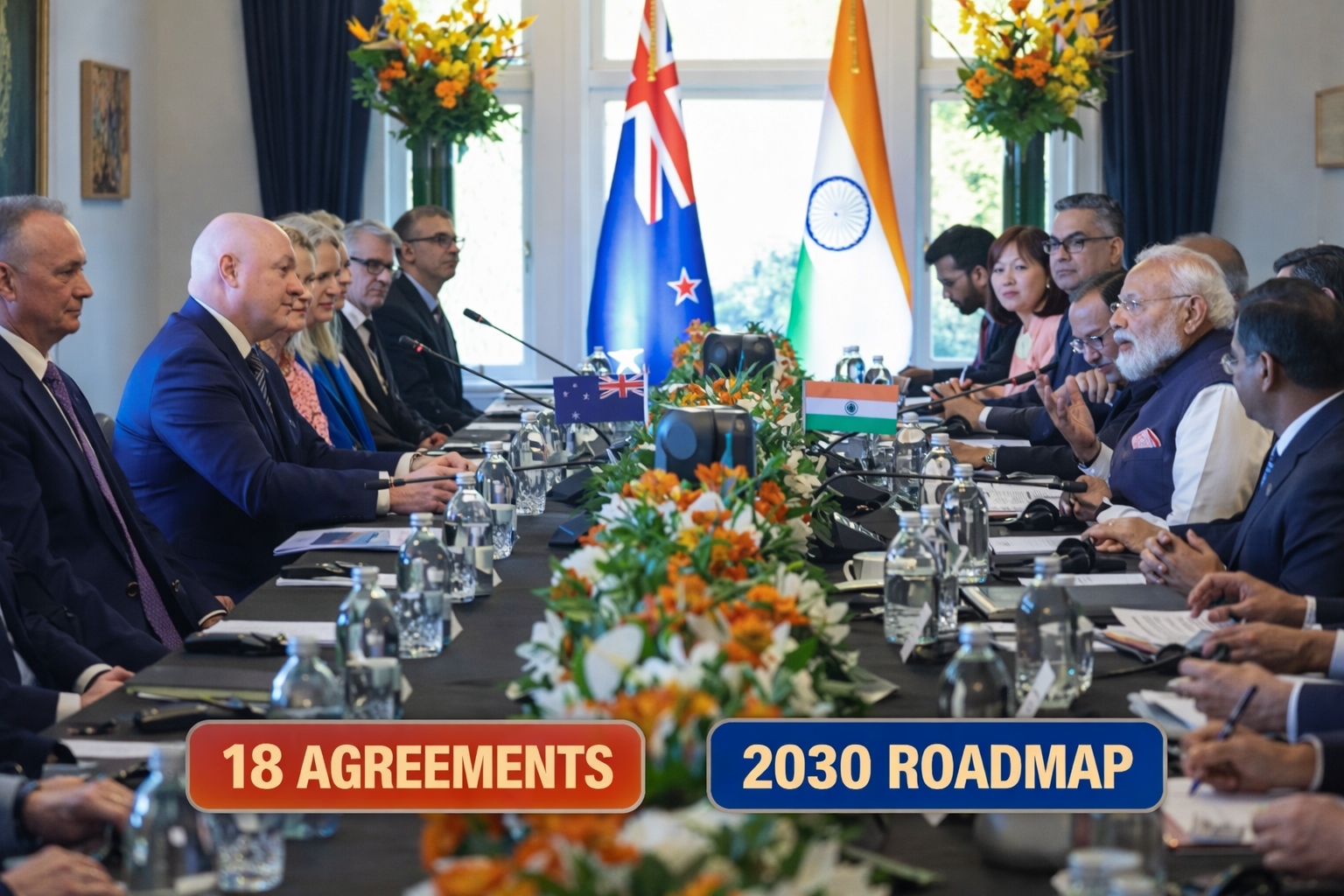
After 40 Years: PM Modi’s Historic Visit to New Zealand
For the first time in nearly four decades, an Indian Prime Minister has set foot in New Zealand. Rajiv Gandhi’s 1986 visit was the last, and now Prime Minister Narendra Modi’s tour marks a watershed moment in India–New Zealand relations. This historic trip wasn’t just symbolic — it delivered 18 landmark agreements and a 2030 strategic roadmap that promises to transform bilateral ties.
From Cordial Ties to Strategic Partnership
India and New Zealand have long enjoyed cordial relations, with diplomatic ties dating back to 1952. Both nations are members of the UN, Commonwealth, WTO, ASEAN Regional Forum, and East Asia Summit. Yet, geographical distance and differing strategic priorities meant cooperation remained limited — mostly in trade, education, tourism, and diaspora connections.
Modi’s visit changed that. The relationship has now been upgraded to a Strategic Partnership, expanding collaboration into defense, maritime security, cyber security, critical minerals, supply chains, space, and emerging technologies. This marks a qualitative shift from transactional diplomacy to long‑term strategic alignment.
The 2030 Roadmap
The newly signed roadmap sets ambitious goals:
· Doubling trade volumes from ₹17–18,000 crore to ₹35,000 crore by 2030.
· Establishing institutional mechanisms for regular ministerial dialogues.
· Coordinating across ministries to ensure effective implementation.
· Expanding cooperation beyond traditional diplomacy into innovation, agriculture, and people‑to‑people exchanges.
Key Agreements: Strengthening Security and Cooperation
Among the 18 agreements, several stand out:
· Strategic Partnership Framework – The umbrella agreement guiding the 2030 roadmap.
· Maritime Cooperation – Enhancing domain awareness, information sharing, and joint search‑and‑rescue operations, crucial in countering China’s growing Indo‑Pacific presence.
· Hydrography & Nautical Charting – Joint mapping of ocean floors to aid naval operations, submarine navigation, and disaster response.
· Mutual Logistic Support – Allowing both nations’ defense forces to use each other’s ports for refueling, repairs, and supplies, extending India’s operational reach in the South Pacific.
· Counter‑Terrorism Cooperation – Intelligence sharing to combat terrorism, violent extremism, and terror financing.
· Disaster Management Collaboration – Combining India’s NDMA expertise with New Zealand’s earthquake response experience.
· Animal Husbandry & Dairy Cooperation – Leveraging New Zealand’s global leadership in livestock genetics and dairy productivity.
· Tourism & Cultural Exchange – Boosting two‑way tourism, connectivity, and cultural ties.
· Sports Cooperation – Beyond cricket, focusing on rugby, rowing, athletics, and sports science.
· Maritime Heritage Collaboration – Linking India’s Lothal Maritime Heritage Complex with New Zealand’s Maritime Museum.
Diaspora: A Living Bridge
With nearly 300,000 people of Indian origin in New Zealand, the diaspora is one of the fastest‑growing ethnic communities there. They contribute across business, healthcare, and education, while serving as a cultural and economic bridge between the two nations.
Geopolitical Significance
This partnership isn’t just bilateral — it’s strategic. By deepening ties with New Zealand, India strengthens its Indo‑Pacific network alongside Australia, Japan, France, and Singapore. It enhances India’s maritime presence in the South Pacific and helps counterbalance China’s Belt and Road investments and security agreements in the region.
Challenges Ahead
Of course, hurdles remain:
· Geographical distance complicates trade and connectivity.
· Agriculture sensitivities may slow market access.
· Implementation of multiple agreements will require sustained political will and coordination.
The Crux
PM Modi’s visit to New Zealand is more than a diplomatic milestone — it’s a strategic leap forward. By signing 18 agreements and charting a 2030 roadmap, India and New Zealand have moved from cordial friendship to a comprehensive partnership spanning defence, economy, culture, and geopolitics.
This historic visit signals India’s intent to invest diplomatic capital in Oceania, strengthen Indo‑Pacific alliances, and build resilient ties with like‑minded democracies.
Written by
Bhavana SharmaDiscussion (0)
Sign in to join the discussion.
Loading comments…