
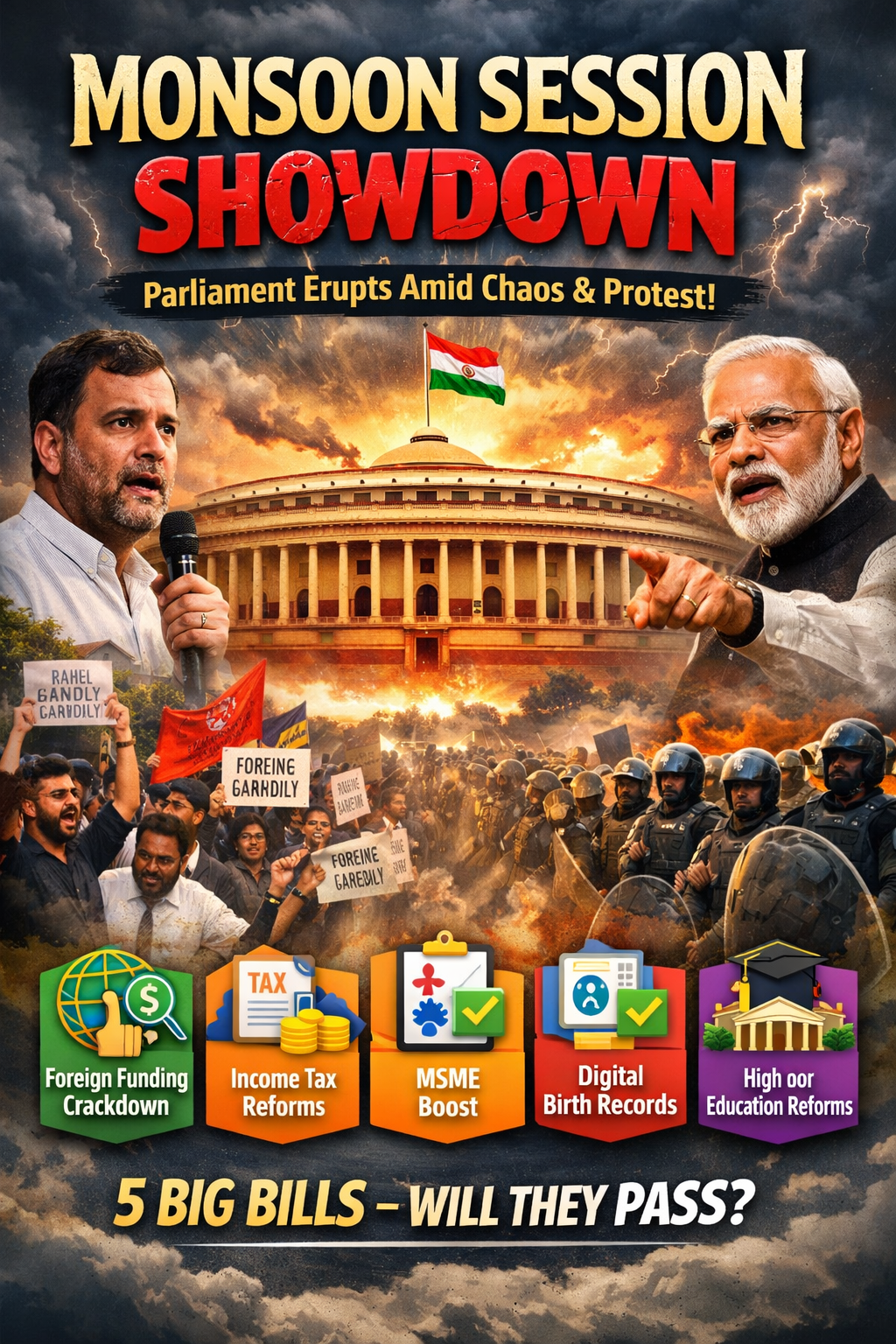
A Stormy Start to the Monsoon Session
India’s Monsoon Session of Parliament has officially begun, but instead of smooth proceedings, the House has been repeatedly adjourned. Opposition parties are pressing their demands, while the government is pushing forward with its own agenda.
Outside Parliament, members of the Cockroach Janata Party (CJP) are staging protests, demanding accountability and reforms. The atmosphere is tense, with both sides refusing to back down.
Rahul Gandhi Warns of Economic Crisis
Adding fuel to the fire, Rahul Gandhi declared that India is heading toward a “major economic crisis.” His statement sparked heated exchanges, with Prime Minister Narendra Modi offering a sharp rebuttal inside the House.
This clash of narratives has only deepened the divide between the ruling party and the opposition, setting the stage for a turbulent session.
Five Big Bills on the Table
Despite the disruptions, the government is determined to introduce five major new bills in this session. Together, these bills target foreign funding, taxation, small businesses, vital records, and higher education, making this Monsoon Session one of the most significant in recent years.
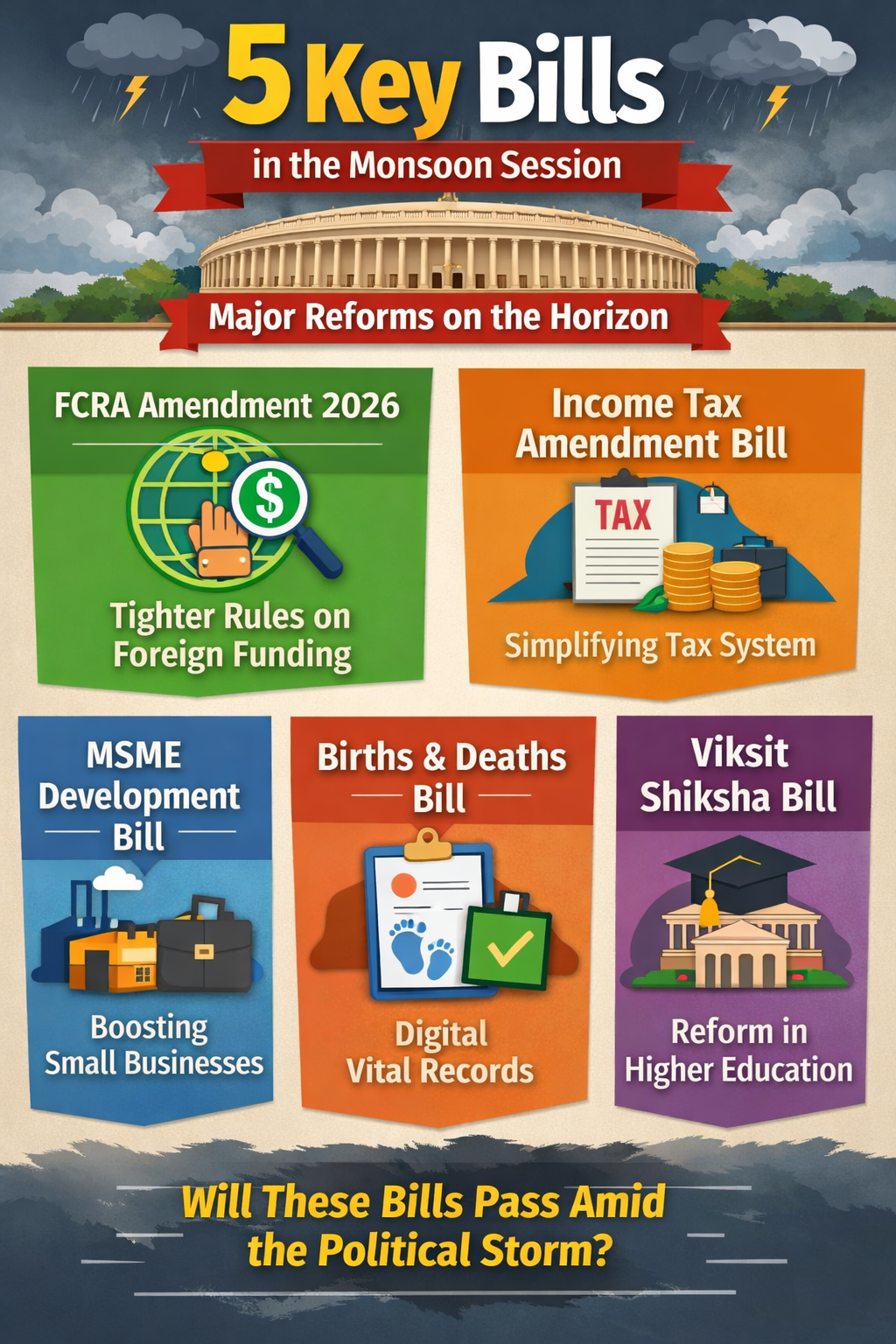
1. Foreign Contribution Regulation Amendment (FCRA) Bill 2026
What it is: Tightens rules on foreign funding received by NGOs, universities, think tanks, and charities.
Why it matters: The government argues foreign money can be misused to influence elections, policies, or media.
Key changes:
Mandatory disclosure of why funds are being received.
Stricter audit mechanisms and digital tracking of every rupee.
Limits on administrative expenses (no more than 20% of foreign funds).
Criticism: NGOs say this will increase compliance burden, hurt humanitarian work, and restrict academic freedom.
2. Income Tax Amendment Bill
What it is: Converts an existing ordinance into law, simplifying India’s tax system.
Why it matters: Aims to reduce litigation, improve compliance, and make tax filing easier.
Key changes:
Consolidation of exemptions and amendments into a single framework.
Digital monitoring to reduce disputes.
Clearer rules for taxpayers to avoid confusion.
Impact: Easier filing for individuals and businesses, better revenue collection for the government.
3. MSME Development Amendment Bill
What it is: Strengthens support for Micro, Small, and Medium Enterprises, the backbone of India’s economy.
Why it matters: MSMEs face challenges like delayed payments, lack of credit, and technology gaps.
Key changes:
Faster payment mechanisms from large companies to small suppliers.
Easier access to credit, complementing schemes like MUDRA.
Reduced compliance burden to encourage scaling and innovation.
Impact: Boosts employment, manufacturing, exports, and resilience of small businesses.
4. Registration of Births and Deaths Amendment Bill
What it is: Updates the 1969 law to fully digitize birth and death records across India.
Why it matters: Vital records are essential for school admissions, passports, Aadhaar, voting, inheritance, and insurance.
Key changes:
Nationwide digital database of births and deaths.
Accurate demographic data for policymaking.
Reduced need for repeated surveys.
Impact: Streamlined governance, better planning, and easier access to essential services.
5. Viksit Bharat Shiksha Adhishthan Bill
What it is: Focuses on governance reforms in higher education.
Why it matters: While primary education is covered under the New Education Policy, higher education needs stronger oversight.
Key changes (expected):
Improved governance structures in universities.
Transparency in funding and administration.
Better alignment with global standards.
Impact: Could reshape India’s higher education system, making it more competitive and accountable.
Parliament vs Protest: Who Will Prevail?
With opposition parties demanding urgent debates and protesters marching toward Parliament, the Monsoon Session is shaping up to be one of the most significant legislative battles in recent years.
The question remains: Will the government succeed in pushing through its reforms, or will the opposition and civil society force concessions?
Written by
Aditya KulshreshthaDiscussion (0)
Sign in to join the discussion.
Loading comments…