
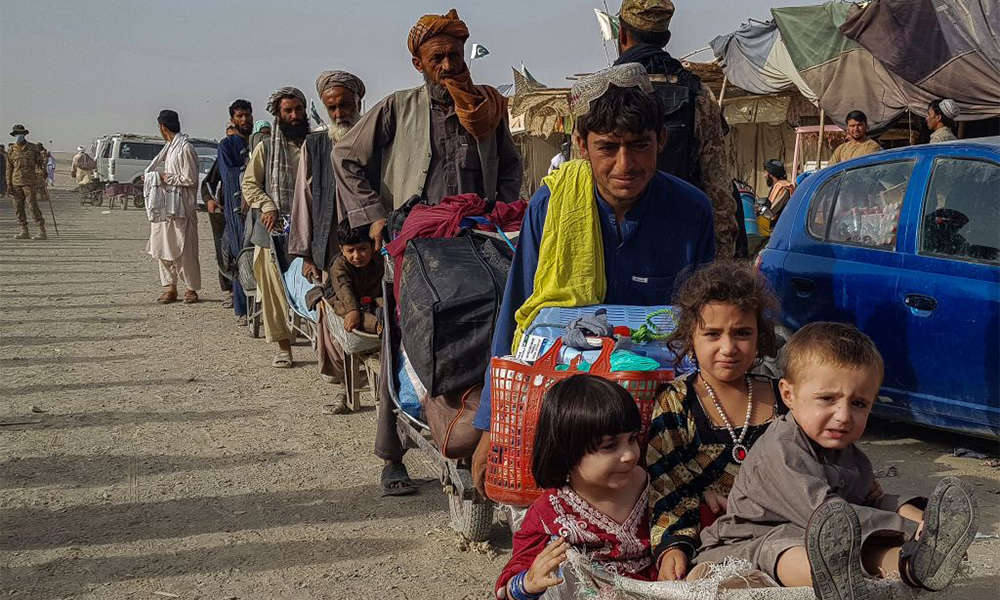
Pakistan has announced one of its toughest immigration enforcement measures in recent years. Under new directives issued by the country’s Ministry of Interior, authorities have been instructed to identify, detain, and deport undocumented Afghan nationals living in Pakistan without valid visas or legal documentation.
The latest phase of the government’s immigration crackdown will begin after July 10, with daily progress reports to be submitted by officials across Punjab, Sindh, Balochistan, Khyber Pakhtunkhwa, and Islamabad.
Pakistan’s New Immigration Order
The directive has been issued under the Illegal Foreigners Repatriation Plan (IFRP), a policy introduced in October 2023 to regulate undocumented foreign nationals.
Provincial governments, district administrations, police departments, and immigration authorities have been instructed to:
• Identify undocumented Afghan nationals.
• Arrest individuals staying illegally after July 10.
• Transfer detainees to holding centres.
• Deport them through designated border crossings.
• Submit daily implementation reports to the federal government.
Unlike the earlier phase of the policy, which encouraged voluntary departures, the current order makes deportation a mandatory enforcement action.
Why Are So Many Afghans Living in Pakistan?
Pakistan has hosted Afghan refugees for more than four decades. Large-scale migration occurred in four major waves.
- Soviet Invasion (1979)
The first and largest refugee wave began after the Soviet Union invaded Afghanistan in 1979. Millions of Afghans fled the country due to war, with Pakistan becoming one of the world’s largest refugee-hosting nations. Most refugees settled in Khyber Pakhtunkhwa and Balochistan because of their proximity to the Afghan border.
Pakistan received financial and humanitarian support from the United States, Saudi Arabia, and the United Nations to accommodate these refugees.
- Afghan Civil War and Taliban Rule (1990s)
Following the Soviet withdrawal, Afghanistan descended into civil war. The rise of the Taliban in 1996 led to another major refugee influx, as many Afghans fled violence and political instability.
- US-led Intervention (2001)
After the September 11 attacks, the United States and NATO launched military operations in Afghanistan. Continued conflict forced another wave of Afghans to seek refuge in Pakistan.
- Taliban’s Return to Power (2021)
When the Taliban regained control of Afghanistan in August 2021, thousands more crossed into Pakistan fearing political persecution, economic collapse, unemployment, and restrictions on civil liberties.
How Many Afghan Nationals Are Currently in Pakistan?
There is no universally accepted figure because migration remains dynamic. However, most estimates suggest that around 1.9 million Afghan nationals are currently residing in Pakistan.
Not all of them are undocumented. They fall into several categories:
• Proof of Registration (PoR) Card Holders: Recognised by the UN refugee agency and allowed to stay temporarily in Pakistan.
• Afghan Citizen Card (ACC) Holders: Possess limited documentation but have fewer legal protections than PoR holders.
• Visa Holders: Individuals with valid student, work, or other visas who are legally residing in the country.
• Undocumented Afghans: Those without passports, visas, or refugee documentation. The new crackdown specifically targets this group.
Why Is Pakistan Taking This Step?
Pakistan has cited several reasons for intensifying its immigration enforcement.
National Security
The government argues that militant groups operating from Afghanistan have carried out attacks inside Pakistan, particularly in Khyber Pakhtunkhwa and Balochistan.
Pakistan has repeatedly accused members of the Tehrik-i-Taliban Pakistan (TTP) of crossing the border to launch attacks before returning to Afghanistan.
Authorities believe stricter immigration enforcement will help strengthen border security.
Economic Pressure
Pakistan is facing severe economic challenges, including inflation, unemployment, and mounting external debt. The government says that undocumented migrants place additional pressure on public services such as healthcare, education, housing, and employment.
One Document Regime
Pakistan has also adopted a “One Document Regime,” requiring every foreign national entering the country to possess valid travel documentation.
Pakistan-Afghanistan Relations
Relations between Pakistan and Afghanistan have become increasingly strained since the Taliban returned to power. Islamabad has repeatedly accused Kabul of failing to prevent militant groups from using Afghan territory to launch attacks inside Pakistan.
Frequent border disputes and security incidents have further weakened bilateral ties, influencing Pakistan’s decision to adopt a stricter immigration policy.
Humanitarian Concerns
International humanitarian organizations have expressed concern over Pakistan’s deportation drive.
Many Afghan families have lived in Pakistan for decades, with children born and raised there. Human rights groups warn that sudden deportations could disrupt education, employment, housing, and healthcare.
There are also concerns about the safety of women and vulnerable groups returning to Taliban-controlled Afghanistan, where restrictions on women’s rights continue to attract international criticism.
What Does International Law Say?
Under international law, every sovereign nation has the right to regulate immigration, determine visa requirements, and deport individuals who are staying illegally.
However, the principle of non-refoulement discourages countries from returning individuals to places where they may face persecution or serious harm.
Pakistan is not a signatory to the 1951 Refugee Convention, which contains this principle. India is also not a party to the convention. Nevertheless, international human rights organizations argue that humanitarian considerations should guide deportation policies, especially in cases involving vulnerable populations.
What This Means for Pakistan and Afghan Refugees
Pakistan’s decision to begin arresting and deporting undocumented Afghan nationals after July 10 marks a significant escalation in its immigration policy. While Islamabad justifies the move on grounds of national security, economic challenges, and border management, the decision has also raised important humanitarian and international law concerns.
As the policy is implemented, its impact will extend beyond immigration enforcement, influencing Pakistan-Afghanistan relations, regional stability, and the lives of hundreds of thousands of Afghan families who have called Pakistan home for decades.
Written by
Bhavana SharmaDiscussion (0)
Sign in to join the discussion.
Loading comments…