
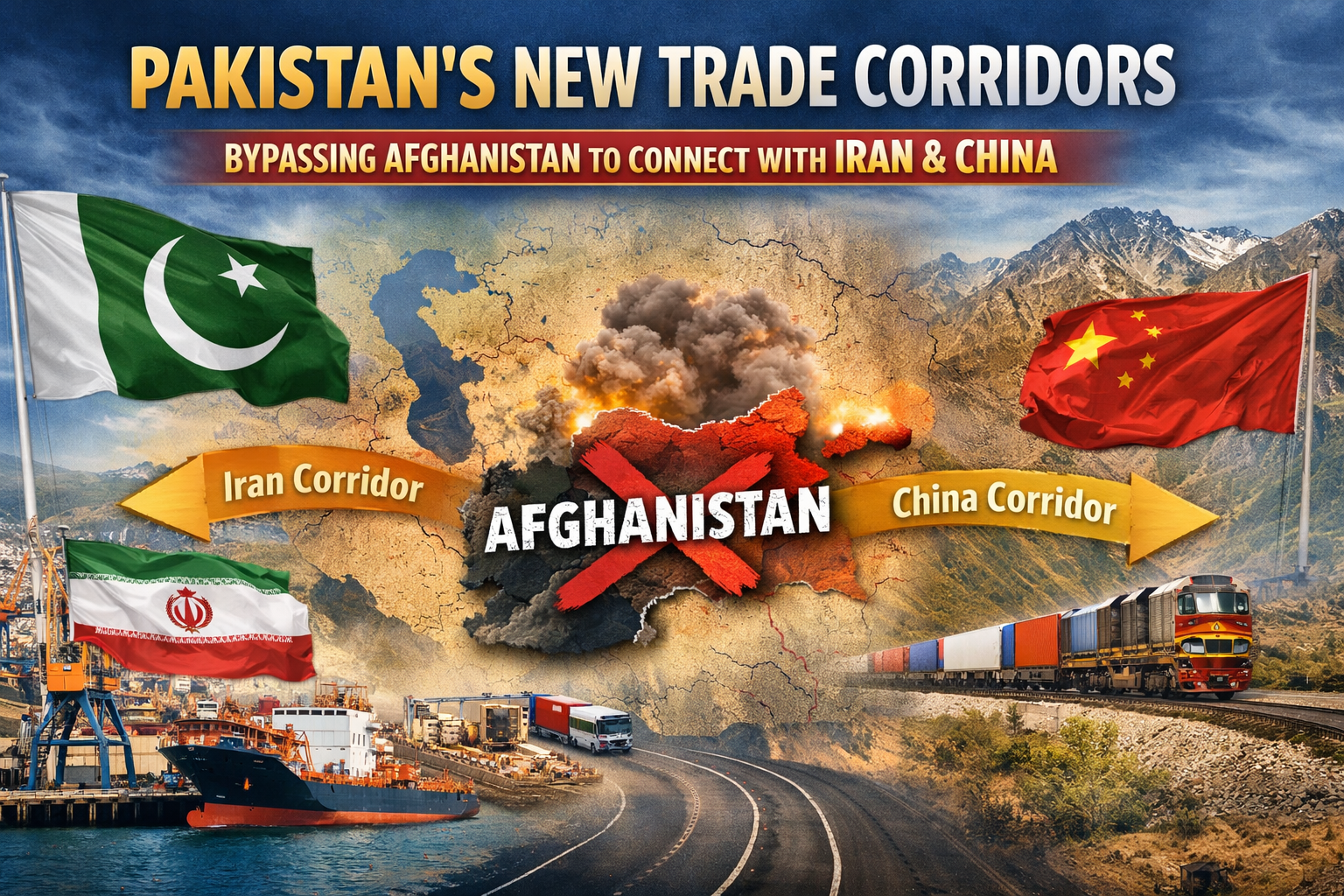
Relations between Pakistan and Afghanistan have hit rock bottom, and Islamabad is wasting no time in finding alternatives. Just a few years ago, Pakistan celebrated the Taliban’s return, expecting Kabul’s new rulers to align against India. But the reality turned out very different, and now Pakistan finds itself frustrated, cutting Afghanistan out of its trade routes.
Today, Pakistan has unveiled new trade corridors through Iran and China, bypassing Afghanistan entirely. This bold move not only deals a heavy blow to Afghanistan’s economy but also hands strategic advantages to Iran and China, reshaping the balance of power in Central Asia.
In a dramatic geopolitical shift, Pakistan has formally begun redirecting its trade and transit strategy away from Afghanistan, establishing two powerful international corridors that could reshape connectivity across Central Asia. This move not only sidelines Afghanistan but also strengthens Pakistan’s position as a rising transit hub in the region.
Why Connectivity Matters for Central Asia?
Central Asian nations like Kazakhstan, Uzbekistan, Turkmenistan, Tajikistan, and Kyrgyzstan are rich in resources like oil, natural gas, uranium, rare earths, cotton, and gold. Yet, being landlocked, they struggle to access global markets without relying on neighboring countries such as Russia, Iran, China, and Pakistan. Transport corridors are their lifelines to the world economy.
Pakistan’s Old Routes: Dependent on Afghanistan
Traditionally, Pakistan facilitated trade through the Gwadar Port, developed with China’s support. Goods from Central Asia passed through Afghanistan via two key crossings:
· Torkham Crossing – linking Peshawar with Jalalabad and Kabul.
· Chaman Crossing – connecting Quetta with Kandahar.
But rising Taliban influence, terrorism, and frequent border closures forced Pakistan to shut these crossings permanently by late 2025.
The New Strategy: Two Corridors to Bypass Afghanistan
Pakistan–Iran Corridor
· Goods now flow through the Gabd-Rimdan crossing in Pakistan’s Balochistan province.
· From there, shipments reach Gwadar Port and move globally.
· Iran benefits massively, earning revenue from customs duties, trucking, warehousing, and logistics while boosting its strategic importance.
Pakistan–China Corridor
· Built under CPEC, the Sost Dry Port along the Karakoram Highway connects Pakistan to China’s Xinjiang region.
· From China, goods move seamlessly into Central Asia.
· This strengthens China’s Belt and Road Initiative (BRI) and deepens its influence in the region.
The QTTTA Agreement
Pakistan, China, Kazakhstan, and Kyrgyzstan signed the Quadrilateral Traffic and Transit Agreement (QTTTA), ensuring cargo movement without Afghanistan. The first Kyrgyz cargo has already passed through these new routes, signaling the corridors are operational.
Winners and Losers
· Afghanistan: Loses transit fees, strategic relevance, and further global recognition.
· Iran: Gains revenue, infrastructure use, and geopolitical leverage.
· China: Strengthens CPEC, supports BRI, and develops Xinjiang.
· Pakistan: Reinvents itself as a regional transit hub, reducing reliance on unstable Afghan routes.
In India’s Perspective
India is closely monitoring these developments. While Pakistan grows stronger as a transit hub, India has its own counter-strategy:
· Chabahar Port in Iran.
· International North-South Transport Corridor (INSTC) to connect with Central Asia.
These initiatives could help India balance Pakistan’s rising influence.
Strategic Outlook
Pakistan’s decision to bypass Afghanistan marks a historic turning point in regional trade dynamics. By aligning with Iran and China, Islamabad is positioning itself as a central player in Eurasian connectivity—reshaping the economic map of South and Central Asia.
Written by
Bhavana SharmaDiscussion (0)
Sign in to join the discussion.
Loading comments…