
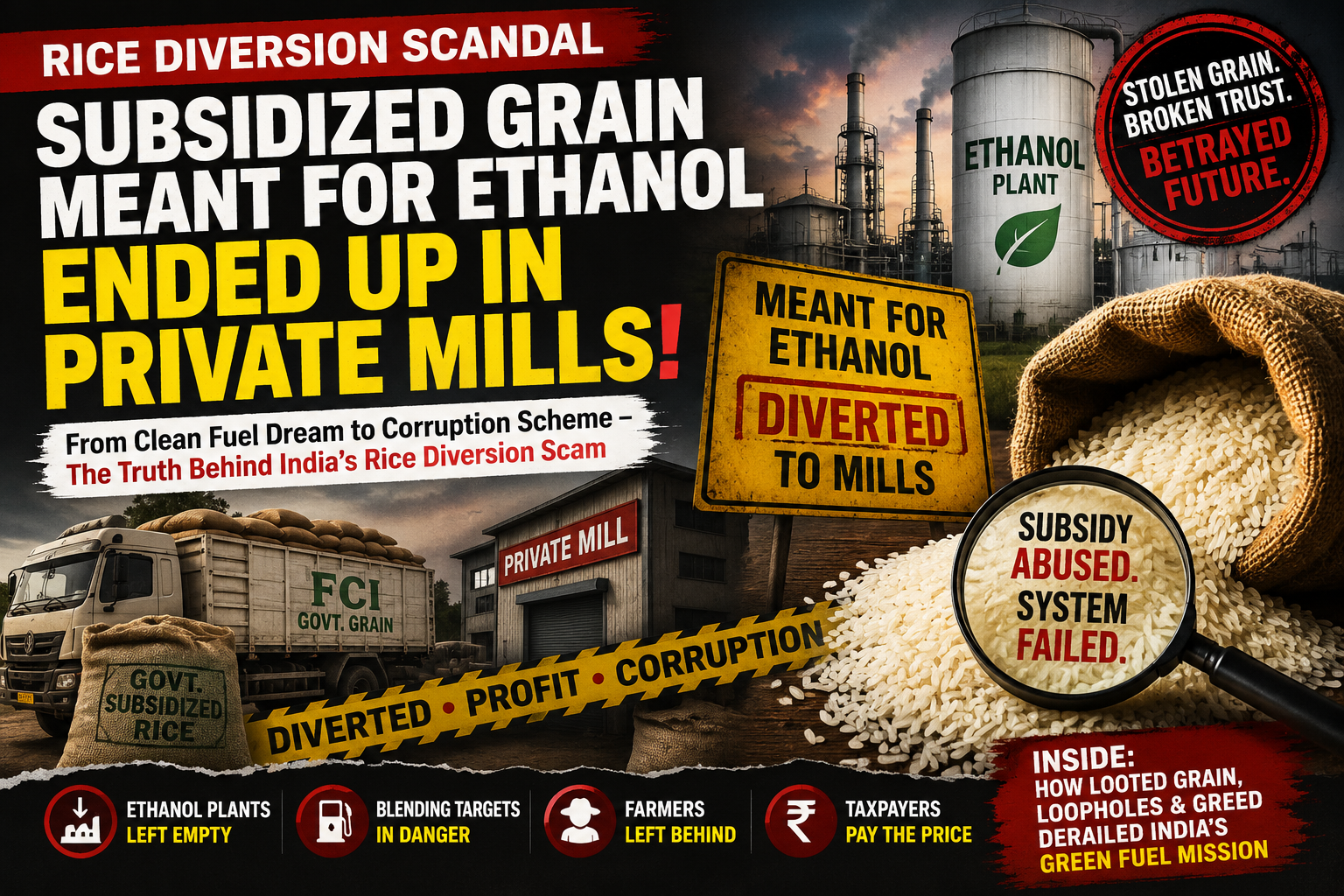
A Grain of Truth, A Mountain of Lies — India’s ambitious ethanol blending program—designed to cut crude oil imports, save foreign exchange, reduce carbon emissions, and boost farmer incomes—has hit a shocking roadblock in Madhya Pradesh. What was supposed to be a clean energy initiative has turned into a murky scandal of diverted rice, private profiteering, and broken accountability.
Rice meant to fuel India’s clean energy dream was quietly diverted from government depots to private mills. What was supposed to power ethanol plants and reduce India’s oil dependency instead lined the pockets of profiteers, exposing cracks in supply chain monitoring and governance. This isn’t just about stolen grain—it’s about stolen trust in India’s push for a greener, self‑reliant future.
Ethanol: India’s Green Fuel Dream
Ethanol, an alcohol produced by fermenting carbohydrates like sugarcane juice, molasses, maize, and surplus rice, is blended with petrol to create cleaner fuel. Blends like E10 (10% ethanol) and E20 (20% ethanol) are already in use, helping India reduce pollution and dependency on imported petroleum.
To support this, the government allowed surplus rice procured by the Food Corporation of India (FCI) to be sold at concessional rates to ethanol plants. This not only prevented wastage of stored grain but also gave farmers an additional market for their produce.
The Diversion Scam
But investigations in Madhya Pradesh revealed a disturbing twist. Rice meant for ethanol plants was being diverted to private mills instead. For instance, 242 quintals of rice dispatched from FCI’s Navegaon depot to an ethanol plant in Chhindwara never reached its destination—it landed in a private mill.
Worse, these mills processed the subsidized rice and sold it back to the government at four to six times the original price. In effect, the government was cheated with its own grain, paying inflated rates for rice that had already been sold cheaply for ethanol production.
The Fallout
This diversion undermines multiple national goals:
· Ethanol plants fail to receive raw material, slowing production.
· Oil marketing companies face shortages, jeopardizing blending targets.
· Farmers lose out on the promised additional income streams.
· Taxpayers bear the brunt as the government pays inflated prices for its own grain.
The scandal exposes weak supply chain monitoring, poor documentation, and lack of traceability in FCI’s operations. Trucks carrying rice were not properly tracked, and accountability was blurred between depots, transporters, and distilleries.
Governance Under Scrutiny
Authorities suspect this is just the tip of the iceberg, with possible involvement of transporters, mill operators, middlemen, and officials across multiple states. A Special Investigation Team (SIT) has been set up to probe the scam.
In response, FCI has tightened rules like ethanol plants now being directly accountable for the rice they receive, and their production outputs will be audited against inputs. Criminal proceedings may follow if misuse is detected.
The Bigger Picture
India’s ethanol program was meant to be a win‑win, such as cleaner air, reduced oil imports, and better farmer incomes. But this scandal highlights how poor governance can derail even the most progressive policies.
Unless supply chains are digitized, monitored end‑to‑end, and corruption weeded out, the promise of green fuel risks being overshadowed by grain‑driven greed.
Curtain Call
What was envisioned as a sustainable energy revolution has, in Madhya Pradesh, turned into a cautionary tale of loopholes exploited and accountability lost. The rice diversion scam is not just about stolen grain—it’s about stolen trust in India’s clean energy future.
Written by
Bhavana SharmaDiscussion (0)
Sign in to join the discussion.
Loading comments…