
How a China-led digital payment revolution aimed to reshape global finance, why Saudi Arabia joined and then quietly left, and what it means for the future of the US dollar. Is Beijing's Plan to Challenge US Dollar Dominance Losing Momentum?
The global financial system is witnessing a silent but high-stakes battle. For decades, the US dollar has dominated international trade, cross-border payments, foreign exchange reserves, and global finance. However, in recent years, China has been actively exploring alternatives to reduce dependence on the dollar-centric system.
One of the most ambitious initiatives in this direction was Project mBridge, a groundbreaking digital payment platform designed to enable countries to transact directly using their own digital currencies.
But in a surprising development, Saudi Arabia, one of the world's largest oil exporters and a key US ally, has exited the project. The move has sparked intense global discussion about the future of digital currencies, geopolitical alliances, and the limits of China's financial ambitions.
What Exactly Is Project mBridge?
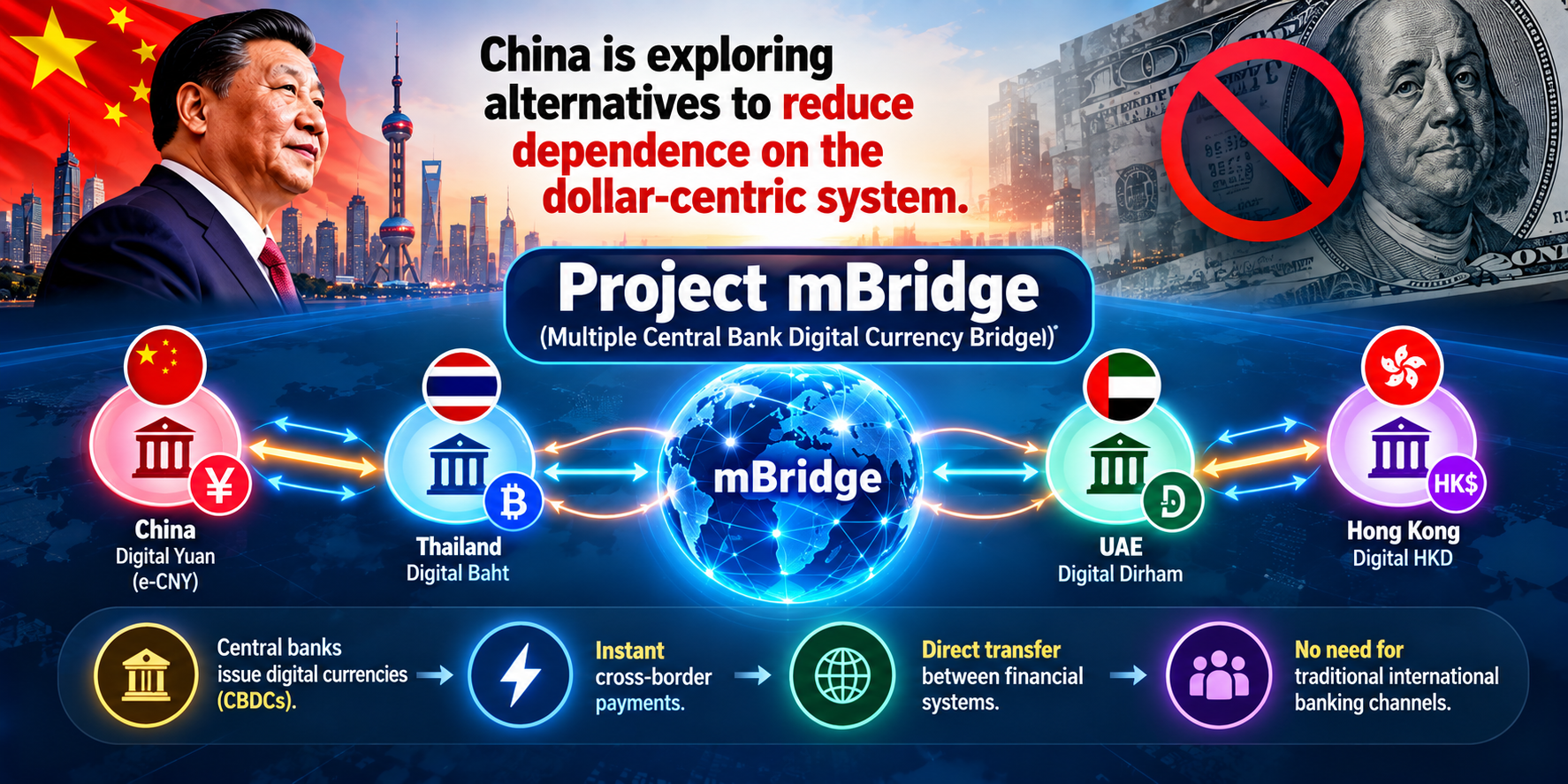
mBridge stands for Multiple Central Bank Digital Currency Bridge (mCBDC Bridge).
The project was developed to facilitate instant cross-border payments and settlements using Central Bank Digital Currencies (CBDCs). These are digital versions of national currencies issued directly by central banks.
For example, India's RBI has introduced the Digital Rupee (e₹). Unlike UPI, which simply transfers existing money between bank accounts, a CBDC is actual legal tender in digital form.
Under mBridge, participating countries could potentially transfer digital currencies directly between their financial systems without relying on conventional international banking channels.
Why Was mBridge Considered a Threat to Dollar Dominance?
Today, international payments often pass through multiple intermediary banks. In many cases, transactions are converted into US dollars before being converted again into another country's currency. This process has several drawbacks:
1. Higher transaction costs
2. Longer settlement times
3. Multiple financial intermediaries
4. Dependence on dollar-based infrastructure
mBridge aimed to eliminate these bottlenecks by allowing countries to exchange value directly using CBDCs.
If successful on a large scale, the platform could reduce reliance on the US dollar for payment settlements, especially among emerging economies and major trading partners.
The Countries Behind the Project
mBridge was not just a Chinese experiment. The initiative involved several major financial institutions and authorities, including:
1. Bank for International Settlements (BIS)
2. People's Bank of China
3. Hong Kong Monetary Authority
4. Central Bank of the UAE
5. Bank of Thailand
The project's credibility increased significantly because the Bank for International Settlements (BIS) participated in its development. This gave mBridge global attention far beyond China's borders.
The situation became even more notable when Saudi Arabia joined, signalling interest from a major energy exporter deeply connected to the global oil trade.
Why Was Saudi Arabia's Participation So Significant?
Saudi Arabia occupies a unique position in the global economy. For decades, the kingdom has aligned closely with the United States, especially through the petrodollar system that emerged from agreements between Washington and Riyadh in the 1970s.

Under this arrangement, oil sales were predominantly conducted in US dollars, reinforcing the dollar's status as the world's primary reserve currency. This is why Saudi Arabia's involvement in a China-linked payment infrastructure attracted massive international attention.
Many analysts viewed the move as a symbolic indication that Riyadh was exploring alternatives while expanding its economic partnerships with Beijing.
How mBridge Could Help China's Bigger Strategy
Beyond payment efficiency, mBridge aligns with some of China's long-term strategic objectives.
1. Internationalizing the Digital Yuan
China's CBDC, known as the e-CNY or Digital Yuan, is one of the world's most advanced central bank digital currencies. A platform like mBridge could encourage greater international use of the Digital Yuan for trade and transactions.
2. Reducing Dependence on US Financial Infrastructure
The current global financial system relies heavily on US-linked institutions and networks. China has increasingly sought mechanisms that provide more financial autonomy and resilience, especially as geopolitical tensions rise.
3. Influencing Future Financial Standards
Whoever develops the next generation of payment infrastructure could have significant influence over technical standards, governance models, and interoperability frameworks.
China clearly wants a seat at that table.
Understanding the Difference: SWIFT vs mBridge
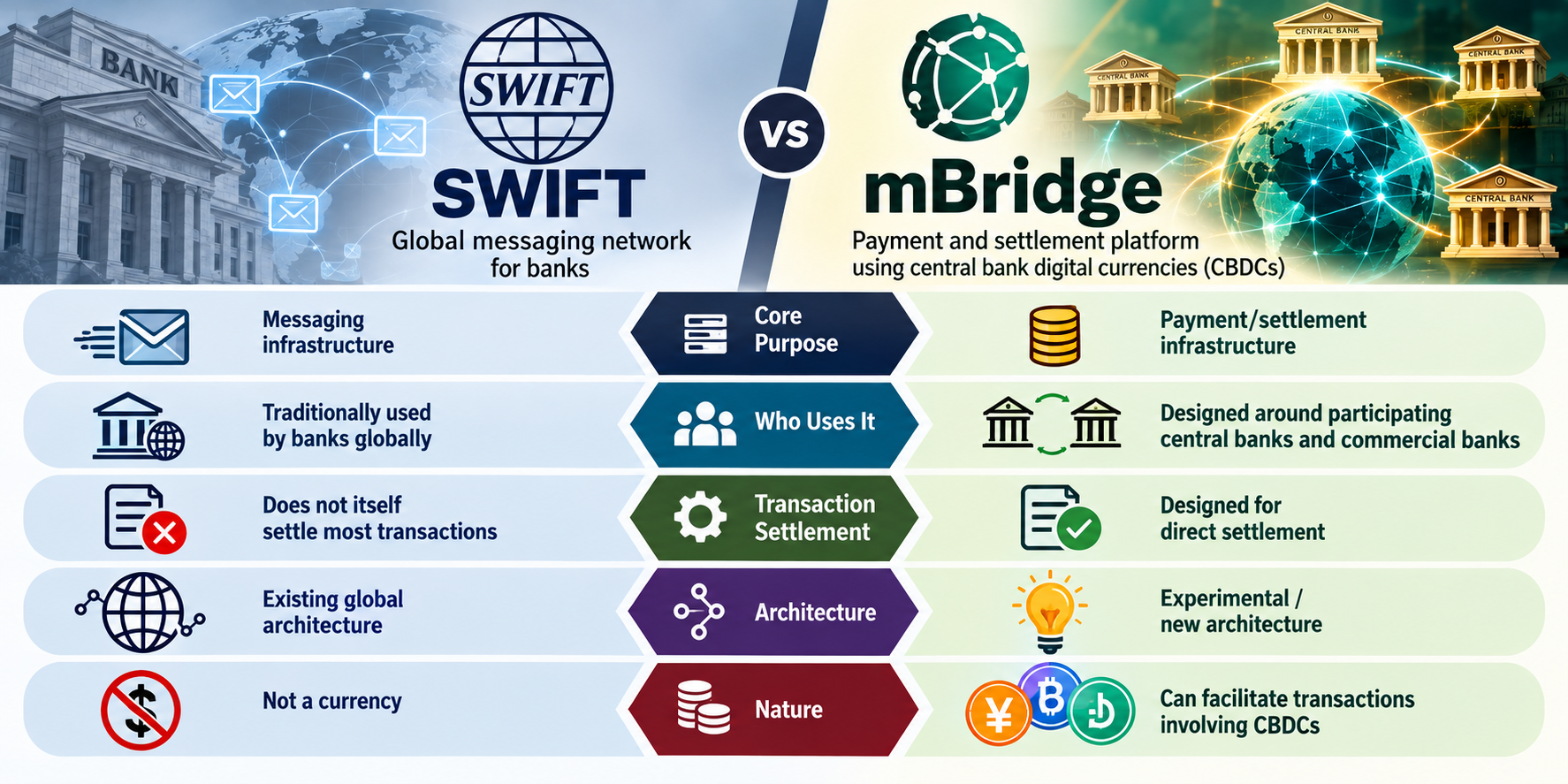
A common misconception is that mBridge and SWIFT are the same thing. They are fundamentally different.
SWIFT
SWIFT is primarily a messaging network that allows banks to communicate payment instructions securely.
mBridge
mBridge functions more like a payment and settlement infrastructure where digital currencies can be exchanged directly.
A simple comparison would be:
✅SWIFT = Communication system
✅mBridge = Transaction platform
Think of SWIFT as a secure postal service for payment messages, while mBridge aims to become the digital highway where the value itself moves.
mBridge’s First Real Test Proved It Was More Than Just a Concept
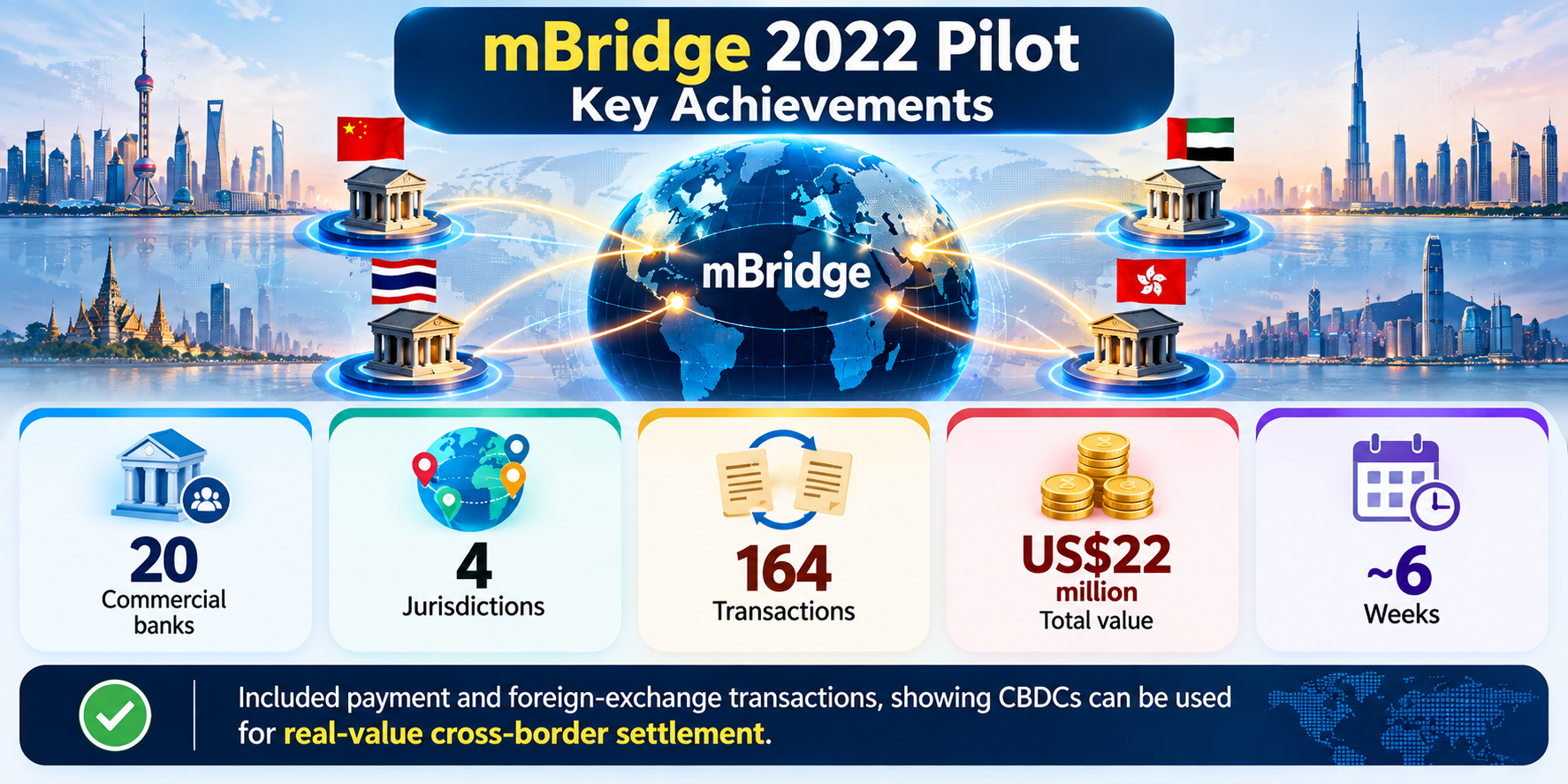
Far from being a theoretical experiment, mBridge successfully demonstrated the real-world potential of Central Bank Digital Currencies (CBDCs). During its 2022 pilot, 20 commercial banks across four jurisdictions processed 164 cross-border transactions worth over $22 million in just six weeks. The transactions included both payments and foreign exchange settlements, proving that CBDCs can support real-value international trade and financial transfers. For supporters of digital finance, the pilot marked a significant step toward faster, cheaper, and more efficient cross-border payments beyond traditional banking systems.
🚀 From Pilot Project to Independent Platform: mBridge’s Defining Moment
1. June 2024 marked a breakthrough as mBridge advanced to the Minimum Viable Product (MVP) stage, proving the platform was ready to move beyond limited testing.
2. Saudi Arabia joined as a full participant, adding significant credibility and geopolitical importance to the China-backed digital payments initiative.
3. The platform was built to welcome more central banks and commercial banks, enabling real-world cross-border transactions using Central Bank Digital Currencies (CBDCs).
4. In October 2024, the Bank for International Settlements (BIS) stepped away from the project and handed operational responsibility to participating central banks.
5. BIS clarified that its exit was not due to project failure or political pressure, but because the initiative had matured enough to continue independently.
6. The key takeaway: BIS's departure did not signal the end of mBridge. Instead, it represented a transition from an internationally supervised development phase to a participant-led expansion strategy.
Why Is the United States Watching Closely?
It would be an exaggeration to say that mBridge could suddenly replace the US dollar. Dollar dominance rests on several pillars:
1. Global trade invoicing
2. Foreign exchange reserves
3. International debt markets
4. Financial contracts
5. Safe-haven status
6. Deep and liquid capital markets
However, payment infrastructure is one area where alternatives can gradually emerge.
If major economies start conducting more trade using digital currencies through platforms like mBridge, the role of the dollar as an intermediary could diminish over time, even if its broader dominance remains intact.
This is one reason why developments around mBridge attract significant attention in Washington.
Why Did Saudi Arabia Leave?
Saudi Arabia initially joined the project as an observer before becoming a full participant. It later took part in the platform's proof-of-concept phase and quietly exited after the exercise concluded in May 2025.
Importantly, the withdrawal does not appear to be a sudden or hostile move. The kingdom completed the testing phase and then stepped away once the exercise ended.
Nevertheless, the timing carries symbolic weight. Saudi Arabia is:
1. A major G20 economy
2. One of the world's largest energy exporters
3. A crucial strategic partner of the United States
Its participation had strengthened the project's geopolitical significance. Its exit, therefore, is widely perceived as a setback for China's efforts to build broader international momentum behind mBridge.
🌍 mBridge Isn’t Dead Yet: Why Saudi Arabia’s Exit Isn’t the End of the Story
1. Despite Saudi Arabia's withdrawal, mBridge continues to expand and attract new participants.
2. In 2026, Macau's Monetary Authority joined the platform, signalling that interest in CBDC-based cross-border payments remains strong.
3. On its very first day, three Macau banks processed 23 cross-border transactions involving China, Hong Kong, and the UAE, with a total value of nearly 1.3 billion Macao patacas.
4. The development highlights a key reality: Saudi Arabia leaving may have been a geopolitical setback, but it did not derail the project.
The Bigger Picture: A Financial Power Struggle in the Digital Age
The real story behind mBridge is not merely about one payment platform. It reflects a growing global debate: Who will shape the future of international finance?
Will the world continue relying on dollar-dominated systems, or will digital currencies create a more multipolar financial landscape?
China believes technology can help rewrite parts of the global financial rulebook. The United States remains confident that the dollar's broader strengths will keep it firmly at the center of world finance.
Saudi Arabia's exit from mBridge may be a temporary setback for China's vision, but the broader contest over digital currencies, payment infrastructure, and financial influence is only just beginning.
🚀 The Road Ahead
Project mBridge represents one of the most ambitious attempts to modernize cross-border payments using digital currencies. While Saudi Arabia's withdrawal has undoubtedly dented its symbolism, the initiative continues to highlight a crucial reality: the future of global money is becoming increasingly digital, interconnected, and geopolitically competitive.
Stay Ahead of the Global Finance Revolution
Want to understand how CBDCs, the Digital Yuan, BRICS initiatives, the Petrodollar system, and the US-Dollar rivalry could reshape the global economy?
✅ Follow our blog for expert geopolitical insights
✅ Get simplified explanations of complex global developments
✅Stay updated on the future of money, trade, and international power politics
The battle for the future of global finance has begun. Don't just watch it unfold. Understand it before everyone else does.
Written by
Devansh KaulDiscussion (0)
Sign in to join the discussion.
Loading comments…