
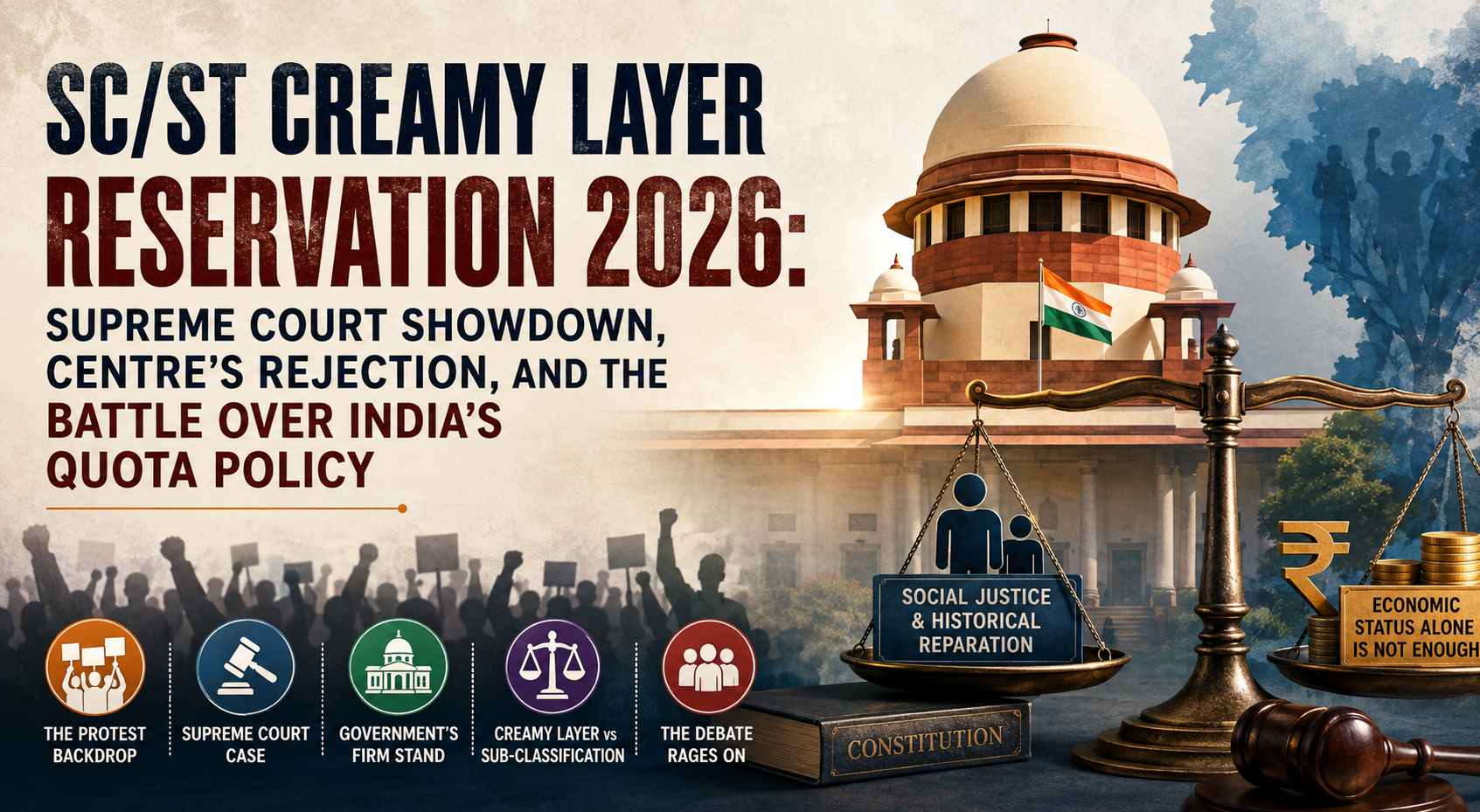
🔥 The Protest Backdrop
India’s reservation debate never sleeps. From Jantar Mantar protests to the “Reservation Hatao Andolan,” demands keep shifting; some want more quotas, others want them scrapped. Recently, the spotlight moved to the Supreme Court, where a petition sought to introduce the “creamy layer” concept for Scheduled Castes (SC) and Scheduled Tribes (ST).
⚖️ The Supreme Court Case
The petition, filed by BJP politician and advocate Ashwini Kumar Upadhyay, argued that affluent SC/ST families, those already well‑off with government jobs and high incomes, should no longer benefit from reservation. He leaned on a 2024 Supreme Court judgment that permitted sub‑classification within SCs, where benefits could be redistributed among communities based on relative deprivation.
But here’s the twist: while some judges hinted at the possibility of extending the creamy layer principle, the Court never ruled it mandatory.
🏛️ Government’s Firm Stand
The Centre filed an affidavit flatly opposing the idea. Why? Because reservation for SCs and STs wasn’t designed as an anti‑poverty program; it was meant to address historical caste oppression, untouchability, social exclusion, and tribal marginalization.
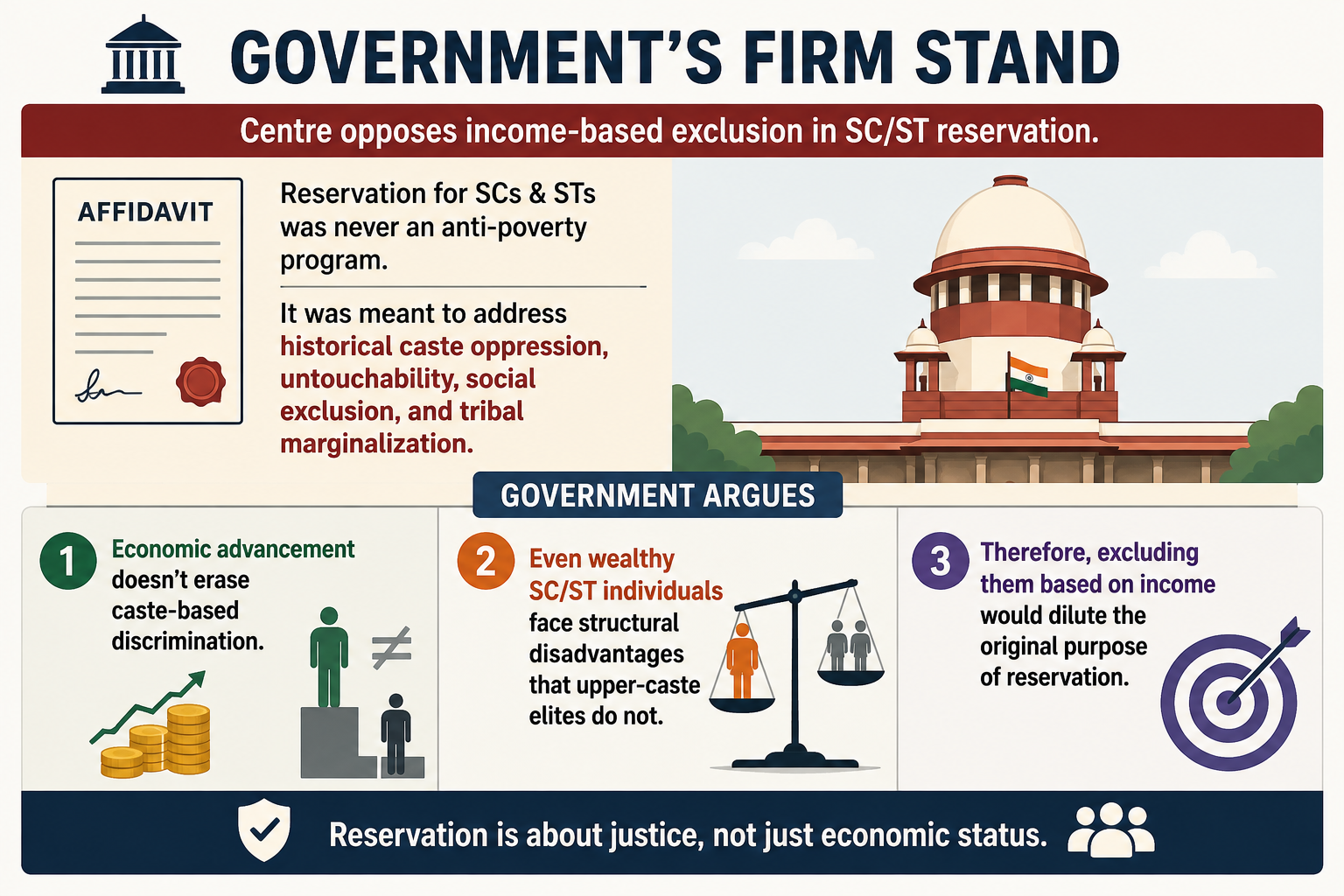
The government argued:
Economic advancement doesn’t erase caste‑based discrimination.
Even wealthy SC/ST individuals face structural disadvantages that upper‑caste elites do not.
Therefore, excluding them based on income would dilute the original purpose of reservation.
Creamy Layer Principle: Who Really Needs Reservation?
The creamy layer principle excludes relatively advanced individuals within a backward class, ensuring that reservation benefits reach those who remain disadvantaged. Rooted in the Supreme Court’s landmark Indra Sawhney v. Union of India (1992) case, it ensures that unequals are not treated as equals within the same community. While widely applied to OBCs, the issue becomes more complex when extended to SCs and STs, where historical discrimination still runs deep.
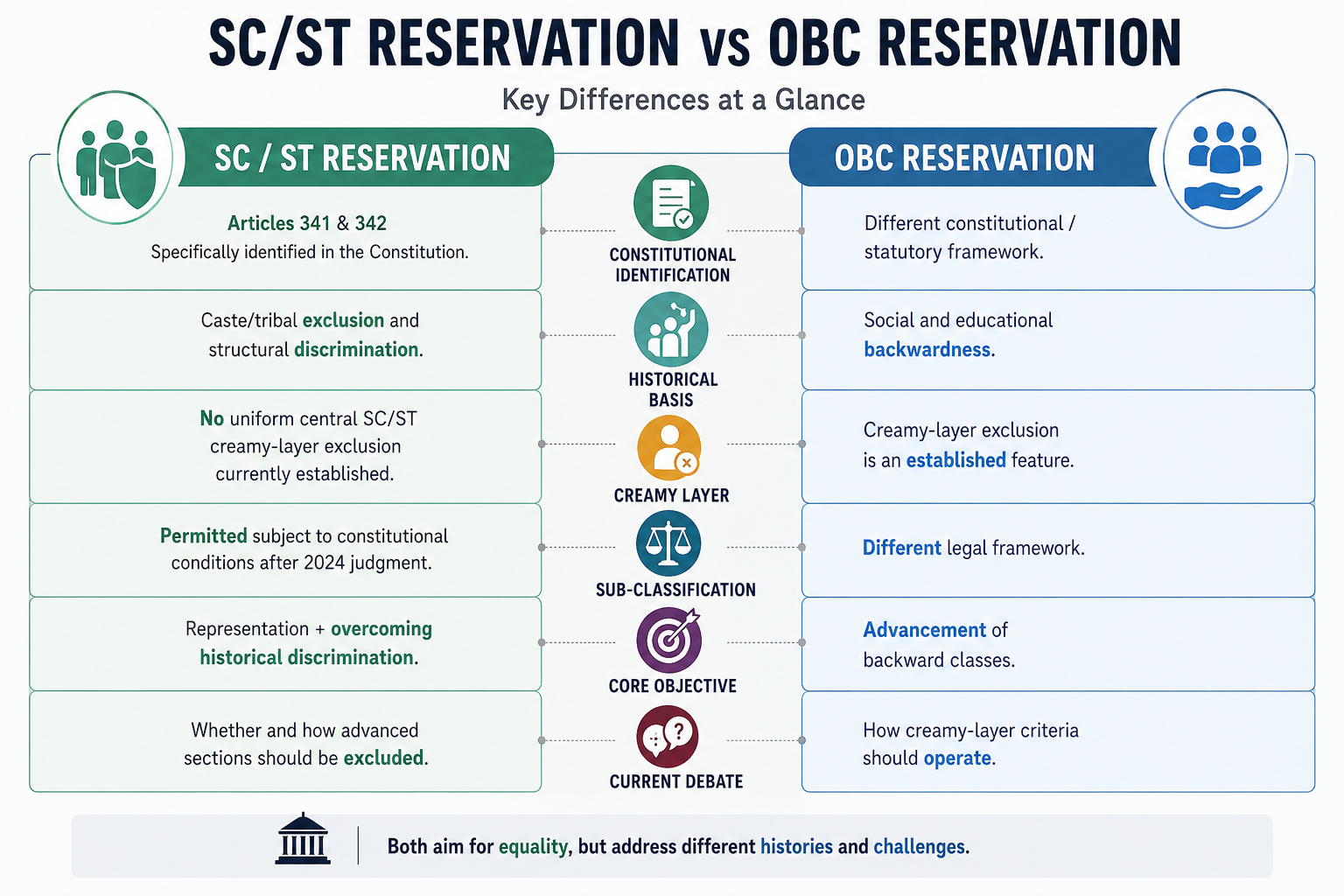
Within the same backward community, affluent families with high education, government jobs, and strong social capital are excluded, so that struggling families with low income, poor schooling, and limited opportunities can rise. In essence, it filters out the well‑off to prioritize the genuinely marginalized.
Creamy Layer vs. Sub‑Classification
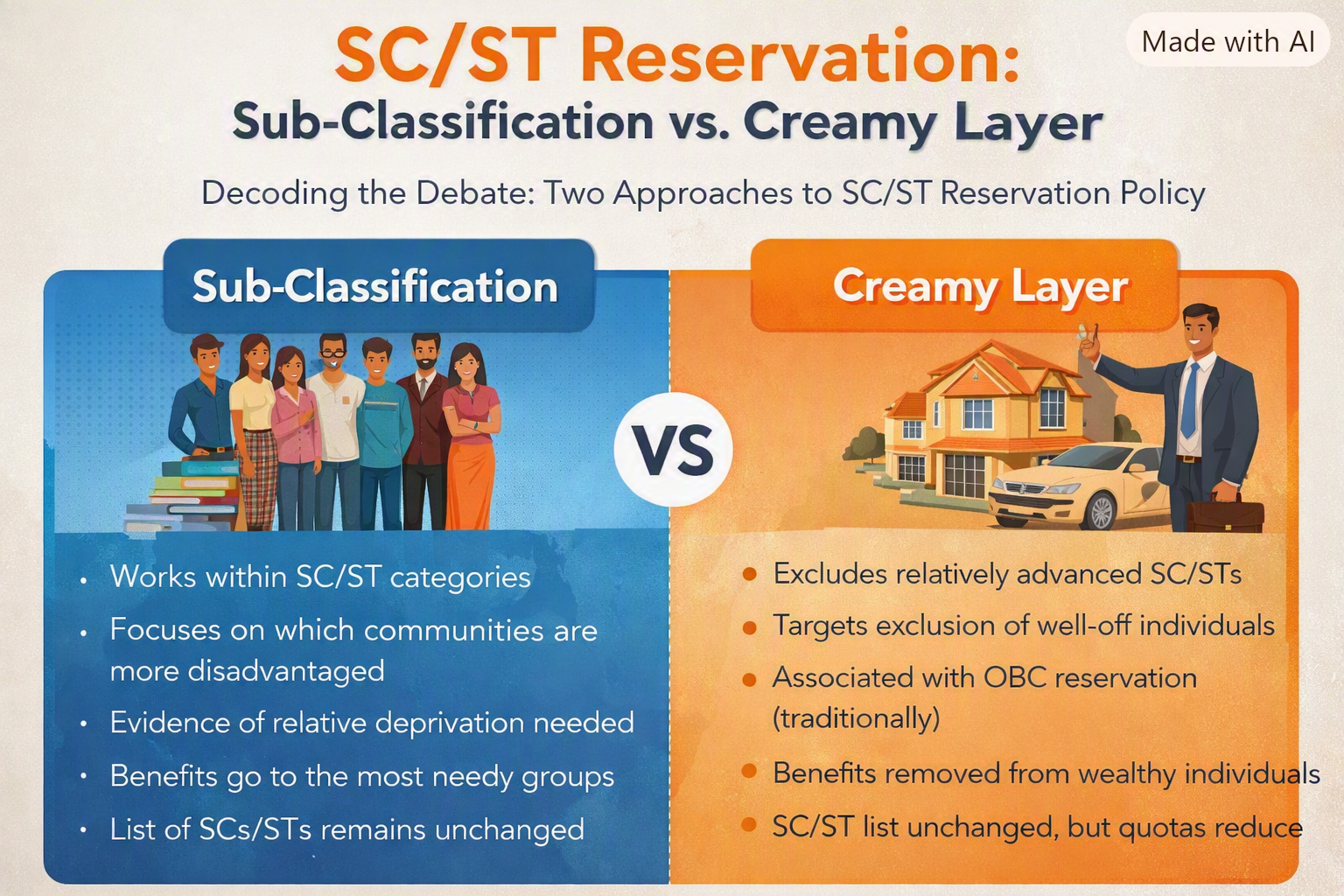
Creamy Layer: Excludes individuals/families who are economically well‑off. (Applied to OBCs since the 1992 Indira Sawhney case.)
Sub‑Classification: Redistributes quota benefits among SC communities to ensure the most deprived groups get a larger share.
In short: creamy layer decides who is out; sub‑classification decides who gets how much.
Justice B.R. Gavai’s Stand on True Equality
Drawing inspiration from Dr. B.R. Ambedkar’s writings, especially What Gandhi and Congress Have Done to the Untouchables, Justice B.R. Gavai underscored that the purpose of reservation is upliftment, not entitlement. He explained that individuals who have used affirmative action to reach only modest positions, like clerical or support roles, may still face deep social and educational disadvantages.
However, those who have climbed to influential or prosperous positions through reservation can no longer be considered backward. Justice Gavai argued that such individuals should gracefully “step out” of the special provisions, allowing the benefits to flow to those who truly need them. In his view, excluding the creamy layer is essential to achieving genuine equality envisioned by the Constitution.
💥 The Debate Rages On
Supporters of Creamy Layer: Say benefits are being monopolized by a few families across generations, leaving the truly needy behind.
Opponents: Warn that income thresholds are arbitrary and fail to capture deep‑rooted social discrimination.
The clash is not just legal; it’s ideological, touching the very foundation of India’s affirmative action policies.
Centre Calls Petition “Misconceived”
The government dismissed the plea as misguided and lacking substance, pointing out that similar provisions already exist for Socially and Educationally Backward Classes (SEBCs) under the Constitution (102nd Amendment) Act, 2018.
Vague Claims, No Evidence
In its affidavit, the Centre argued that the petition’s demands were broad, unclear, and unsupported by proof. It noted that the petitioners had failed to identify which specific government schemes should be expanded or explain how such measures would genuinely help below‑poverty‑line (BPL) citizens across communities.
The Core Message
The government’s stance was clear; policy changes must be data‑driven, not assumption‑based, and any reform in reservation frameworks requires empirical evidence and constitutional precision, not generalized appeals.
Reservation is one of India’s most sensitive and defining policies. Should the creamy layer apply to SC/STs, or does it risk undermining the fight against caste oppression?
👉 Share your thoughts, debate with peers, and let your voice be heard. The future of social justice in India may depend on how this question is answered.
Written by
Vedant BhardwajDiscussion (0)
Sign in to join the discussion.
Loading comments…