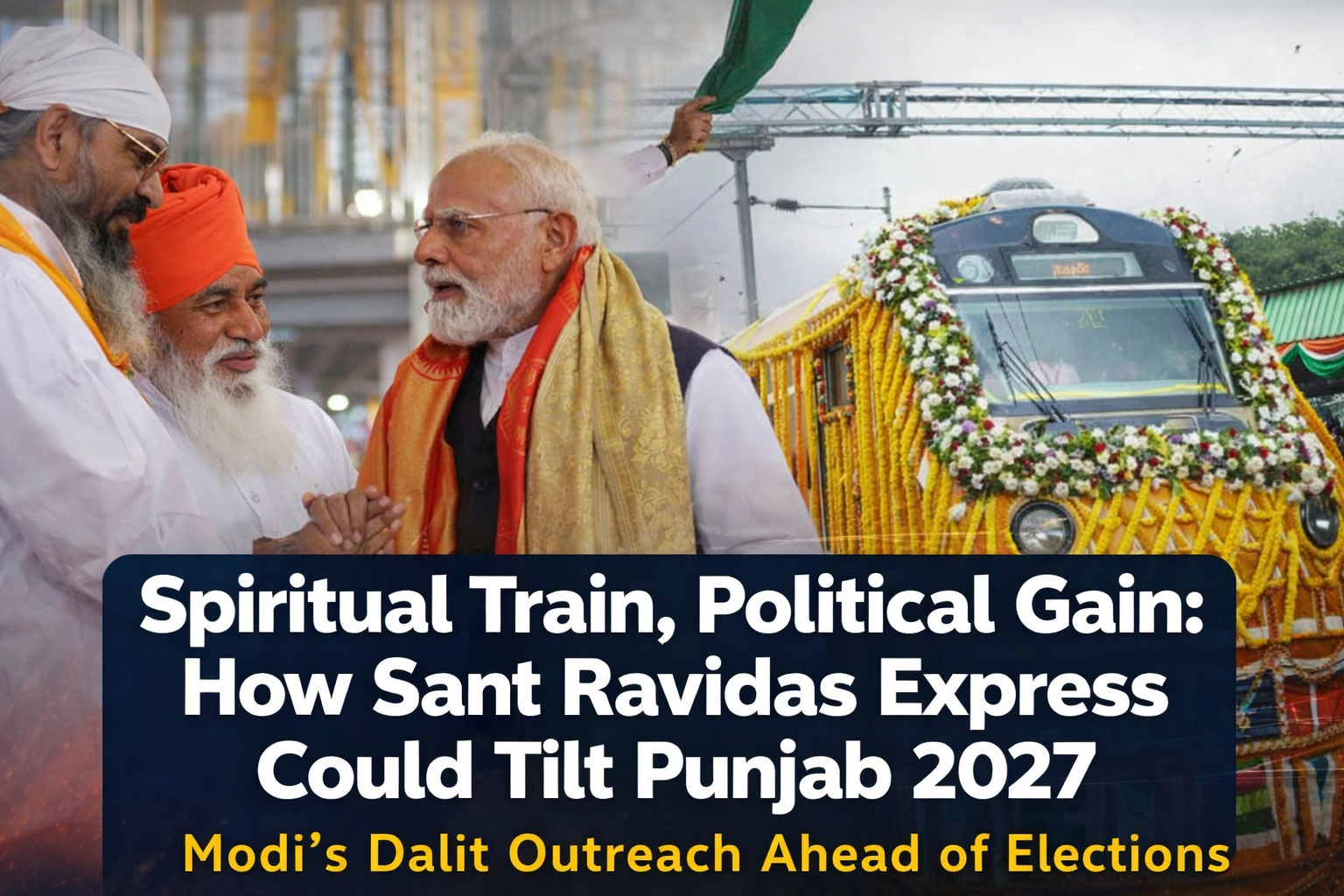
When Prime Minister Narendra Modi arrives in Jalandhar today, it won’t just be another official visit. Beneath the ribbon‑cutting ceremonies and railway redevelopment announcements lies a calculated political move, one that could reshape Punjab’s electoral landscape in 2027.
At the heart of this visit is the inauguration of the Sant Ravidas Express, a spiritual train journey connecting Amritsar to Varanasi, the birthplace of Sant Ravidas. For the Ravidasia community, a Dalit group with deep spiritual ties, this is more than infrastructure; it’s recognition, respect, and a powerful symbol of inclusion.
Why This Matters?
Dalit Demographics: Dalits make up nearly 32% of Punjab’s population, double the national average. In the Doaba region alone, Scheduled Castes account for nearly 45%, with the Ravidasia community dominating 19 of 23 assembly seats.
Strategic Outreach: By honouring Sant Niranjan Das with a Padma Shri earlier this year and renaming Adampur Airport as Guru Ravidas Airport, the BJP is embedding itself in the spiritual and cultural identity of this community.
Electoral Chessboard: With Jat Sikhs distancing themselves from the BJP post‑farm laws, the party is pivoting toward marginalized groups- Ravidasias, Mazhabi Sikhs, and OBCs- to build a new coalition of support.
The Ravidasia Identity Shift
The Ravidasia community’s split from Sikhism in 2009, after violent clashes and the assassination of Sant Ramanand in Vienna, marked a turning point. They established their own religious identity, worshipping Amrit Vani instead of Guru Granth Sahib, greeting each other with Jai Gurudev instead of Sat Sri Akal, and adopting the Hari symbol in place of Sikh emblems.
This assertion of identity created fertile ground for political recognition. The BJP, through social engineering and symbolic gestures, has positioned itself as the party willing to validate and amplify this distinct identity.
The Bigger Picture
Congress Factor: With Charanjit Singh Channi as a prominent Dalit face, Congress has long held sway in Doaba. BJP’s moves are a direct counter to this influence.
Social Engineering: From inducting Vijay Sampla into the Union Cabinet in 2014 to elevating him as Chairman of the National Commission for Scheduled Castes, the BJP has been laying the groundwork for over a decade.
Regional Strategy: While Malwa remains dominated by Jat Sikhs, and Majha by Panthic issues, Doaba is the BJP’s chosen battlefield, where Dalit votes could tilt the balance.
The Road to 2027
The Sant Ravidas Express is more than a train; it’s a political vehicle. When Prime Minister Narendra Modi flagged off the Sant Ravidas Express, it was more than the launch of a new train; it was the unveiling of a political strategy on wheels.
This spiritual journey from Amritsar to Varanasi, the birthplace of Sant Ravidas, carries not just pilgrims but also the weight of Punjab’s electoral future.
By intertwining spiritual recognition with infrastructure development, the BJP is signaling to Punjab’s Dalit voters: we see you, we honor you, and we stand with you.
Whether this outreach translates into electoral gains will only be clear in 2027, but one thing is certain: the BJP is rewriting its Punjab playbook, one symbolic gesture at a time.
Written by
Ishaan TrivediDiscussion (0)
Sign in to join the discussion.
Loading comments…