
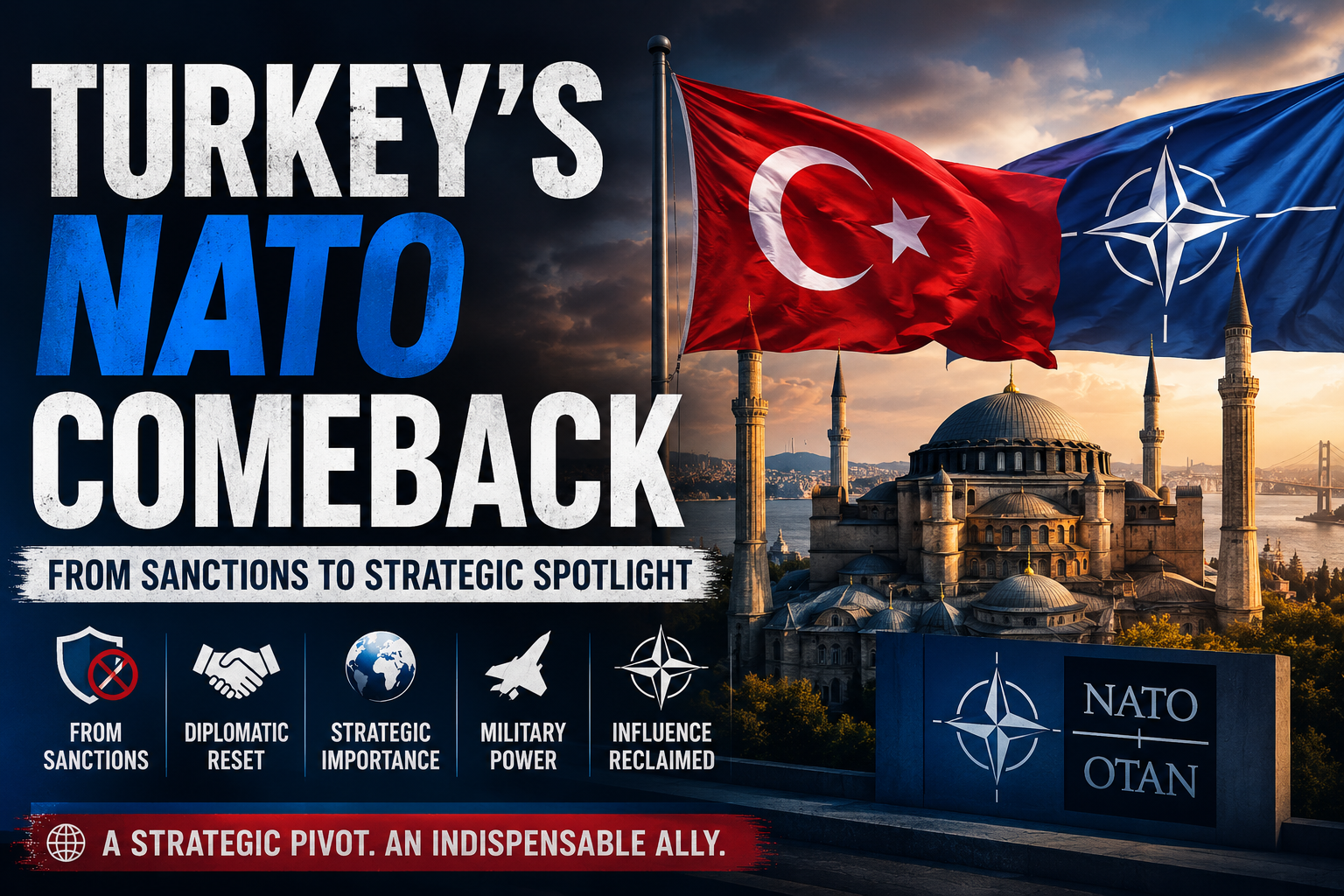
The recent NATO summit wasn’t just another diplomatic gathering - it was Turkey’s moment of resurgence.
For years, Ankara had been pushed to the margins of NATO politics and been treated as a “difficult ally”. U.S. sanctions, disputes over Russian weapons purchases, and tensions over Kurdish forces in Syria had strained relations. Turkey was even excluded from the F‑35 fighter jet program, a clear signal of mistrust. But this summit, held on Turkish soil, flipped the script.
Turkey didn’t just host; it emerged as a "big diplomatic winner", reclaiming influence and spotlight within the alliance. What was once a sidelined partner is now being recognized as a strategic player whose voice cannot be ignored.
The recent NATO summit in Ankara wasn’t just another diplomatic gathering - it was a turning point. Leaders from across the alliance, from Donald Trump to European heads of state, converged in Turkey for what many are calling one of the most consequential NATO summits in recent years.
Why This Summit Was Different
Traditionally, NATO’s agenda has revolved around Russia. But Ankara’s summit widened the lens: discussions spanned the Russia‑Ukraine war, instability in the Red Sea, the Israel‑Iran conflict, and Europe’s military preparedness. Turkey’s geography made it impossible to ignore — straddling Europe, Asia, and the Middle East, and controlling the Bosporus and Dardanelles straits, the only maritime gateways linking the Black Sea to the Mediterranean.
This unique position makes Turkey indispensable. It’s not just about maps; it’s about leverage. Refugee flows, military bases, and industrial capacity all underscore why Europe and the U.S. need Ankara on their side.
From Isolation to Influence
Turkey’s troubles with NATO were rooted in three flashpoints:
· Russian S‑400 purchase (2017): Seen as a betrayal, leading to U.S. sanctions.
· Syrian Kurdish forces: Supported by NATO but opposed by Turkey, creating deep mistrust.
· Sweden & Finland’s membership bids: Turkey delayed approvals, demanding action against Kurdish groups.
Despite these tensions, shifting geopolitics changed the calculus. Russia’s aggression, Iran’s destabilizing role, and refugee pressures made Turkey’s cooperation vital. As one line from the transcript puts it: “Europe now feels it cannot function without Turkey.”
Trump’s Reset
Under President Biden, criticism of Turkey was routine. But Trump’s return brought a reset. He announced the removal of sanctions tied to the S‑400 deal, promised deeper defense cooperation, and even pledged to reintegrate Turkey into the F‑35 program. This marked a dramatic reversal — and a clear diplomatic victory for Ankara.
Turkey’s Military Edge
Beyond politics, Turkey’s military strength is formidable. It has NATO’s second‑largest standing army after the U.S., advanced drone capabilities (such as the Bayraktar TB2), strong naval bases, and a booming domestic defence industry that produces tanks, helicopters, and air defence systems. Ankara’s ambition is clear: to integrate its defense supply chains with Europe and cement its role as a cornerstone of NATO security.
Wider Ripples: North Korea & Asia
The summit also drew sharp reactions from North Korea, which slammed NATO for “expanding into Asia” and accused it of trying to become an “Asian NATO” aimed at containing China and Pyongyang. NATO leaders, meanwhile, demanded complete denuclearization of North Korea and pledged stronger ties with Indo‑Pacific partners like Japan, South Korea, Australia, and New Zealand.
Conclusion: A Diplomatic Victory
Turkey’s journey from sanctions to spotlight is a reminder of how fast geopolitics can shift. Once criticized for its independent foreign policy, Ankara now finds itself indispensable to NATO’s future. Geography, military power, and shifting alliances have turned Turkey into a strategic pivot point — and this summit proved it.
Written by
Bhavana SharmaDiscussion (0)
Sign in to join the discussion.
Loading comments…