
New UPI Transaction Fees Explained: Who Pays, How Much, and Why It Could Change the Way India Pays
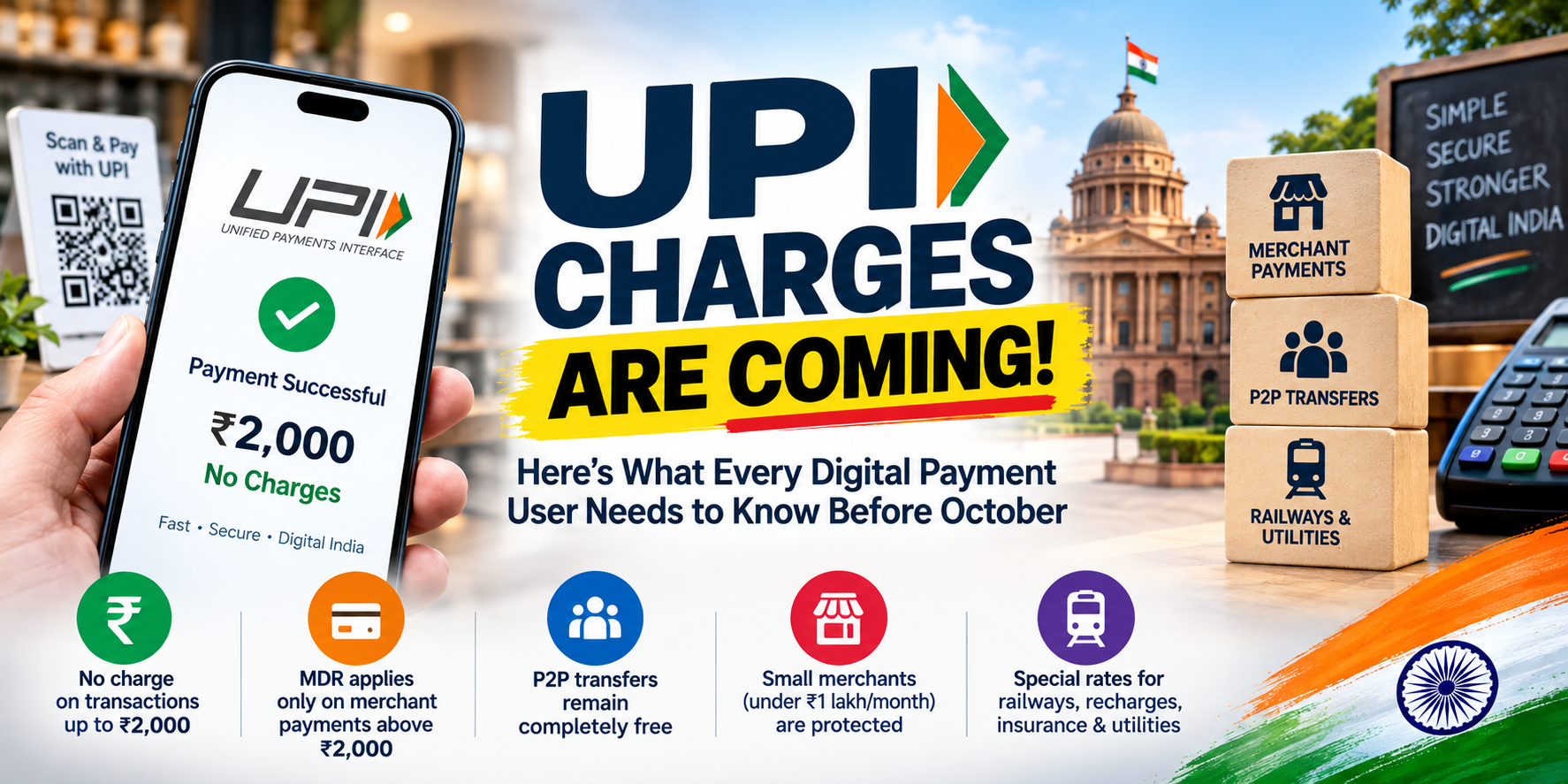
India’s digital payment revolution is entering a new phase. After years of virtually free UPI transactions, a new Merchant Discount Rate (MDR) framework is set to come into effect, bringing charges on certain UPI payments.
But before panic sets in, here’s the most important thing: most users will continue to make UPI payments exactly as they do today, without paying anything extra.
So, who will be charged? When will charges apply? What about Google Pay, PhonePe, Paytm, railway ticket bookings, mutual fund investments, and small shopkeepers?
Let’s break it all down.
The Big Change: UPI Charges Begin on Merchant Payments Above ₹2,000
Under the proposed framework, charges will apply only to Person-to-Merchant (P2M) transactions. This means that when you pay a shopkeeper, restaurant, café, fuel station, or business using UPI, charges may apply if:
✅ Transaction value exceeds ₹2,000
❌ No charge on transactions up to ₹2,000
For example:
1. ₹500 payment to a store: No charge
2. ₹1,500 payment to a merchant: No charge
3. ₹2,000 payment: No charge
4. ₹3,000 payment: Charges applicable
The MDR has been proposed at 0.4% of the transaction value, subject to a cap.
Who Will Actually Pay the Charge?
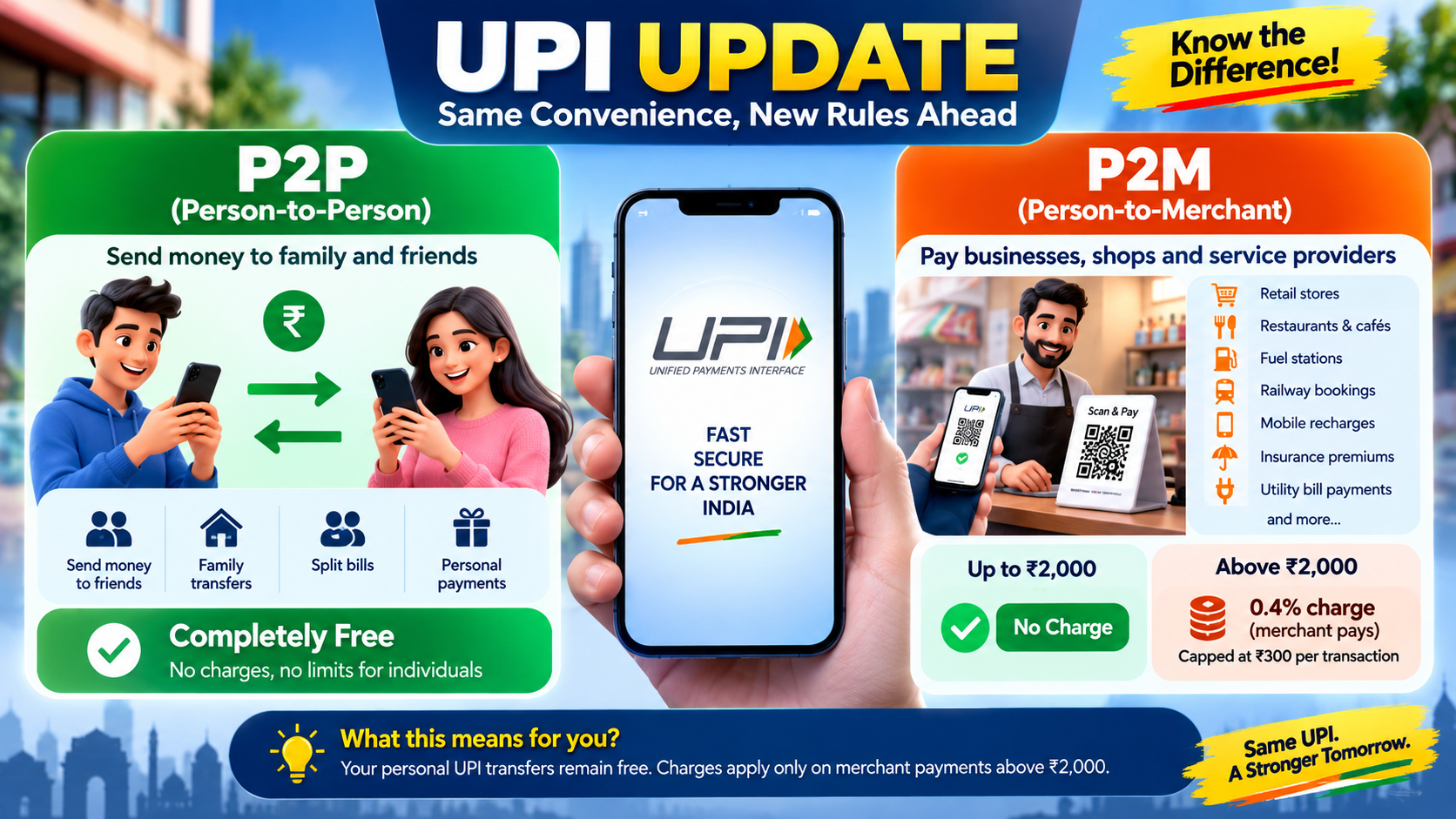
This is where many people are confused. The MDR is officially designed as a merchant charge, not a customer charge. Suppose you make a UPI payment of ₹10,000 at a retail store.
1. MDR at 0.4% = ₹40
2. Customer pays = ₹10,000
3. Merchant receives = ₹9,960
Technically, the fee is deducted from the merchant. However, in the real world, some merchants may try to pass on the cost to customers, similar to how certain businesses add extra charges on card payments.
Whether merchants absorb the cost or transfer it to customers remains to be seen.
Relax! Person-to-Person (P2P) UPI Transfers Remain Completely Free
One of the biggest concerns among users is whether sending money to friends and family will become chargeable.
The answer is simple: No charges whatsoever.
Whether you transfer ₹100, ₹5,000, ₹50,000 or ₹1 lakh to a friend, family member, or any individual, Person-to-Person (P2P) UPI transactions remain free.
So, your daily money transfers, bill sharing, and family payments are safe from MDR charges.
There’s a Maximum Charge Limit Too
The government has also placed a ceiling on MDR charges. Even if the transaction value is very high, the charge on a single transaction cannot exceed ₹300.
Example:
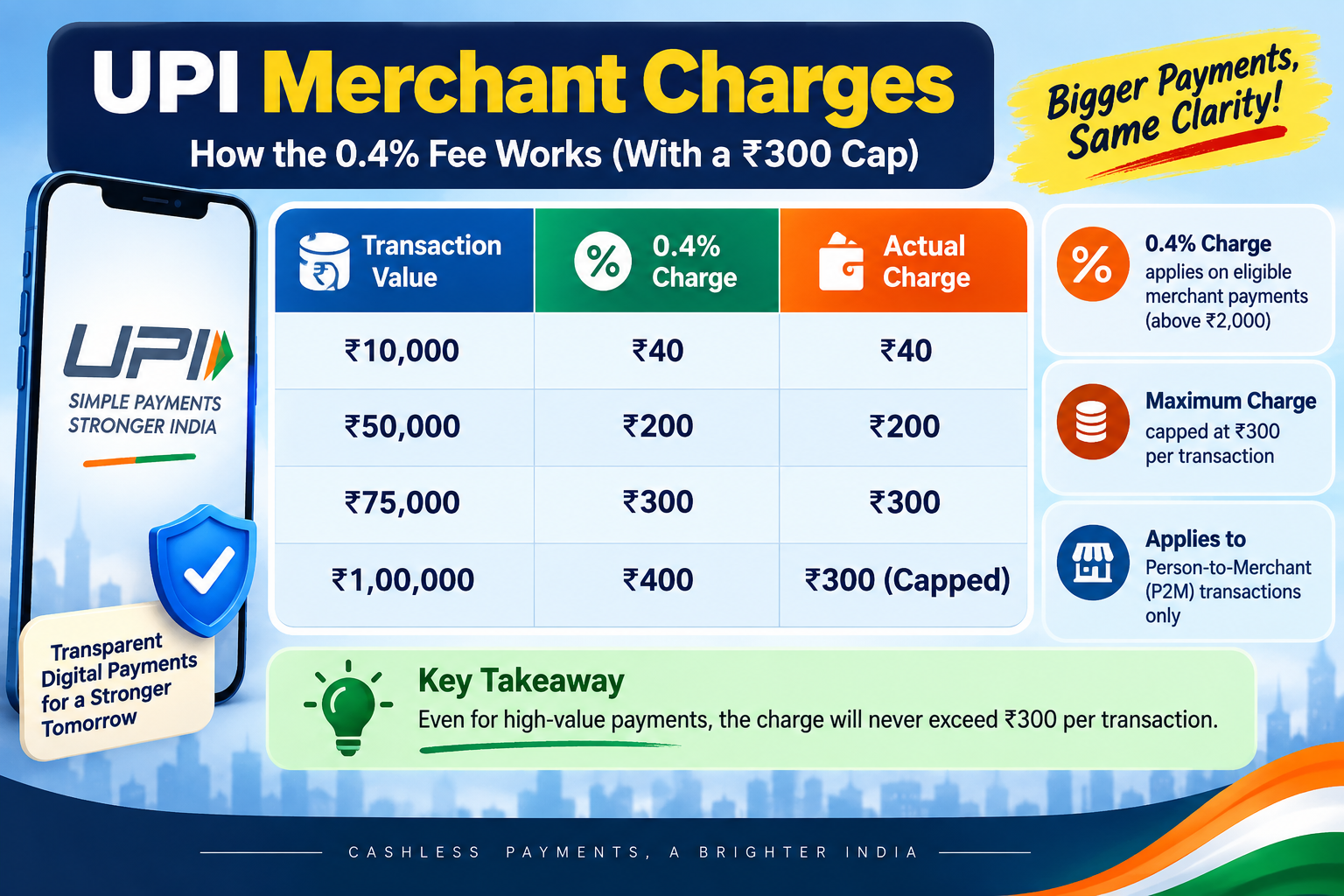
This means no merchant can be charged more than ₹300 per transaction, regardless of payment size.
Will Google Pay, PhonePe, or Paytm Deduct Charges From Your Account?
Another common misconception is that UPI apps themselves will start deducting fees.
The answer is: Absolutely not.
Apps such as Google Pay, PhonePe, Paytm and BHIM will not automatically deduct MDR from your bank account.
The charge applies at the merchant settlement level, not through the UPI application used by consumers.
Good News for Small Shopkeepers
The government has introduced special protection for small merchants.
Businesses whose total monthly UPI transaction volume remains below ₹1 lakh will fall under a protected category.
What Does It Mean?
If a small vendor, tea stall, street seller, local grocery store, or neighbourhood shop processes less than ₹1 lakh in monthly UPI transactions:
✅ No MDR charges
✅ No additional cost burden
Even occasional payments above ₹2,000 won't trigger charges if the merchant remains within the prescribed monthly threshold.
The goal is clear: protect small businesses while allowing larger merchants to contribute to the digital payments ecosystem.
Special Relief for Railways, Mobile Recharges, Insurance & Utilities
Not all industries will face standard MDR rates. Certain sectors have received concessional treatment, including:
1. Railway ticket bookings
2. Telecom payments
3. Insurance premiums
4. Fuel payments
5. Public utility services
For these sectors:
✅No percentage-based MDR
✅Flat charge of ₹5 on transactions above ₹2,000
Example
a) For instance, if you pay a ₹3,500 annual mobile recharge bill via UPI, the transaction would attract only a flat ₹5 charge, rather than the standard percentage-based MDR applicable to regular merchant payments.
b) Similarly, if you use UPI to pay a ₹8,000 insurance premium, the transaction would incur only a ₹5 flat fee, thanks to the concessional rates offered to select sectors such as telecom, insurance, railways, fuel, and public utilities.
That’s a significant relief for consumers and service providers alike.
Mutual Funds & Stock Market Investors Get Special Rates
Investors can breathe easy. Transactions related to capital markets, including:
1. Mutual fund investments
2. Demat account funding
3. Stock market transactions
will attract a much lower MDR of just 0.02%. Even here, the maximum charge remains capped at ₹300.
The rationale is straightforward: investment transactions are highly value-sensitive, and excessive charges could discourage participation in financial markets.
What About UPI AutoPay Subscriptions?
From OTT subscriptions to insurance payments and EMIs, AutoPay has become part of daily life. The current proposal indicates:
✅ No MDR on AutoPay transactions
This means recurring payments for Netflix, Amazon Prime, Insurance policies, Utility bills and EMI payments are expected to remain unaffected.
Why Is the Government Introducing UPI Charges Now?
For years, UPI operated under a near-zero-cost model that fueled explosive growth. Today, UPI handles billions of transactions and has become India's preferred payment method. With over 2,450 crore transactions worth almost ₹30 lakh crore processed in a month, UPI has evolved from a payment tool into the foundation of India's cashless economy.
But maintaining this ecosystem isn’t free. The government argues that costs are involved in:
1. Payment infrastructure
2. Banking networks
3. Cybersecurity
4. Fraud prevention systems
5. Technology upgrades
The new MDR framework aims to make the rapidly expanding UPI ecosystem financially sustainable without burdening the vast majority of users.
95% vs 67%: The Statistic Driving UPI Charges
While over 95% of UPI merchant transactions fall below ₹2,000, the relatively few high-value payments above that limit contribute nearly two-thirds of the total transaction value. That's why the ₹2,000 threshold sits at the center of the new MDR framework.
Will Indians Stop Using UPI?
Probably not.
The biggest reason is convenience.
A few years ago, people relied heavily on cash, cards, and bank transfers. Today, a QR scan can complete a payment in seconds.
Even if some large-value merchant transactions attract fees, UPI remains more affordable than many card-based payment systems, where merchant charges are often considerably higher.
While criticism continues on social media, most experts believe UPI's ease of use and widespread acceptance will keep it firmly at the center of India's payment ecosystem.
The Bottom Line
The headlines may sound alarming, but the reality is far less dramatic.
For most Indians:
✅ Person-to-person transfers remain free
✅ Payments up to ₹2,000 remain free
✅ Small merchants receive protection
✅ Utility, railway, telecom, and insurance sectors get concessional rates
✅ Investment-related transactions enjoy ultra-low charges
In short, the new MDR framework is targeted primarily at larger merchant transactions and is designed to support the long-term sustainability of India's digital payments infrastructure.
🚀 What Do You Think?
Should UPI remain completely free, or is a small charge necessary to sustain India's digital payments ecosystem?
Share your thoughts in the comments, and don't forget to bookmark this article for future reference as the UPI charging framework evolves.
👉 Stay tuned for more breaking updates, fintech insights, and digital economy trends shaping India's future.
Written by
Ishaan TrivediDiscussion (0)
Sign in to join the discussion.
Loading comments…