
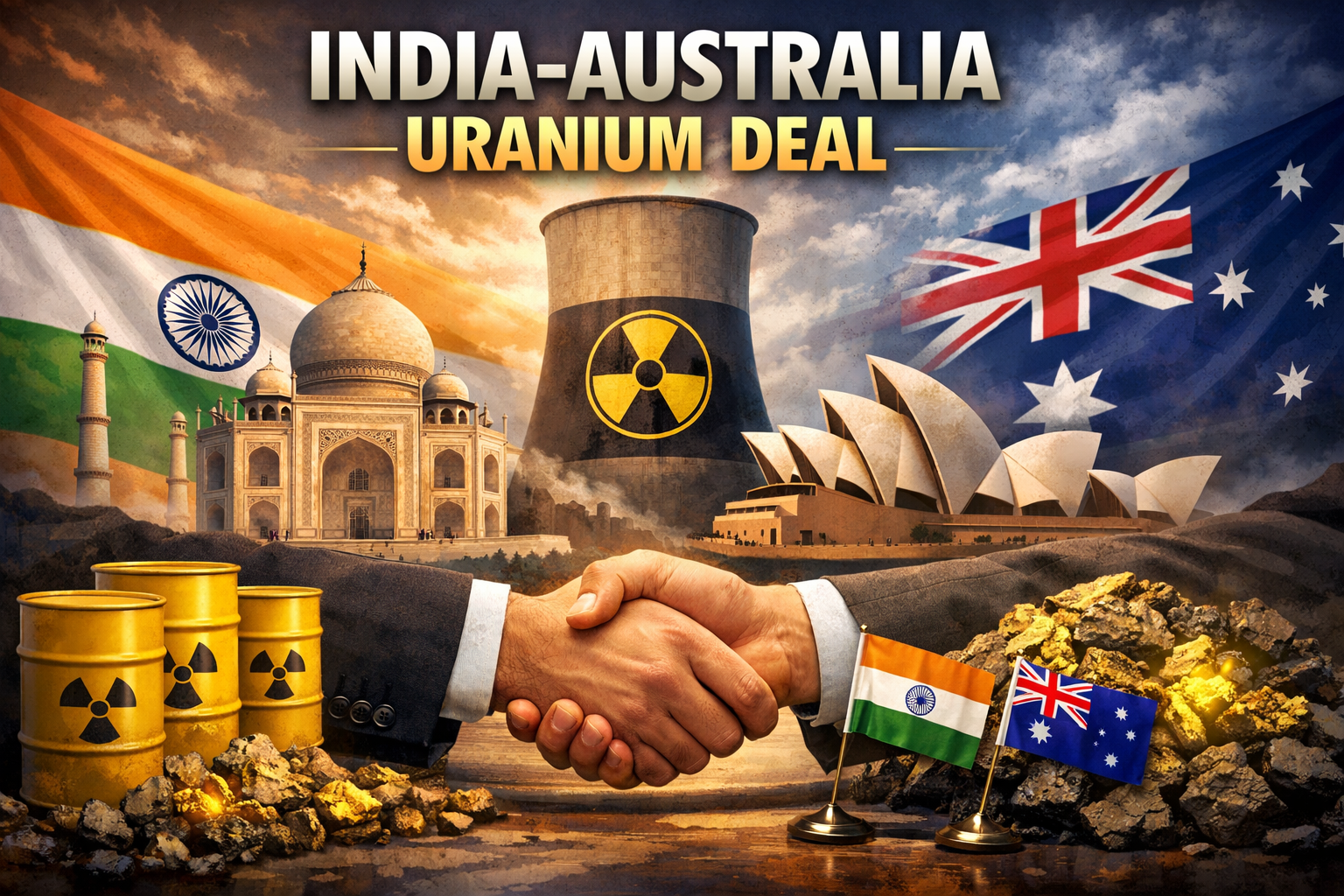
India has just unlocked a historic milestone in its energy journey. During Prime Minister Narendra Modi’s recent visit to Australia, Australian PM Anthony Albanese announced that Australia will finally begin exporting uranium to India — a decision that ends nearly 15 years of hesitation and marks one of the most strategic developments in India–Australia relations.
Why This Deal Matters
Australia is the world’s largest producer of uranium, holding nearly one third of global reserves. Yet, for decades it refused to supply uranium to India because New Delhi is not a signatory to the Nuclear Non-Proliferation Treaty (NPT). That barrier has now been lifted, with Australia officially recognizing India as a responsible nuclear power despite being outside the NPT framework.
This shift is monumental. Uranium is the lifeblood of nuclear energy — a single kilogram of uranium can generate millions of times more energy than coal, with far lower carbon emissions. For a country like India, striving to reduce dependence on fossil fuels, this deal is a leap toward clean, reliable, and scalable energy.
India’s Nuclear Ambition: The Three-Stage Program
India’s long-term nuclear energy roadmap, designed by visionary scientist Homi J. Bhabha, unfolds in three stages:
1. Stage One: Pressurized Heavy Water Reactors (PHWRs)- Natural uranium fuels these reactors, producing electricity and plutonium.
2. Stage Two: Fast Breeder Reactors (FBRs)- Using plutonium and depleted uranium, these reactors generate more fuel than they consume. India’s prototype FBR at Kalpakkam recently achieved criticality — a major milestone.
3. Stage Three: Thorium Reactors- Leveraging India’s vast thorium reserves (especially along Kerala and Tamil Nadu coasts), this stage aims to achieve true energy independence.
With Australia’s uranium supply, India can accelerate Stage One and Stage Two, paving the way for the ultimate thorium revolution.
From Isolation to Integration
India’s nuclear journey hasn’t been easy. After the 1974 Pokhran test and the 1998 declaration as a nuclear weapons state, many Western nations imposed sanctions. Australia, too, kept its distance.
The turning point came in 2008 with the India–US Civil Nuclear Agreement, which ended India’s nuclear isolation. The Nuclear Suppliers Group (NSG) granted India a special waiver, allowing participation in global nuclear commerce despite being outside the NPT. Since then, India has built a strong record of non-proliferation and responsible nuclear conduct — winning global trust.
Geopolitics Behind the Deal
This uranium agreement isn’t just about energy. It’s also about strategy. With China’s assertive rise in the Indo-Pacific, India and Australia share common concerns over freedom of navigation, maritime security, and regional stability. Alongside uranium, the two nations are deepening cooperation in defense, cybersecurity, maritime intelligence, and strategic partnerships.
Australia has even declared India a “top tier security partner.” While the deal doesn’t explicitly target China, it undeniably strengthens India–Australia ties in balancing power across the Indo-Pacific.
Looking Ahead
India currently generates only a small fraction of its electricity from nuclear energy. But the vision is bold, and it’s that by 2047, India aims to install 100 GW of nuclear power capacity. With Australia now joining Kazakhstan, Canada, Russia, Namibia, and Uzbekistan as a key uranium supplier, India’s nuclear expansion looks far more achievable.
The Big Picture
The uranium deal with Australia is more than just an energy agreement — it’s a strategic partnership, a climate solution, and a geopolitical signal. For India, it’s a decisive step toward clean energy independence and a stronger role in the Indo-Pacific.
Written by
Bhavana SharmaDiscussion (0)
Sign in to join the discussion.
Loading comments…