
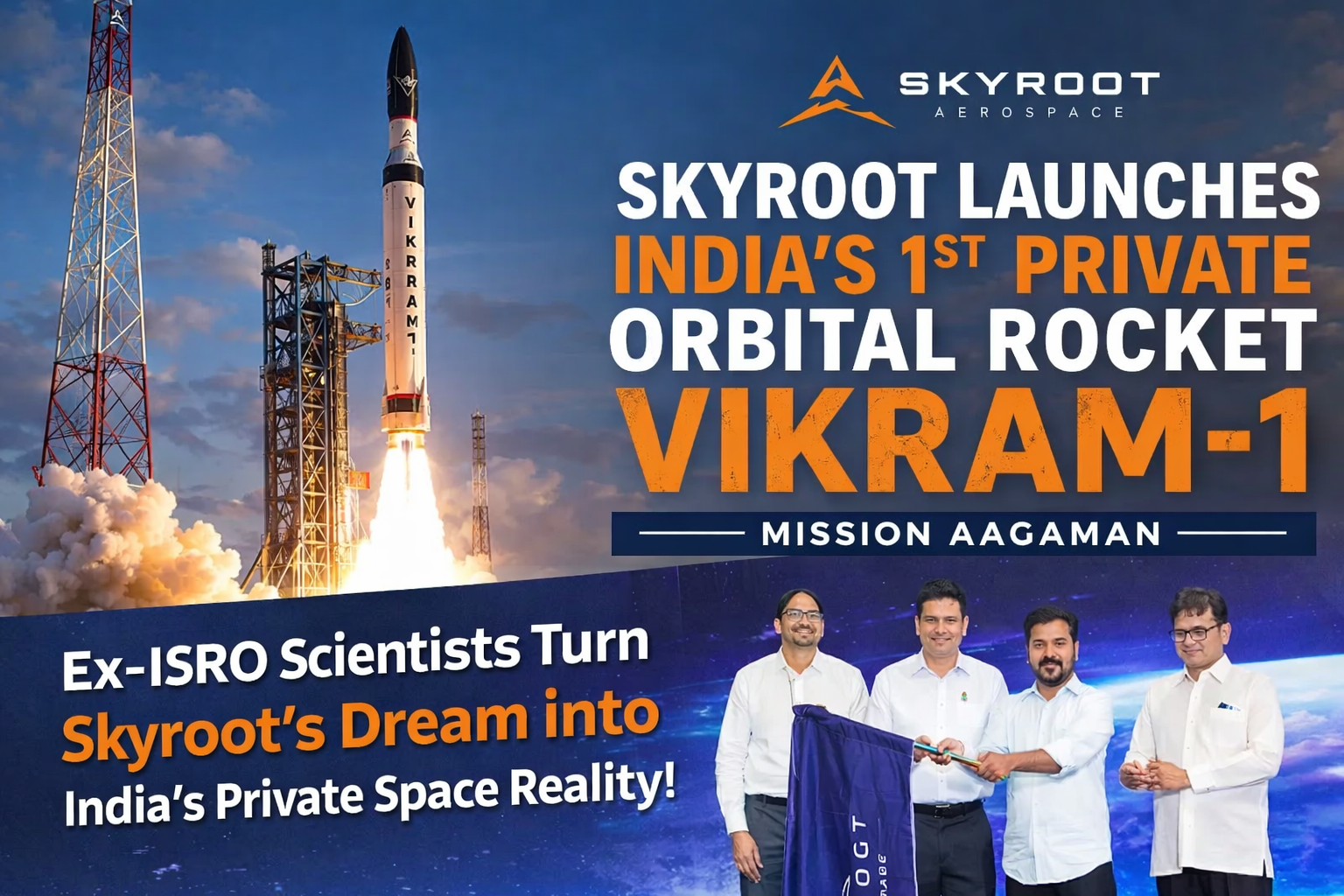
On 18 July 2026, India achieved one of its most important milestones since the establishment of ISRO in 1969. Hyderabad‑based startup Skyroot Aerospace successfully launched Vikram‑1, the nation’s first privately developed orbital launch vehicle, from Sriharikota’s Satish Dhawan Space Centre. The mission, aptly named “Aagaman” (Arrival), signals the arrival of India’s private space industry on the global stage.
Why Vikram‑1 Matters?
For six decades, India’s space program was government‑dominated, with ISRO designing and conducting all launches. But since 2020, reforms opened the sector to private participation, encouraging startups to build rockets, satellites, and offer launch services. Vikram‑1 is the proof of concept that Indian private companies can now place satellites into orbit, just like SpaceX in the US.
About Skyroot Aerospace
Founded in 2018 by former ISRO scientists, Pawan Kumar Chandana (CEO & CTO) and Naga Bharath Daka (COO), who brought their expertise from India’s premier space agency into the private sector. Skyroot Aerospace is headquartered in Hyderabad. With a vision to make space accessible, affordable, and reliable, Skyroot has quickly risen to become India’s first space‑tech unicorn.
Its mission is clear: empower India’s private sector to compete globally in orbital launches.
Importance of Small Satellite Launch Vehicles
Small Satellite Launch Vehicles (SSLVs) are crucial because:
They reduce ISRO’s burden, letting it focus on major missions like Gaganyaan and Chandrayaan.
They enable startups, universities, and private firms to launch satellites for agriculture, IoT, defense, navigation, and Earth observation.
They provide flexibility and affordability for smaller payloads.
Economic Significance of Vikram‑1
Positions India as the third nation (after US & China) to achieve private orbital launches.
Boosts exports, foreign investment, and high‑skilled employment.
Strengthens India’s role in the global space economy, projected to grow rapidly by 2030.
Opens doors for Indian startups to compete in the global launch services market.
Ten Explosive Truths Behind Vikram‑1’s Historic Flight
First Private Orbital Rocket: Vikram‑1 is India’s first privately developed orbital launch vehicle, placing six payloads into low Earth orbit.
Name- Aagaman: “Aagaman” means Arrival. It symbolizes the arrival of India’s private space industry into the global arena. Just as ISRO once marked India’s entry into space, Aagaman marks the arrival of startups into orbital launch services.
Honoring Vikram Sarabhai: The rocket is named after Dr. Vikram Sarabhai, father of India’s space program, reflecting his vision of using space for national development and public benefit. Vikram‑1 reflects that vision by combining public science with private innovation.
Technical Specs: Height: ~22 meters; Diameter: 1.4 meters; Payload capacity: up to 350 kg in low Earth orbit.
Stage Configuration: Three solid stages + one liquid orbital module. The solid stages provide thrust, acceleration, and orbital velocity; the liquid module ensures precise satellite deployment.
Indigenous Innovation: Built with carbon composite structures, lighter and stronger than steel, improving efficiency and payload fraction.
3D‑Printed Engine: Vikram‑1’s engine is 3D‑printed, reducing components, cost, and production time. This is among India’s biggest technological achievements in rocketry.
Advanced Avionics: Equipped with modern flight computers, GPS integration, inertial navigation, and telemetry systems for precision.
Economic Significance: Private launches will ease ISRO’s burden, allowing it to focus on major missions while startups handle small satellites for agriculture, IoT, defense, and navigation.
Global Ambition: India now joins the US and China as the third country to place satellites in orbit via a private company, opening doors to exports, foreign investment, and high‑skilled employment.
Challenges Ahead & Future Roadmap
While Vikram‑1’s success is historic, challenges remain:
Reliability: multiple successful launches are needed to prove consistency.
High launch frequency: to attract international customers.
Cost competitiveness: to rival established players like SpaceX.
Global partnerships: building trust and securing contracts worldwide.
Skyroot’s roadmap includes scaling up launches, enhancing payload capacity, and proving India’s private sector can deliver world‑class orbital services.
Beyond the Horizon
Vikram‑1 is more than a rocket; it’s the arrival of India’s New Space Era, where startups and scientists together propel the nation into a future of innovation and global leadership, and carry forward Sarabhai’s dream of using space technology to benefit the nation.
Written by
Ritvik DeshmukhDiscussion (0)
Sign in to join the discussion.
Loading comments…