
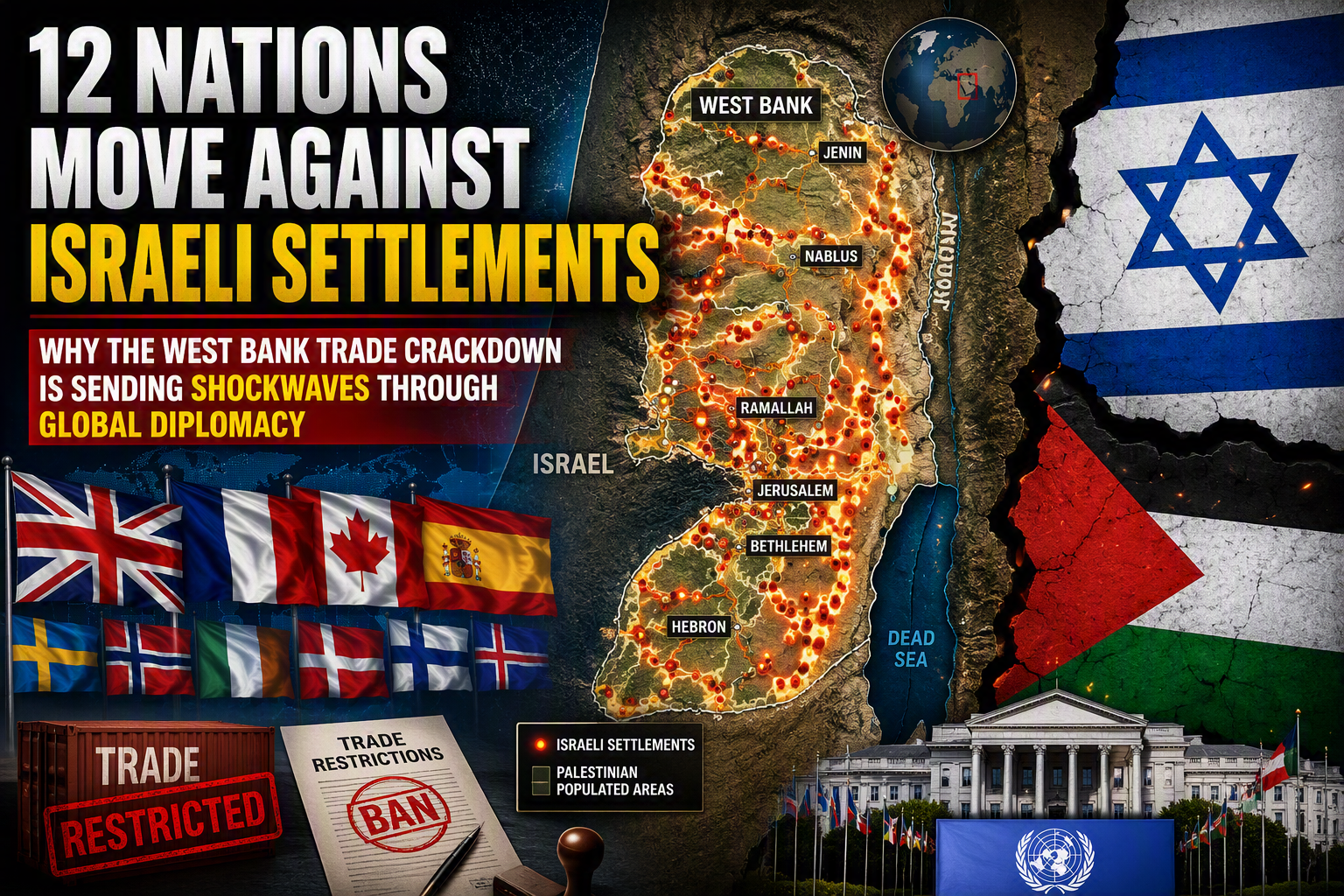
UK, France, Canada and 9 Other Countries Take a Bold Stand as Global Pressure Mounts on West Bank Settlements
A major diplomatic development is reshaping the international conversation around the Israel-Palestine conflict. In a coordinated move, 12 countries including the United Kingdom, France, Canada, Spain, Sweden, Norway, Ireland, Denmark, Finland, Iceland, Poland, and Portugal have announced measures aimed at restricting trade linked specifically to Israeli settlements in the West Bank.
While this is not a boycott of Israel itself, the decision sends one of the strongest political messages yet against the continued expansion of settlements in territories claimed by Palestinians. The move is being seen as a significant challenge to Israeli policies and a fresh effort to preserve hopes for a future Two-State Solution.
What Exactly Happened?
Twelve nations issued a coordinated statement expressing their intention to introduce national restrictions on goods originating from Israeli settlements in the West Bank.
The key point here is important:
✅ Trade with Israel continues.
❌ Trade involving products originating from Israeli settlements in the occupied West Bank faces restrictions and potential bans.
Leading this initiative are the United Kingdom, France, and Canada, countries that have traditionally maintained close ties with Israel. Their active role has surprised many geopolitical observers and signaled growing frustration with settlement expansion.
What Are Israeli Settlements and Why Are They So Controversial?
To understand the controversy, we need to look at history.
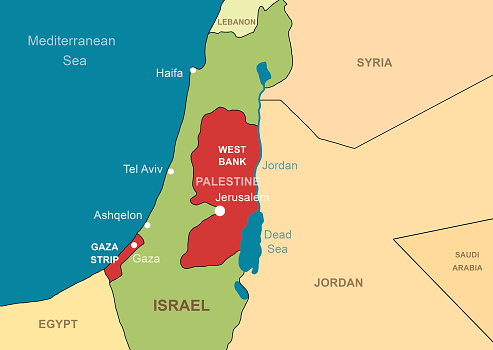
The West Bank, located west of the Jordan River and east of Israel, came under Israeli control after the 1967 Six-Day War, when Israel captured the territory from Jordan.
Since then, Israel has established numerous Jewish settlements across the region. Today:
More than 260 settlements exist across the West Bank and East Jerusalem.
Hundreds of thousands of Israeli settlers live in these areas.
Many countries and international organizations consider these settlements illegal under international law.
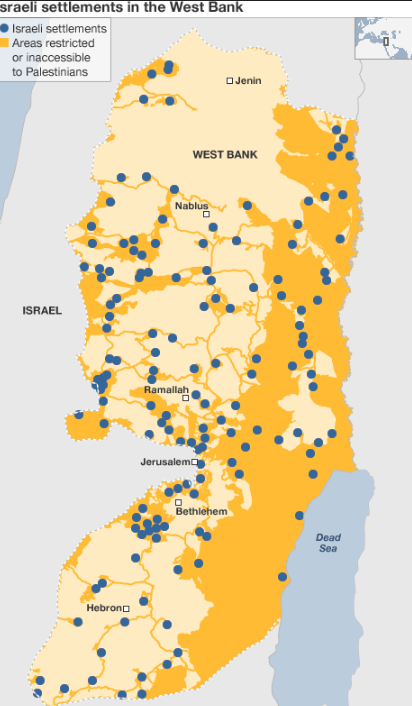
Critics argue that these settlements alter the demographic and territorial realities of the region, making a future Palestinian state increasingly difficult to establish.
Why International Law Remains at the Center of the Debate
Much of the opposition to Israeli settlements stems from interpretations of the Fourth Geneva Convention, which many governments and legal experts cite when arguing that an occupying power should not transfer its civilian population into occupied territory.
As a result, a significant portion of the international community views the settlements as inconsistent with international legal norms.
Israel, however, disputes several legal interpretations and argues that security concerns, historical ties, and strategic considerations justify its policies.
How Settlements Impact the Two-State Solution
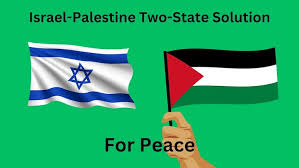
The concept of a Two-State Solution envisions:
An independent State of Israel.
An independent State of Palestine.
For this model to work, clear and contiguous borders are generally considered essential.
The challenge, according to settlement critics, is that West Bank territory has become increasingly fragmented due to expanding settlement blocs, roads, and security arrangements.
As settlements grow, Palestinian-controlled areas become more disconnected, making future border negotiations far more complicated.
This is one of the main reasons many Western countries are becoming increasingly vocal about settlement expansion.
The E1 Project: Why the World Is Watching Closely
One of the most controversial developments is the proposed E1 Settlement Project, located near East Jerusalem.
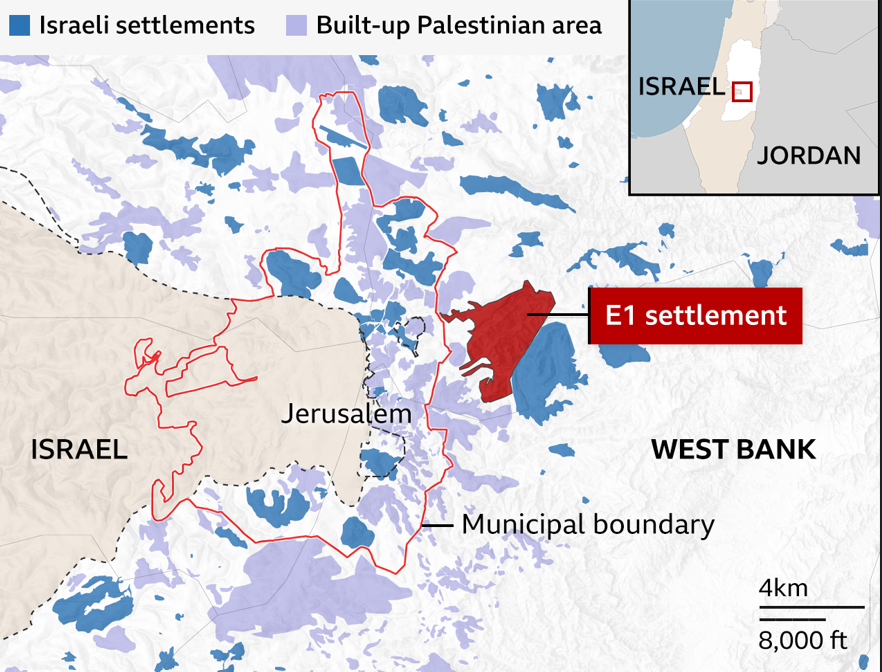
The project involves plans for large-scale housing construction, which critics claim could:
Further divide Palestinian territories.
Complicate territorial continuity between East Jerusalem and the rest of the West Bank.
Make future peace negotiations significantly harder.
Several countries supporting trade restrictions have specifically cited concerns over projects such as E1, describing them as obstacles to long-term peace efforts.
Why Are the UK, France, and Canada Leading the Push?
The involvement of these three countries is particularly notable because they have historically enjoyed close diplomatic relations with Israel.
United Kingdom
Britain has adopted an increasingly firm stance on settlement activities and has announced measures targeting goods linked to settlements. It has also discussed sanctions against individuals and entities associated with settlement expansion.
France
French officials have repeatedly warned that growing settlement activity and settler-related violence are increasing instability across the West Bank.
Canada
Canada's shift is especially significant. Traditionally seen as one of Israel's closest partners among Western nations, Ottawa has moved beyond rhetorical criticism and is now supporting stronger policy actions.
Which Products Could Be Affected?
Most goods linked to settlement areas fall into categories such as:
Dates
Citrus fruits
Herbs
Wine
Other agricultural products
Manufactured products produced in settlement industrial areas.
Analysts believe the direct economic impact may be relatively limited. However, the political and diplomatic impact is enormous.
The restrictions send a clear signal that a growing number of countries are distinguishing between Israel and territories occupied since 1967.
Why Not Sanction Israel Directly?
This is one of the most frequently asked questions. Western governments appear to be pursuing a balancing strategy:
Objective 1:
Increase pressure on Israel to halt or slow settlement expansion.
Objective 2:
Maintain broader diplomatic, economic, and security relations with Israel. Many Western capitals continue to support Israel's right to security while simultaneously opposing settlement growth in Palestinian territories. The current measures attempt to draw a line between those two positions.
Israel's Strong Response
Israel has reacted sharply to the latest developments. Israeli officials have accused some governments of interfering in Israeli affairs and have warned of diplomatic consequences. Tensions have risen particularly with the United Kingdom, where disagreements over settlement policy have become increasingly public. What began as a trade-related dispute is now evolving into a broader diplomatic confrontation.
Where Does the United States Stand?
The United States remains one of Israel's strongest allies. Washington has expressed scepticism regarding whether trade restrictions on settlements will meaningfully alter Israeli policy. U.S. officials generally argue that diplomatic engagement, rather than economic pressure, offers a more productive path to resolving disputes. This divergence highlights a growing difference in approach between parts of Europe and the United States.
Why the European Union Isn't Fully United
Although several European countries support stronger action, the European Union has not adopted a completely unified position.
The reason is simple:
Some EU member states favour tougher measures against settlement expansion.
Others maintain closer relations with Israel and oppose additional restrictions.
As a result, national governments are increasingly taking independent actions rather than waiting for an EU-wide consensus.
The International Court of Justice Factor
Adding another dimension to the debate, the International Court of Justice (ICJ) issued an advisory opinion in 2024 questioning the legality of Israel's continuing occupation policies in Palestinian territories.
While advisory opinions are not automatically enforceable, they have strengthened calls among some governments for greater diplomatic and economic pressure regarding settlement activities.
What This Means for the Future
The move by 12 nations may not dramatically damage Israel's economy, but it marks a major shift in international diplomacy. The message is clear:
Many of Israel's traditional partners are increasingly separating their support for Israel's security from their opposition to settlement expansion in the West Bank.
As geopolitical tensions continue to rise, these measures could influence future peace negotiations, international trade policies, and the broader debate over the future of both Israel and Palestine.
🚨 The Bottom Line
The decision by 12 countries to target trade linked to Israeli settlements is about far more than commerce. It is a powerful diplomatic statement about borders, sovereignty, international law, and the future of the Israel-Palestine conflict.
Whether this pressure changes realities on the ground remains uncertain, but one thing is clear: The global conversation on Israeli settlements has entered a new and far more consequential phase.
📢Stay Ahead of Global Geopolitics
Want deep, simplified, and unbiased analysis of the world's biggest geopolitical developments?
👉 Follow our blog for expert breakdowns, global conflict insights, diplomacy updates, and international affairs explained in a simplified way.
🔔 Subscribe now and never miss the stories shaping the future of global politics.
Written by
Samar PrakashDiscussion (0)
Sign in to join the discussion.
Loading comments…