
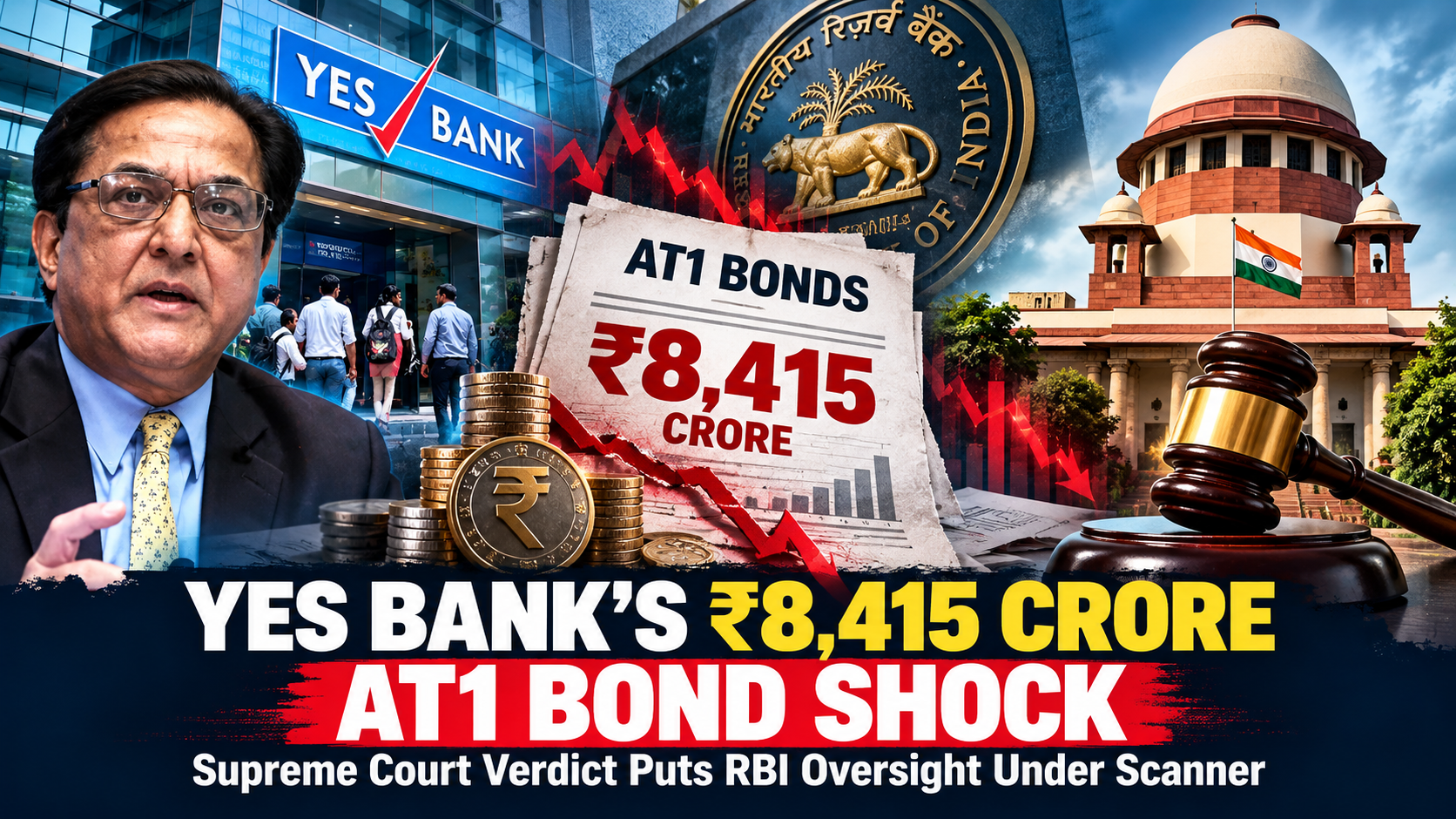
A Landmark Verdict Reignites the Yes Bank Crisis
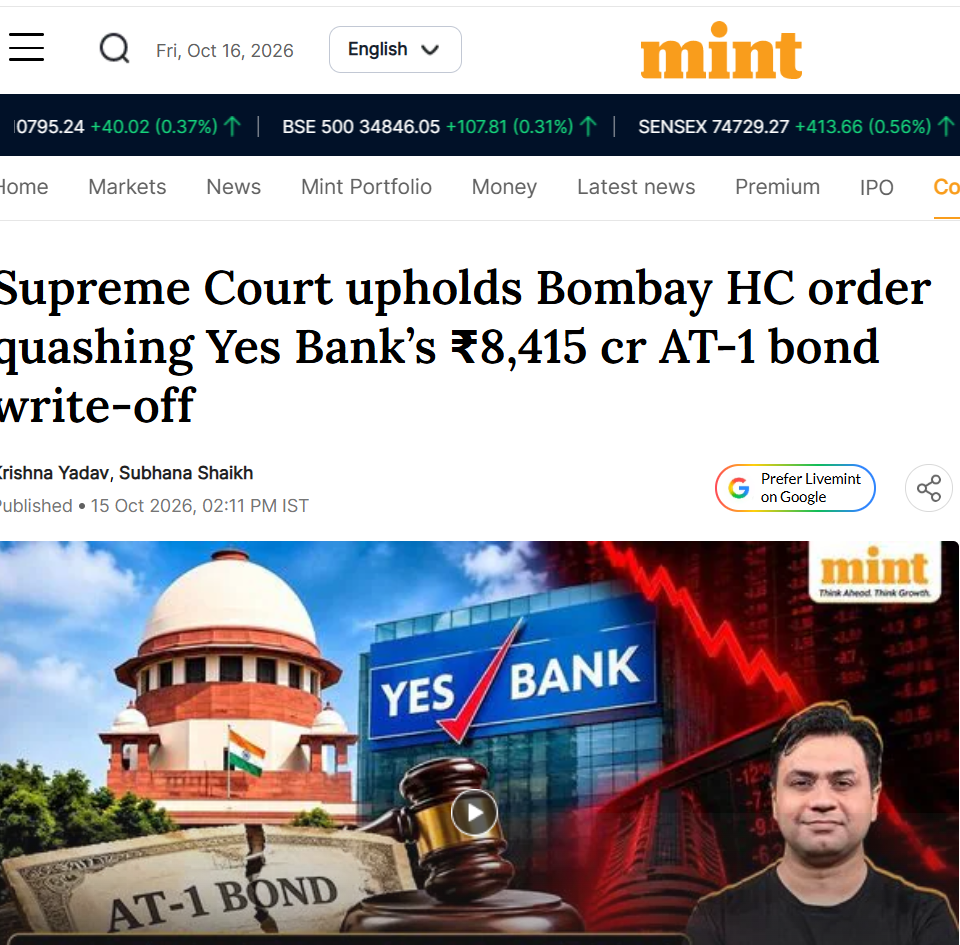
Six years after Yes Bank was dramatically rescued from the brink of collapse, the crisis has returned to the spotlight. In a major judgment, the Supreme Court has upheld the Bombay High Court's ruling that the write-off of ₹8,415 crore worth of Additional Tier-1 (AT1) bonds during Yes Bank's 2020 rescue was illegal.
The verdict has sent shockwaves through financial markets, triggering a sharp fall in Yes Bank's shares and raising serious questions about banking regulations, investor protection, and the role of the Reserve Bank of India (RBI).
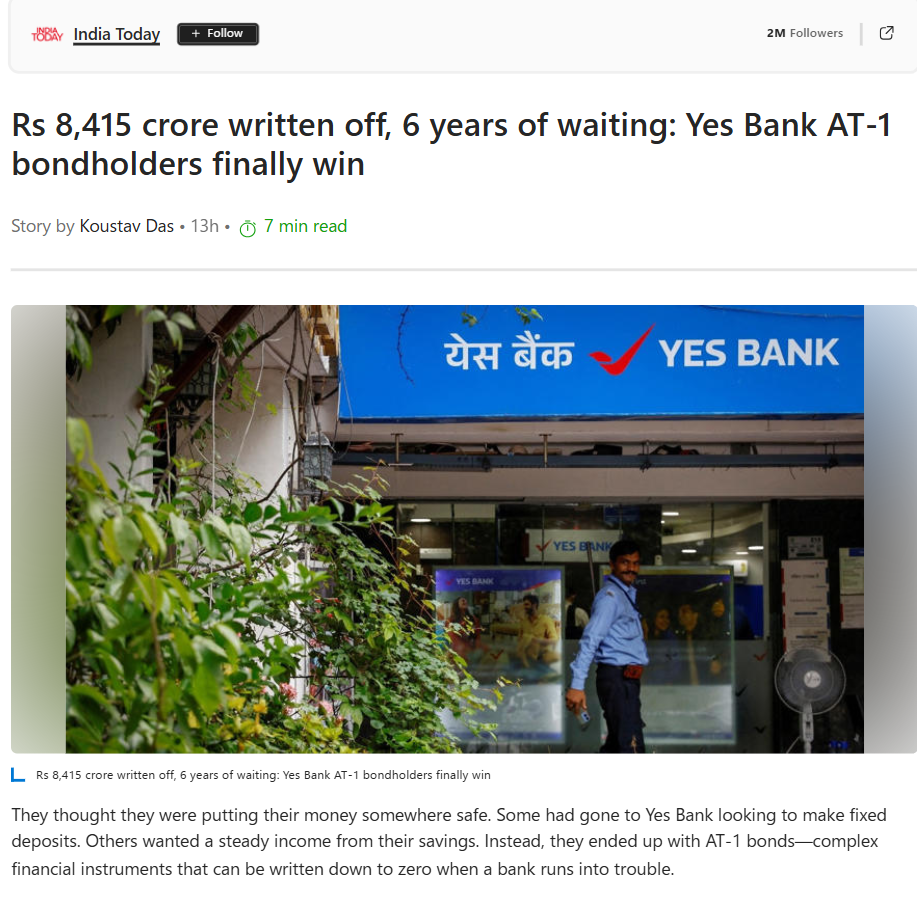
For thousands of investors who saw their investments wiped out overnight during the bank's rescue, the ruling marks a potentially historic victory.
Flashback: When Yes Bank Was on the Verge of Collapse
Back in early 2020, India was preparing for the COVID-19 pandemic and nationwide lockdowns. At the same time, another crisis was unfolding in the banking sector.
Yes Bank, once celebrated as one of India's fastest-growing private sector banks, was facing severe financial stress. Concerns over poor asset quality, questionable lending practices, stressed loans, and governance issues had begun to erode confidence in the bank.
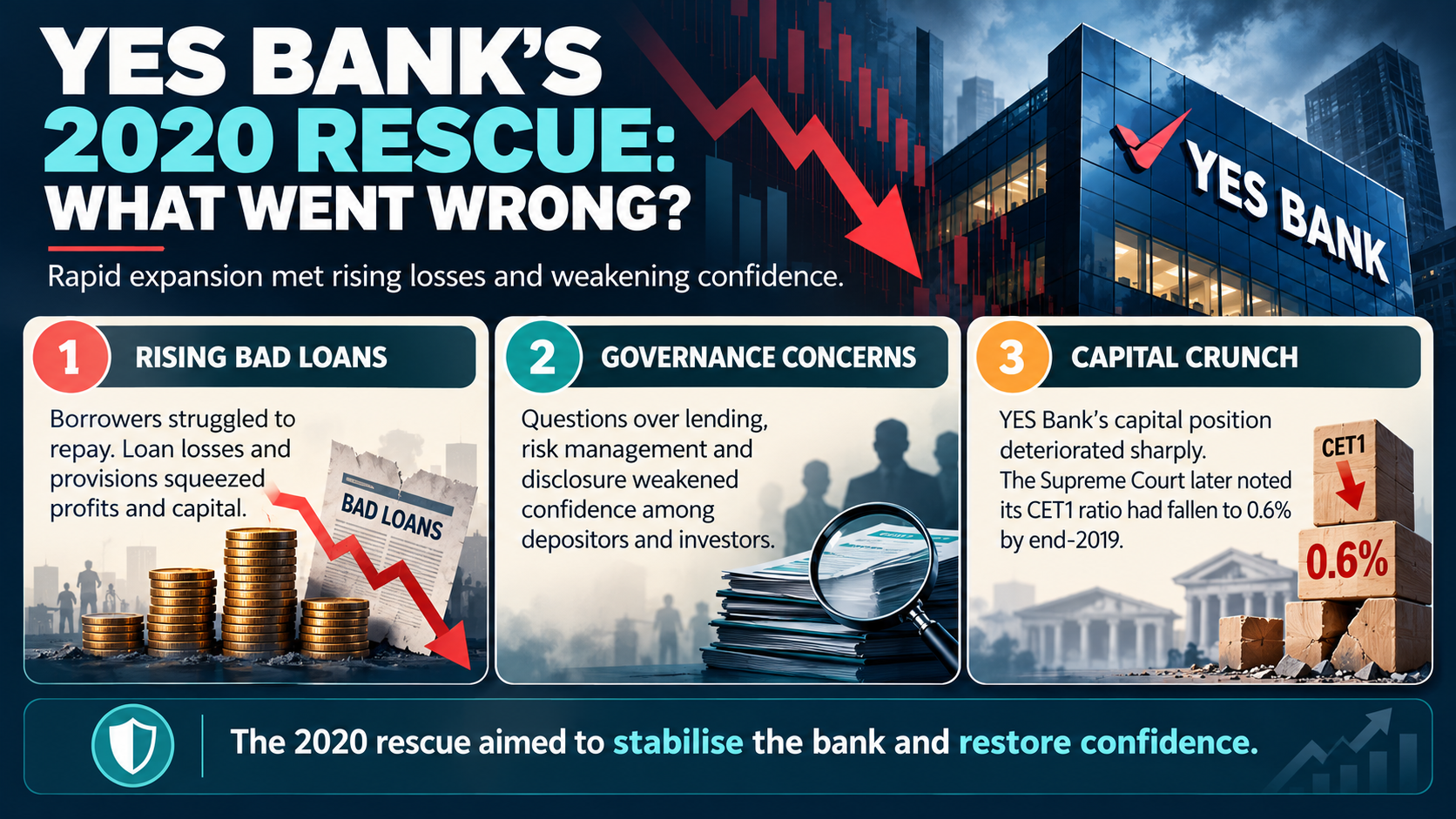
Investigations and allegations involving the bank's founder, Rana Kapoor, further intensified scrutiny. As bad loans mounted and capital levels deteriorated, fears grew that the bank could fail.
The situation became so severe that RBI had to step in.
The Emergency Rescue Plan
In March 2020, RBI unveiled a reconstruction scheme to prevent a banking catastrophe. Major institutions such as SBI and LIC were brought in to inject capital and stabilize the bank. The move was aimed at restoring confidence and protecting depositors.
At one point, withdrawal restrictions were imposed on customers, creating panic among account holders who feared for their savings. Eventually, the rescue succeeded, and depositors regained full access to their money.
But one critical question remained unresolved: “Who would absorb the losses? Would it be shareholders, the financial system, taxpayers, or bondholders?’’
That is where AT1 bonds entered the spotlight.
What Are AT1 Bonds and Why Are They So Controversial?
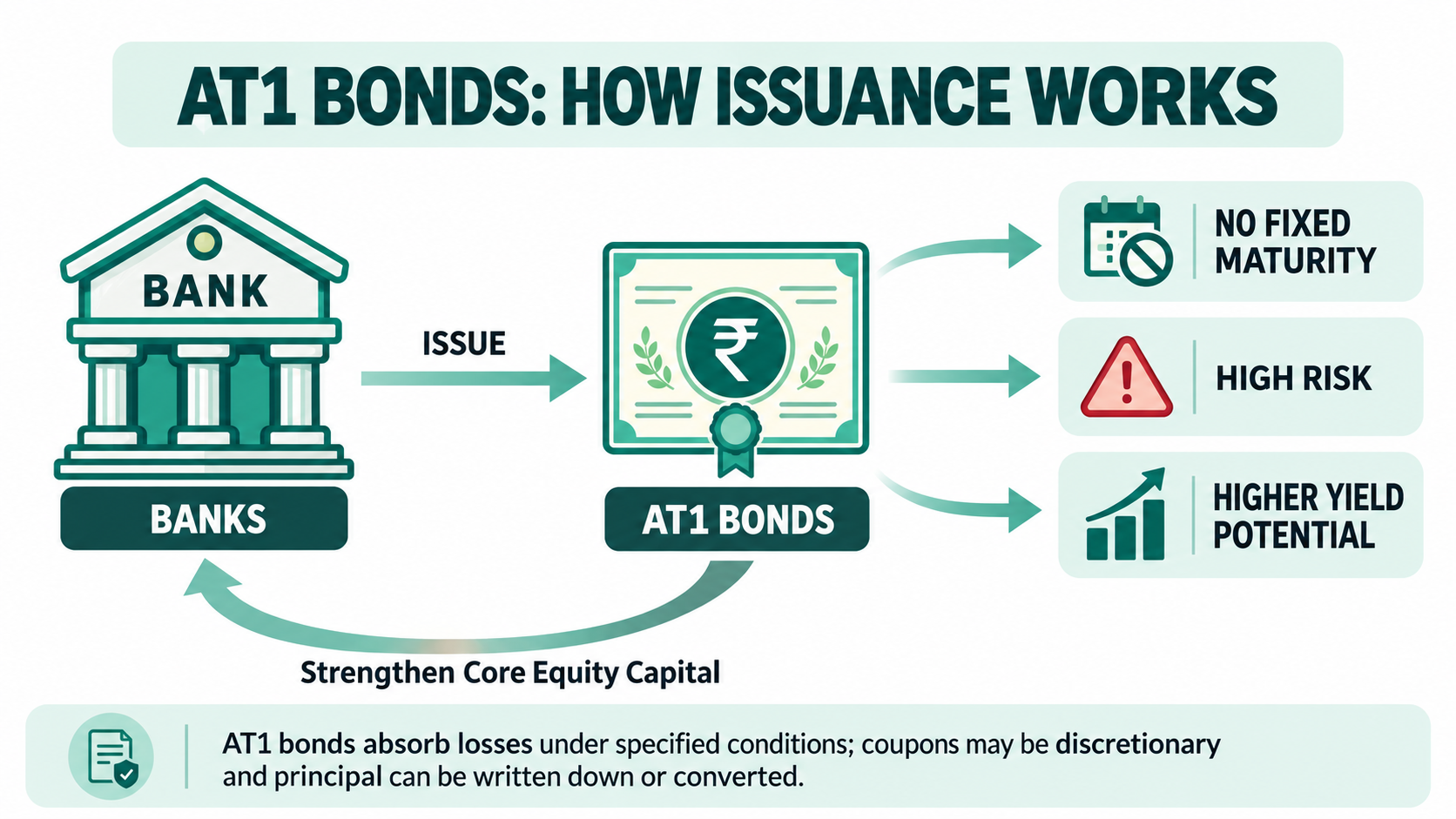
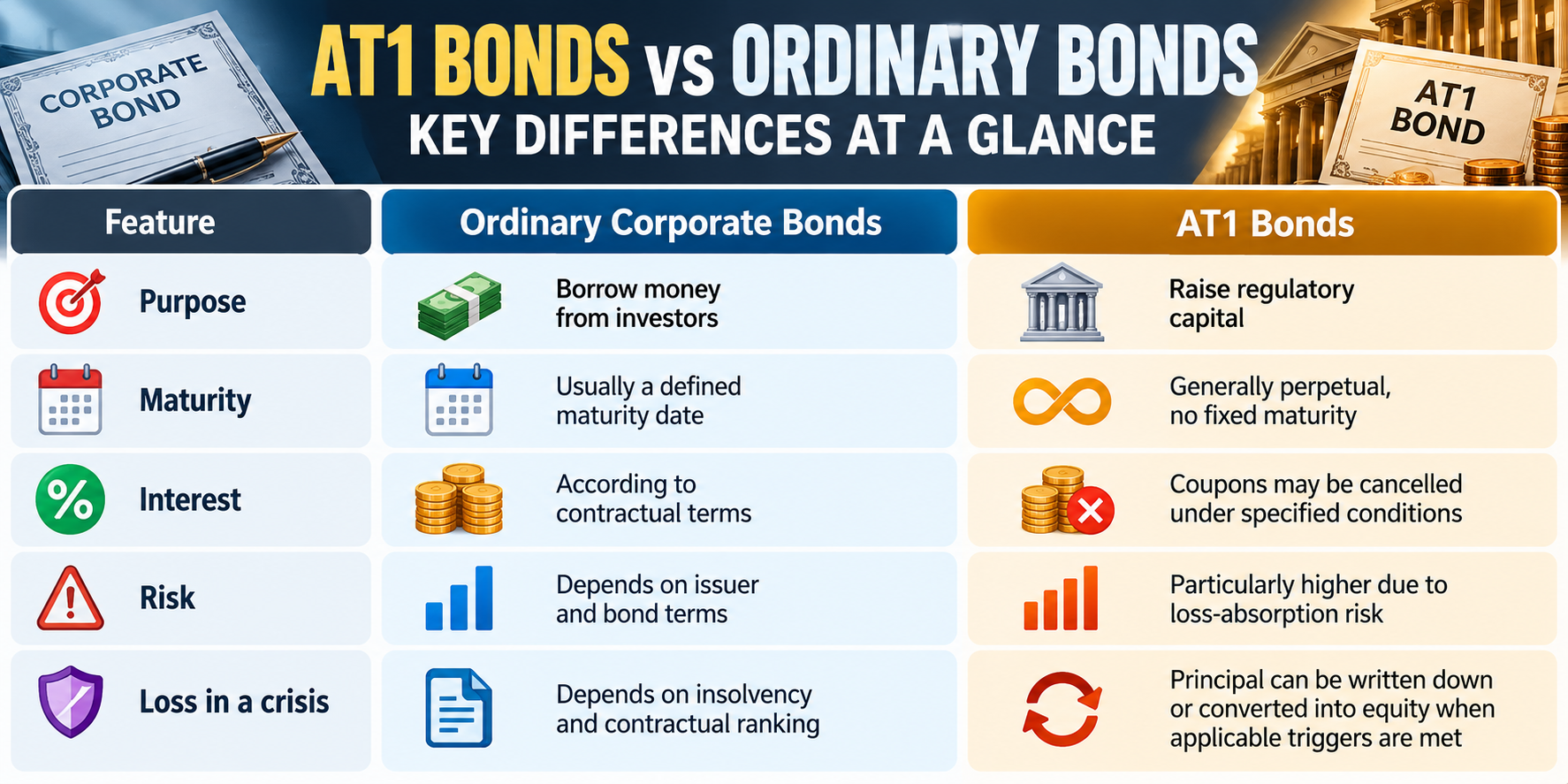
Additional Tier-1 (AT1) bonds are special financial instruments issued by banks to strengthen their capital base. Unlike traditional bonds, they come with significantly higher risks.
A regular bond may offer a fixed return of 6% to 7% annually. AT1 bonds generally offer much higher returns because investors take on greater risk.
The catch? If a bank faces severe financial stress, AT1 bonds can be:
1. Written off entirely
2. Converted into equity shares
3. Used to absorb losses before depositors are affected
In simple terms, investors earn higher returns because they accept the possibility of losing their entire principal amount during a crisis. This makes AT1 bonds one of the riskiest debt instruments in the banking sector.
Why Was Yes Bank in Trouble?
One of the biggest indicators of a bank's health is its capital adequacy ratio. Under Basel III norms, banks are required to maintain a minimum capital buffer against risk-weighted assets. Tier-1 capital is particularly important because it acts as the first line of defense during financial stress.
According to observations mentioned during the legal proceedings, Yes Bank's Common Equity Tier-1 (CET1) ratio had plunged to around 0.6% in 2020. To understand the severity:
1. Healthy banks are expected to maintain substantially higher capital levels.
2. A CET1 ratio of just 0.6% signals an extreme capital shortage.
With capital rapidly eroding, the bank was losing its ability to absorb losses and continue operations normally. This prompted the emergency intervention by RBI and the government.
📊 Basel III Explained: The Safety Rules Designed to Prevent Another Banking Crisis
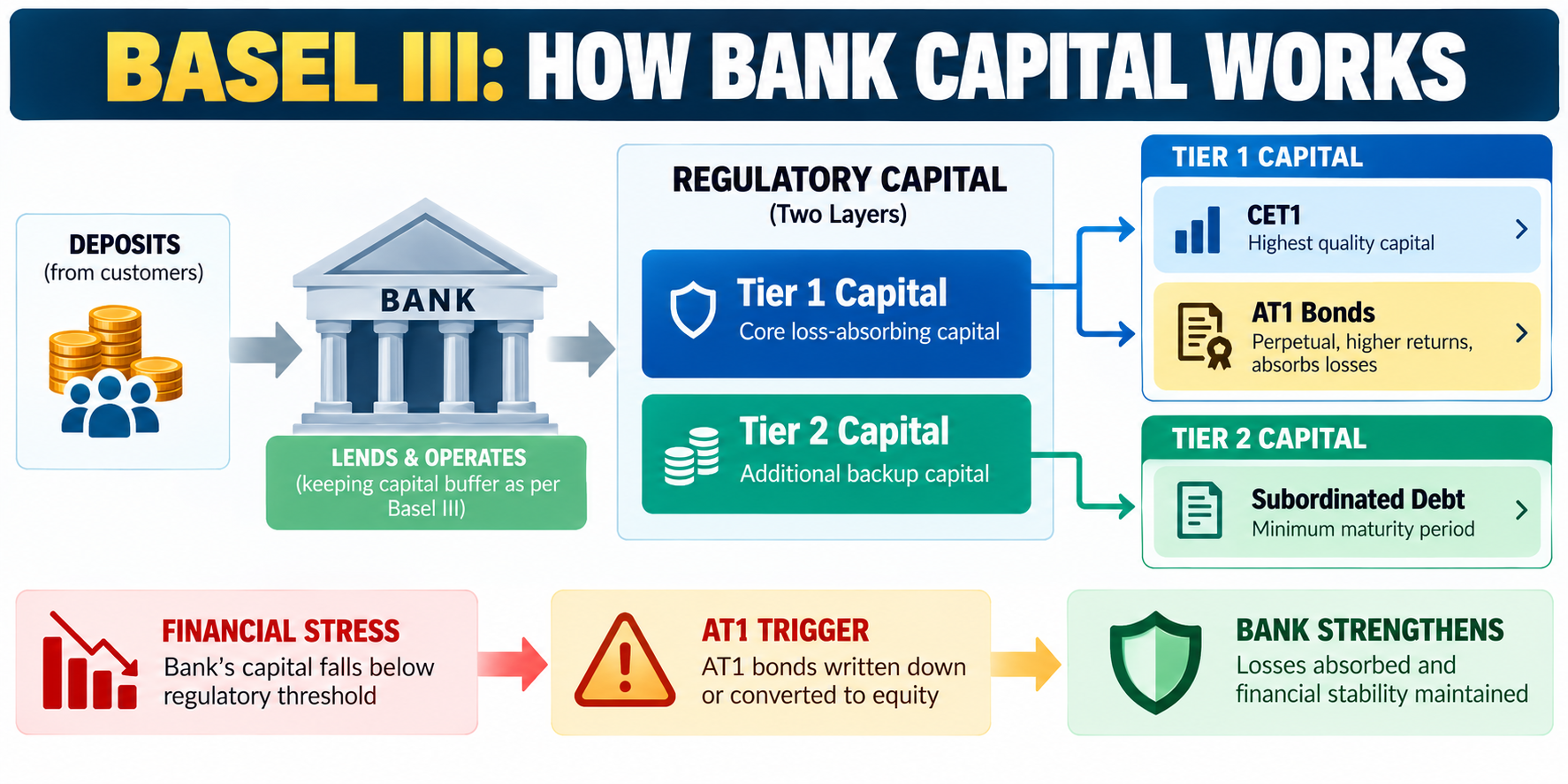
Basel III is a global banking framework introduced after the 2008 financial meltdown to make banks safer, better capitalized, and more resilient during economic shocks.
Under these rules, banks must maintain sufficient capital buffers instead of lending out most of the money they receive from depositors. The objective is simple: ensure banks can absorb losses without collapsing.
How Bank Capital Is Structured
Basel III divides a bank's regulatory capital into two layers:
a) Tier 1 Capital: The core financial cushion used to absorb losses.
b) Tier 2 Capital: Additional backup capital that supports financial stability.
Tier 1 capital is further split into:
✅ Common Equity Tier 1 (CET1)
The highest-quality capital, consisting mainly of ordinary shares and retained earnings. Investor returns largely depend on the bank's financial performance.
✅ Additional Tier 1 (AT1) Capital
A special category of perpetual bonds that helps banks raise capital while offering higher returns to investors in exchange for higher risk.
Why AT1 Bonds Are Different
Unlike traditional bonds:
a) They do not have a fixed maturity date.
b) Interest payments can be suspended under certain conditions.
c) They are designed to absorb losses when a bank faces severe financial stress.
What Is Tier 2 Capital?
Tier 2 capital typically consists of subordinated debt instruments with a minimum maturity period, providing an additional layer of protection beyond Tier 1 capital.
⚠️ The Critical Basel III Trigger
If a bank's core capital falls below prescribed regulatory thresholds, AT1 bonds may be written down or converted into equity to strengthen the bank's financial position and protect the broader banking system.
This mechanism makes AT1 bonds attractive for higher returns but also significantly riskier than conventional debt investments.
The ₹8,415 Crore Question
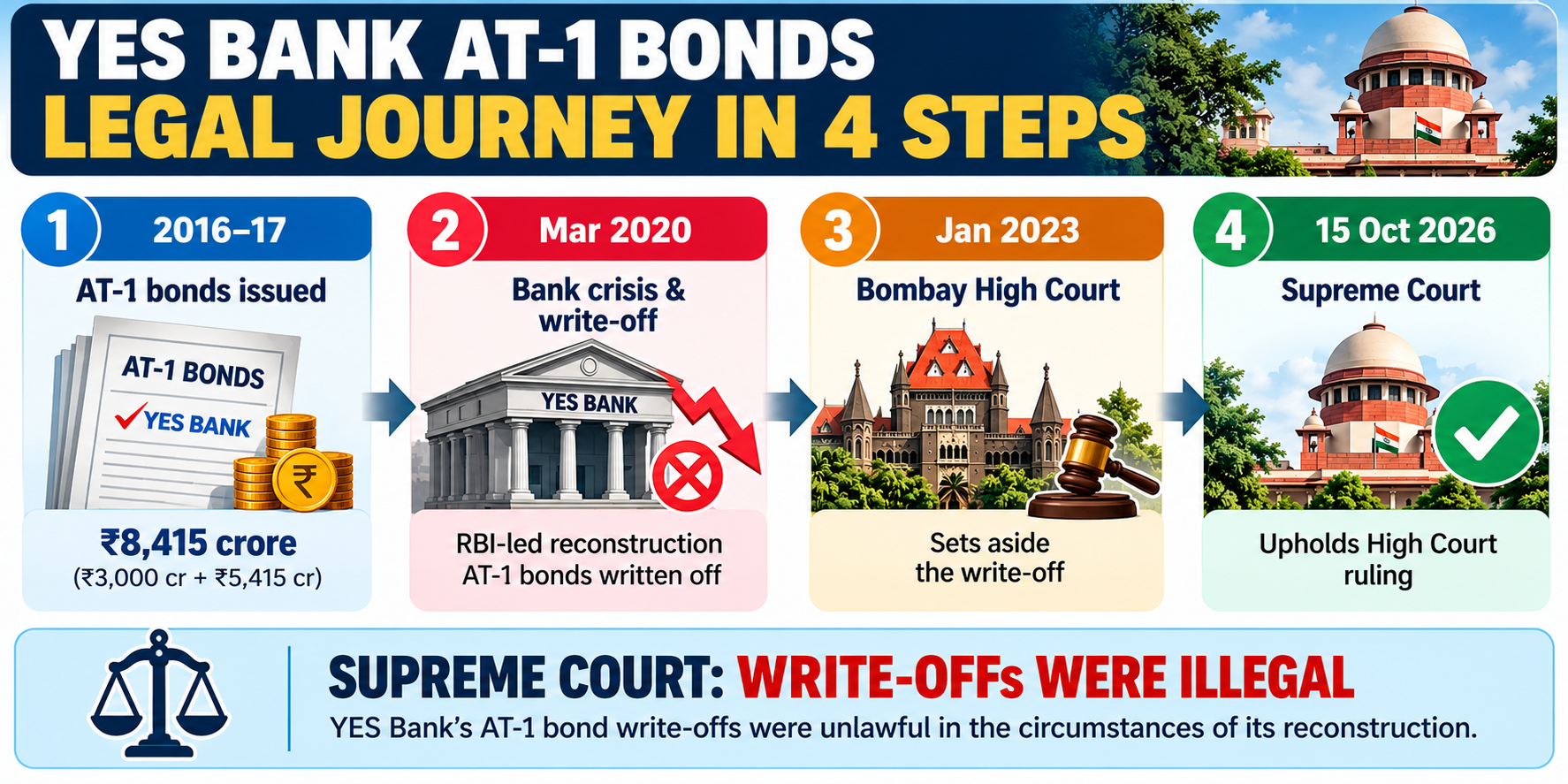
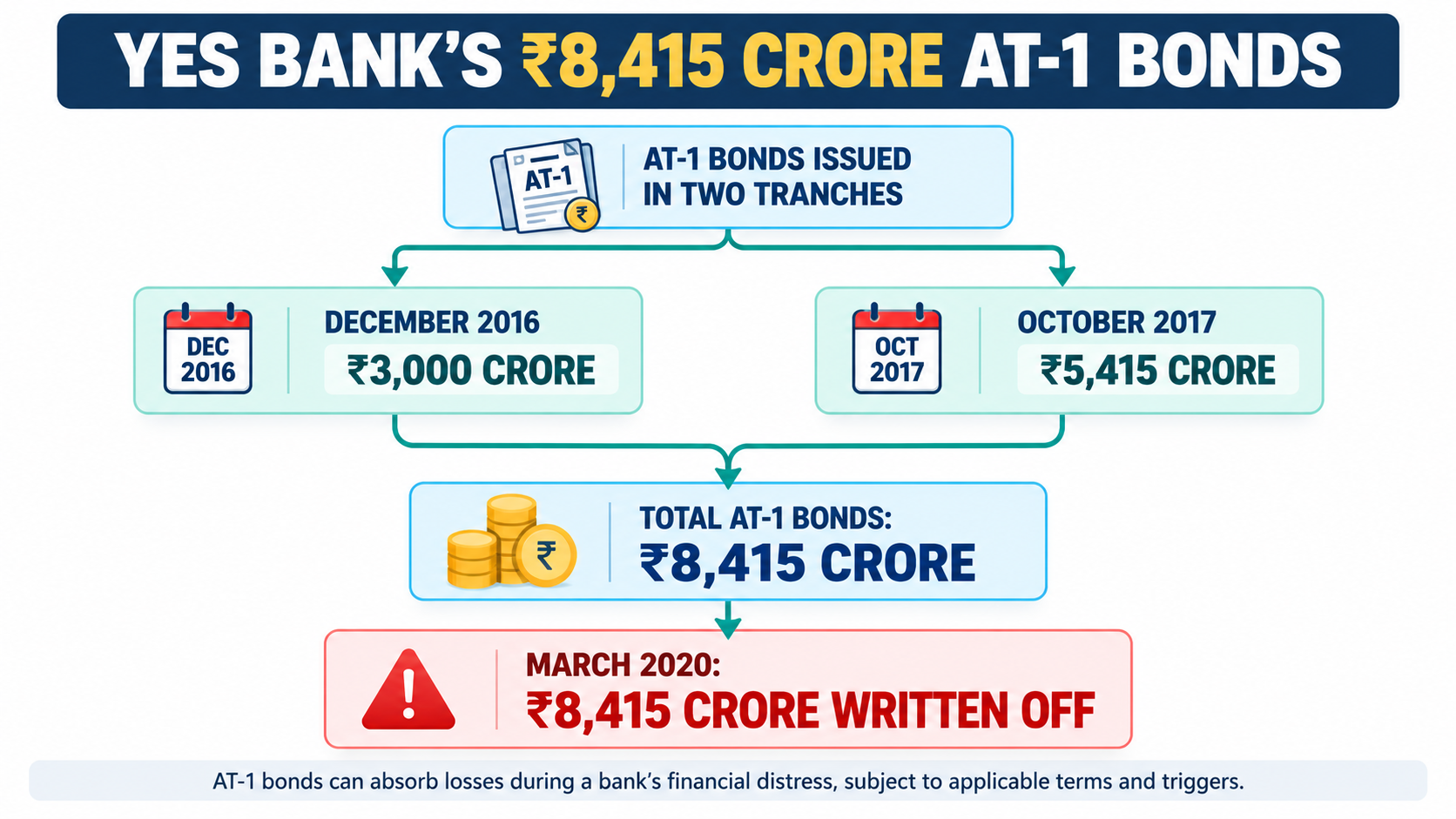
Between 2016 and 2017, Yes Bank issued AT1 bonds worth a total of ₹8,415 crore. Thousands of investors purchased these instruments, attracted by their relatively high returns.
However, during the 2020 rescue, Yes Bank wrote off the entire AT1 bond amount. The impact was devastating.
Many investors saw their investments reduced to zero overnight. Naturally, bondholders challenged the move in court.
What Did the Bondholders Argue?
Interestingly, investors did not primarily argue that AT1 bonds could never be written off.
Instead, their key argument focused on procedure. According to bondholders, the final reconstruction scheme approved during the rescue did not explicitly mention that AT1 bonds would be completely written off.
Their argument was straightforward: “If the authorities intended to eliminate ₹8,415 crore of investor money, that decision should have been clearly included in the reconstruction plan itself.”
Since it was not, they claimed the write-off lacked legal backing.
What Did the Courts Decide?
In January 2023, the Bombay High Court ruled in favour of the bondholders and declared the write-off illegal. The matter was subsequently challenged by Yes Bank, RBI, and the Union Government before the Supreme Court.
Now, the Supreme Court has upheld the Bombay High Court's decision. The Court's position is particularly significant.
It did not say that AT1 bonds can never be written off. Instead, it emphasized that such actions must follow the proper legal process.
According to the judgment, if the write-off had been explicitly incorporated into the reconstruction scheme, the situation might have been different.
The problem was not necessarily the write-off itself. The problem was the procedure followed.
RBI Faces Tough Questions
The ruling has also placed RBI under the scanner. The Supreme Court reportedly questioned why the regulator did not object when the write-off was carried out without following the appropriate procedural framework.
As India's banking regulator, RBI's responsibilities include:
1. Supervising banks
2. Maintaining financial stability
3. Ensuring regulatory compliance
4. Protecting confidence in the banking system
According to some financial analysts and legal experts, more proactive supervision by the RBI during the restructuring process could have reduced the risk of subsequent legal challenges.
The judgment therefore extends beyond Yes Bank and touches upon broader issues of regulatory accountability.
Why Did Yes Bank Shares Crash?
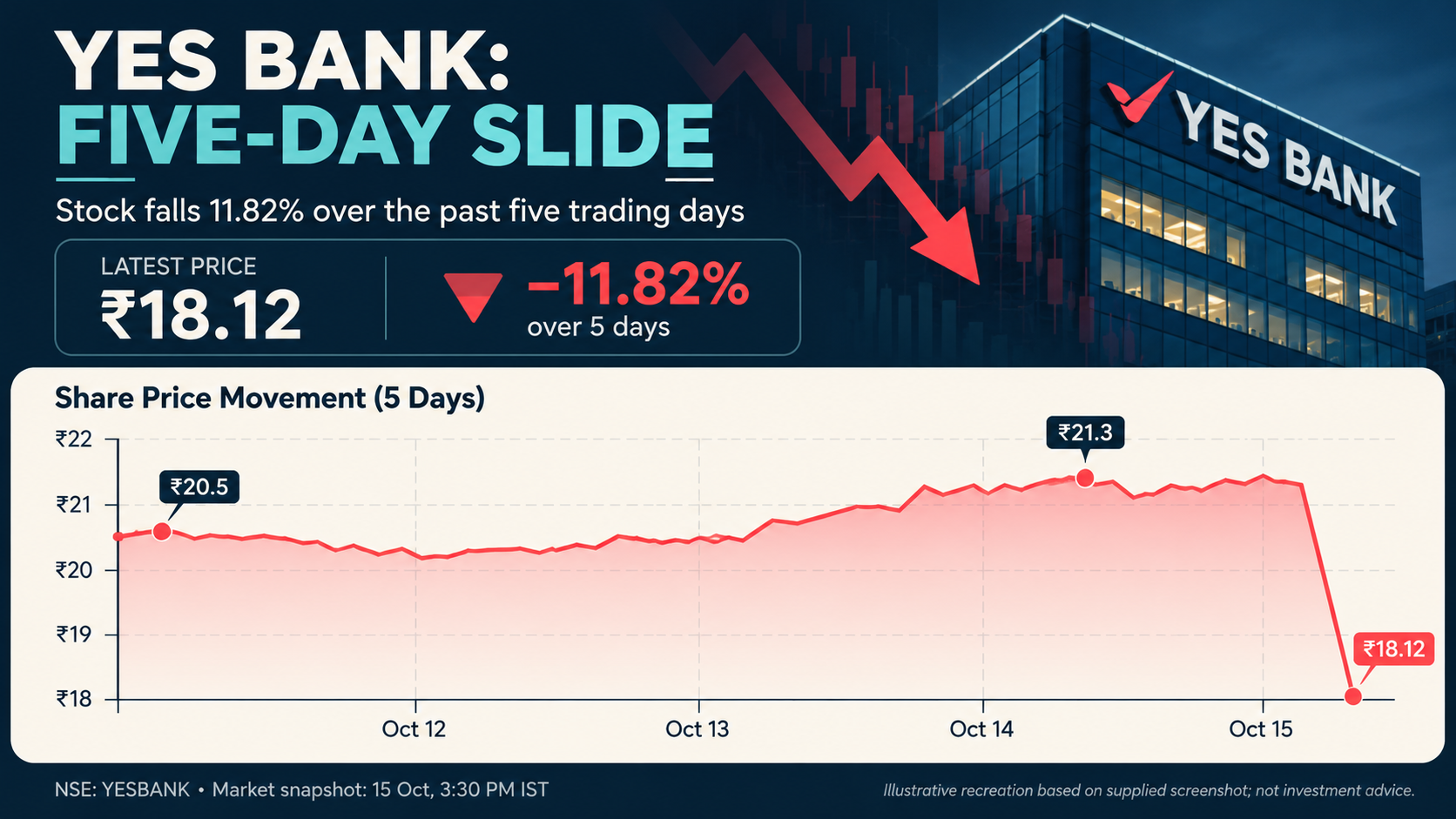
Investor reaction was immediate. Following the Supreme Court's verdict, Yes Bank shares plunged sharply, at one stage falling nearly 20% before recovering some losses later in the trading session.
The reason is simple. If Yes Bank ultimately has to compensate AT1 bondholders, the financial burden could be enormous.
The amount involved is ₹8,415 crore, a figure that exceeds multiple years of the bank's recent profit generation.
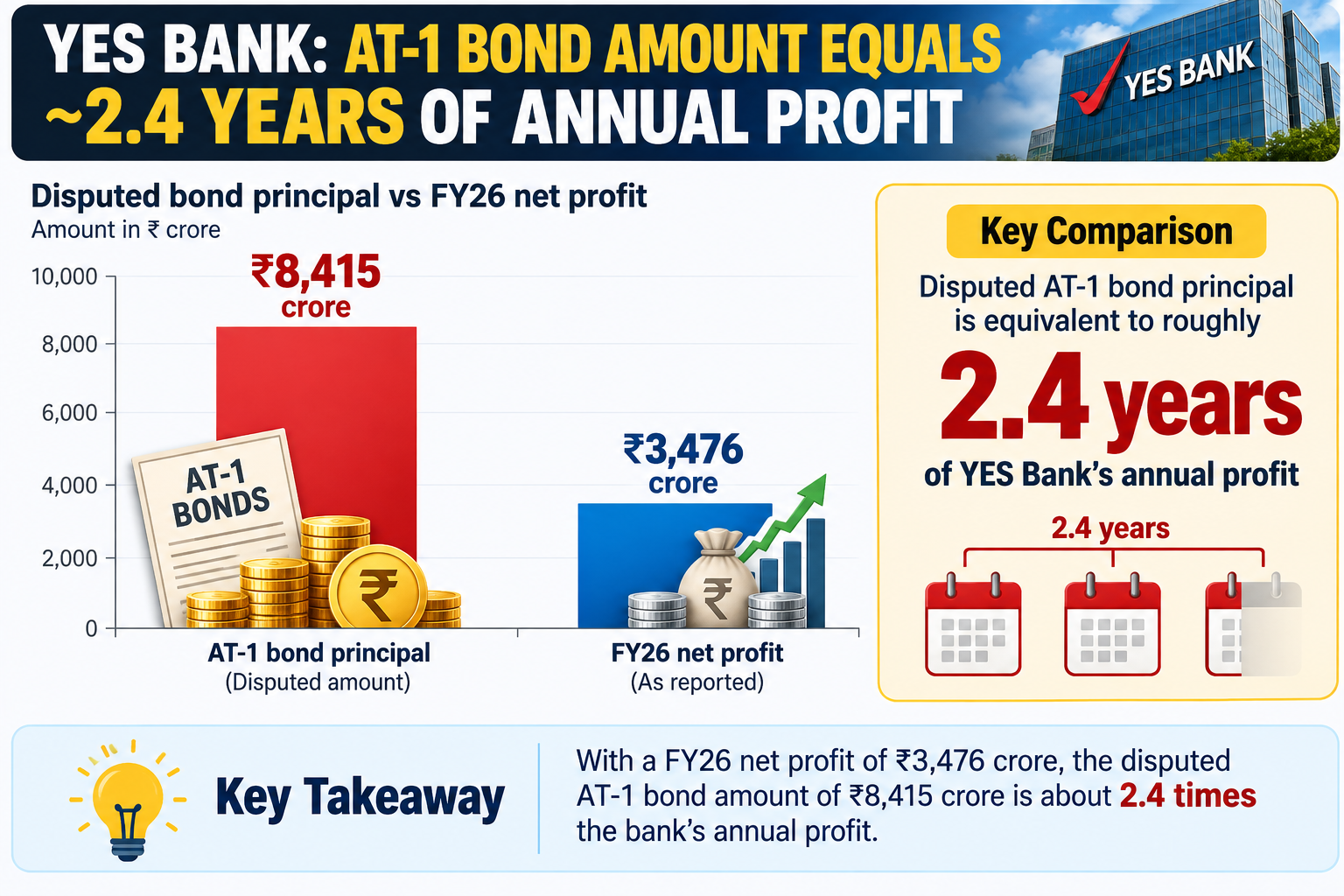
The market fears that such a liability could significantly affect the bank's balance sheet, capital planning, and future growth trajectory.
What Happens Next?
The final financial implications are still unfolding. Yes Bank has indicated that it is examining the Supreme Court's order and evaluating possible legal options, including further review measures.
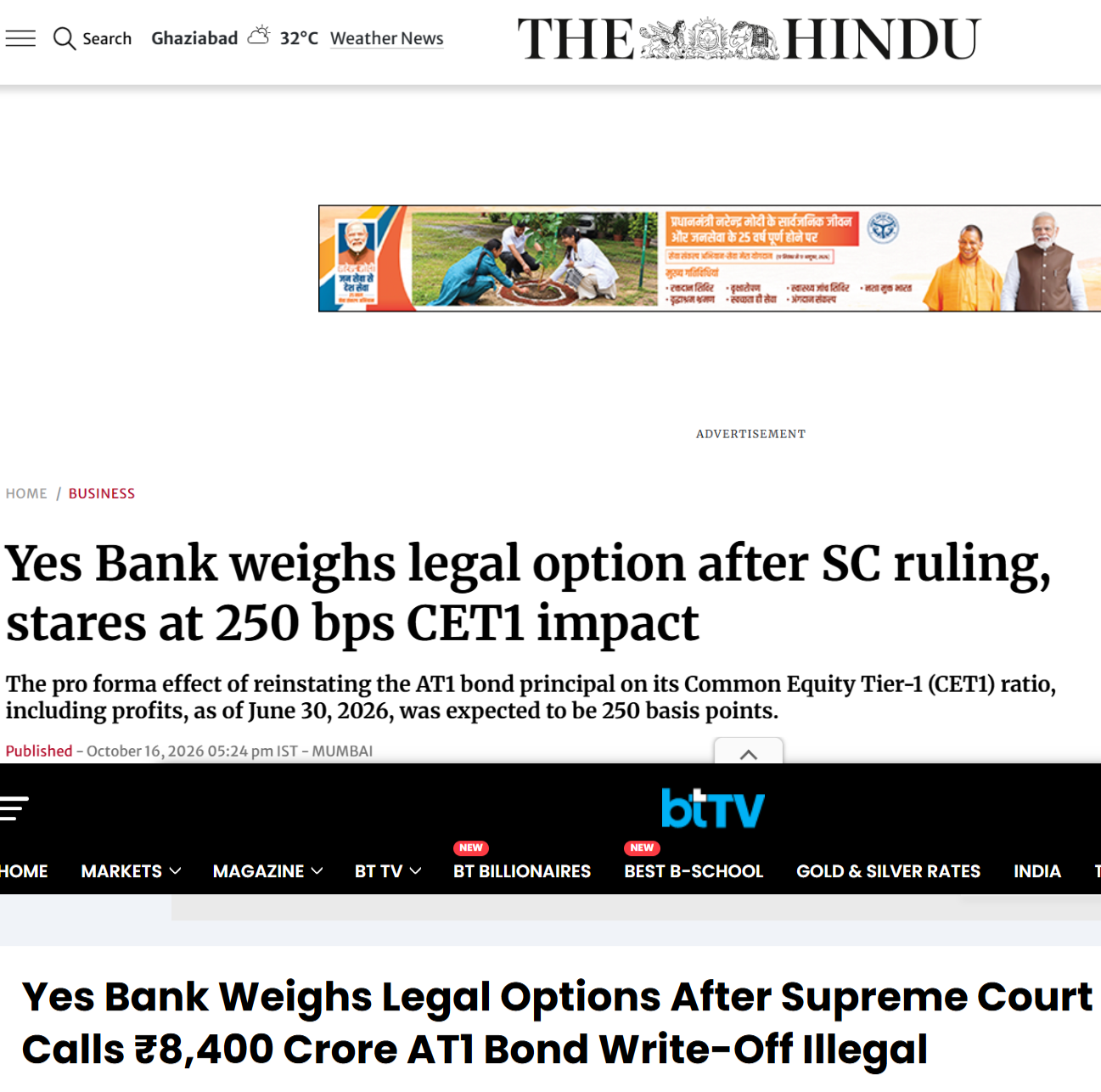
However, if the ruling ultimately results in repayment to affected bondholders, the bank could face a substantial financial challenge.
For investors, regulators, and the broader banking sector, the case serves as a crucial reminder that transparency and due process remain as important as financial stability itself
⚖️ Why This Verdict Matters
The Yes Bank crisis was once viewed as a remarkable rescue story that prevented a major banking collapse. But the Supreme Court's latest verdict has reopened old wounds and raised fresh questions about how India's financial system handles extraordinary emergencies.
While AT1 bonds were always designed to bear losses during crises, the Court has made one thing clear: even in an emergency, rules and procedures cannot be ignored.
The decision could reshape how future bank rescues are structured, how regulators exercise oversight, and how investors assess risk in complex financial instruments.
👉 Your Take on the Verdict?
Should AT1 bond investors bear the full cost when a bank is rescued, or should regulators and banks be held accountable for procedural lapses?
Share your views in the comments below and follow us for more in-depth analysis of India's biggest financial, economic, and policy developments. 🚀
Written by
Aarav VashishtDiscussion (0)
Sign in to join the discussion.
Loading comments…