
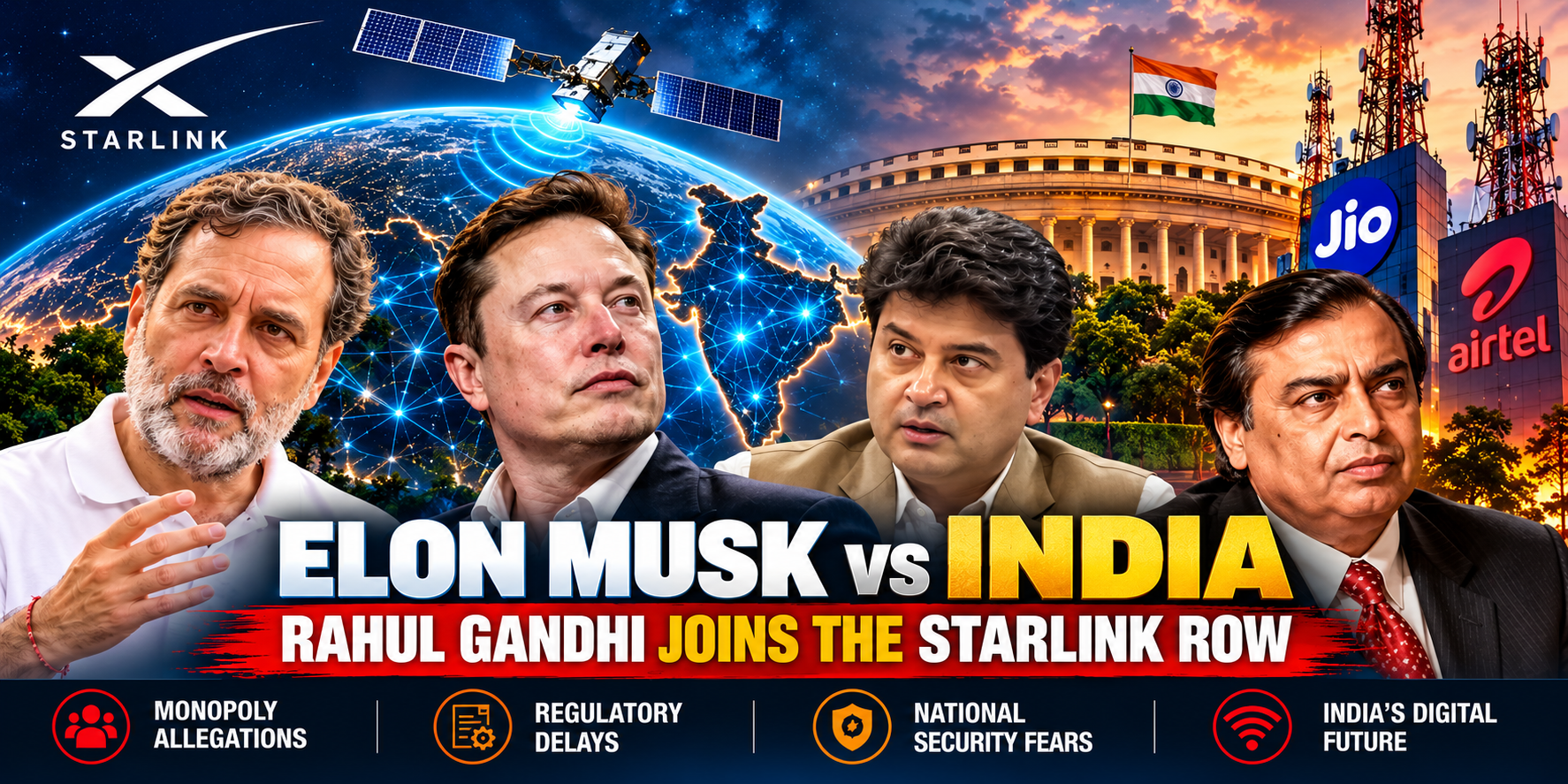
The Starlink controversy is drawing in Elon Musk, Rahul Gandhi, Ambani, and Adani as questions mount over satellite internet approvals, market competition, national security, and India's digital future. Is Starlink really being blocked, or is the truth far more complex?
The Controversy That Has Everyone Talking
A fresh controversy has erupted over Elon Musk’s satellite internet company Starlink and its long-delayed entry into India. What started as a discussion about regulatory approvals has now snowballed into a high-profile debate involving the Indian government, billionaire industrialists, and even Leader of the Opposition Rahul Gandhi.
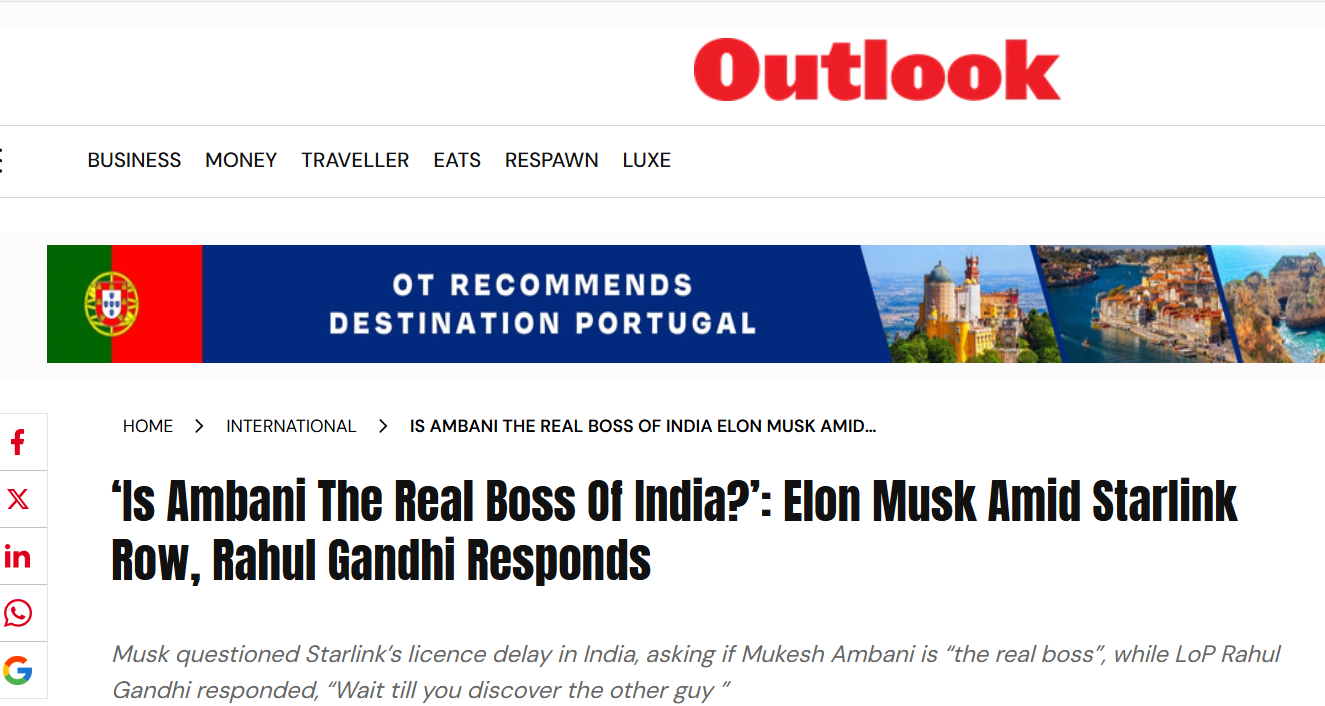
The issue grabbed headlines after Elon Musk alleged that Starlink’s launch in India was being hindered by influential business interests. While he did not initially name anyone directly, many observers interpreted his comments as a reference to Reliance Industries chairman Mukesh Ambani.
Soon after, the Indian government responded. Then came Rahul Gandhi’s remarks. And before long, the Starlink saga had become one of the most talked-about political and technology stories in the country.
But what exactly is happening? Why has Starlink still not launched in India despite years of waiting? And why are national security experts raising concerns? Let's break it down.
Elon Musk’s Explosive Allegation
The controversy began when Musk responded to questions about Starlink’s delayed launch in India. 👉Starlink Standoff: Elon Musk Takes on India’s Telecom Titans as Monopoly Claims and Security Fears Intensify.
According to Musk, powerful interests were preventing Indian consumers from getting access to Starlink services. He suggested that certain "oligarchs" wanted to maintain a monopoly over internet services and that blocking competition was unfair to Indian citizens.
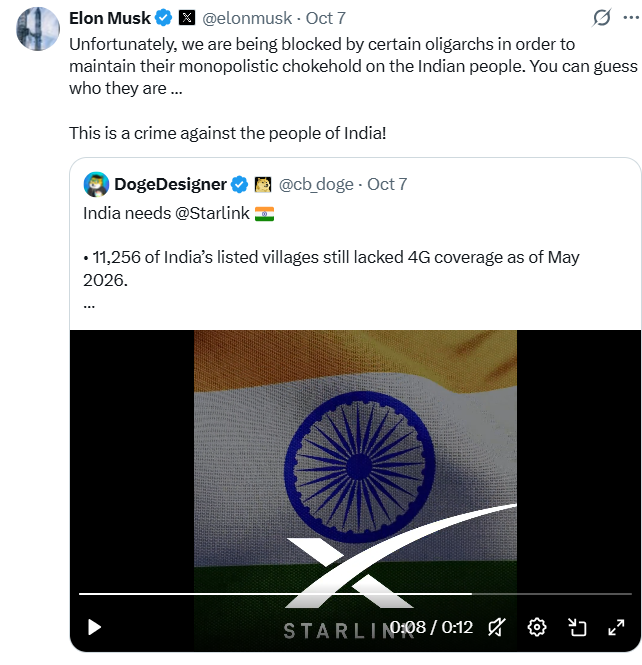
The comments quickly sparked speculation that Musk was indirectly targeting Mukesh Ambani, whose Reliance Jio dominates India's telecom and broadband market.
The allegation immediately triggered a political storm, raising questions about whether Starlink was facing unfair treatment or simply dealing with regulatory hurdles.
India’s Response: “The Process Is Fair for Everyone”
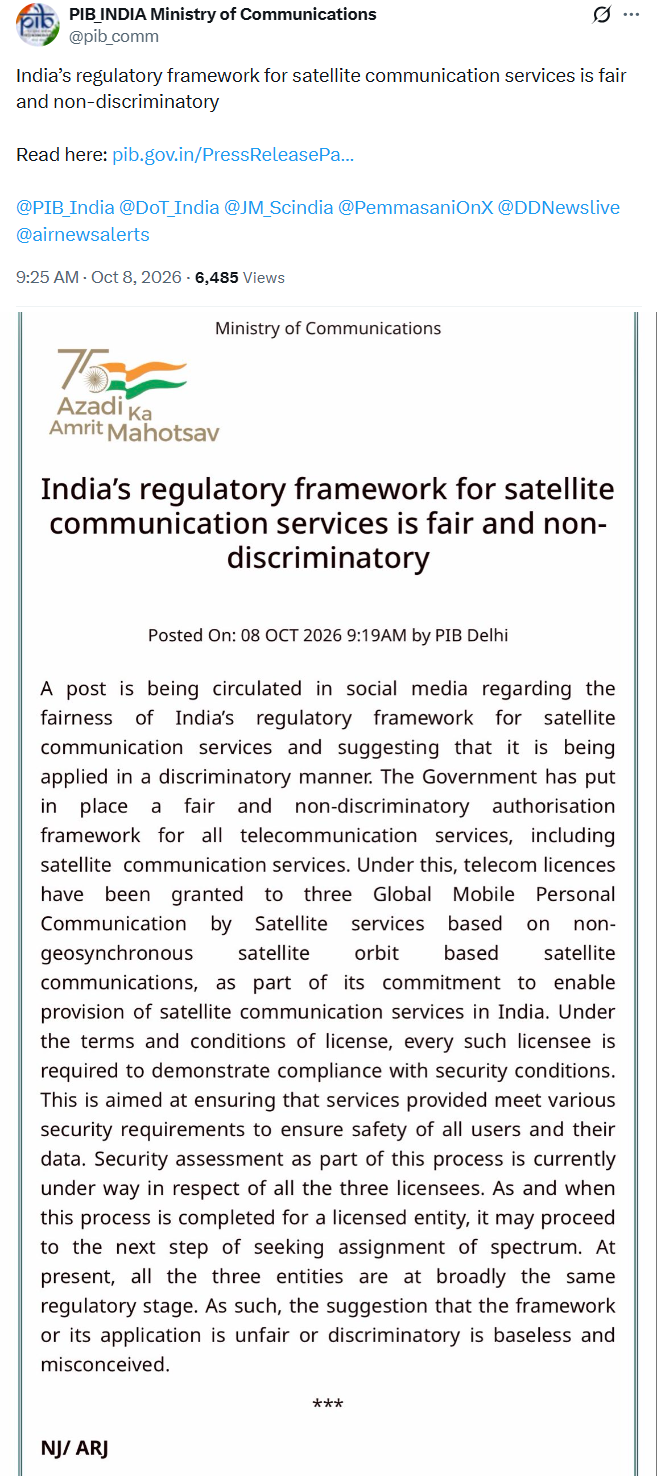
India’s Ministry of Communications soon pushed back against Musk’s claims. Government officials clarified that the approval process for satellite internet services is still underway and applies equally to all companies. According to the government, the framework is neither discriminatory nor biased.
Importantly, officials pointed out that Starlink is not the only company waiting for approvals. Three major players are currently seeking to provide satellite internet services in India:
1. Starlink
2. Reliance Jio
3. Airtel-backed OneWeb
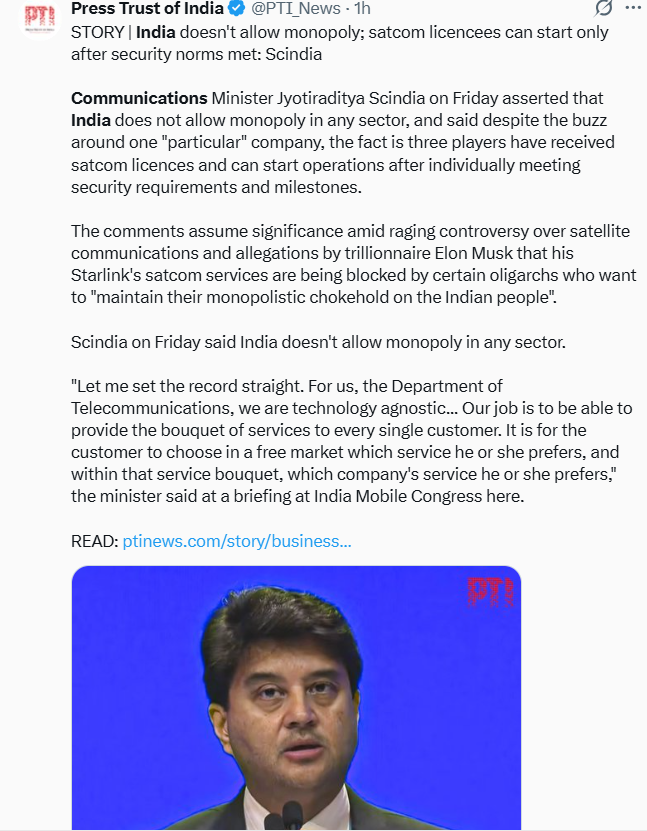
The government maintains that all three companies remain at broadly similar stages of the regulatory process. In other words, Starlink has not been uniquely singled out.
Musk Escalates the Fight
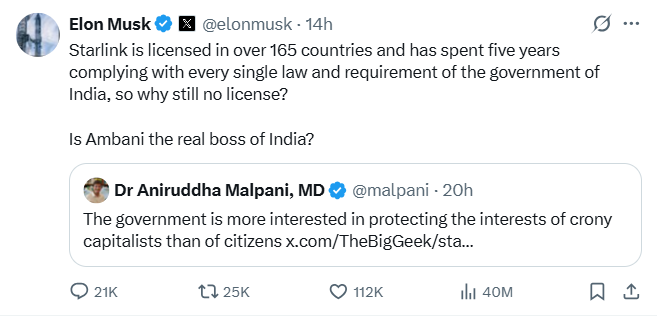
The debate intensified when Elon Musk doubled down on his criticism.
He argued that Starlink already operates in more than 165 countries and has spent years complying with India’s regulatory requirements. Despite meeting numerous conditions, Musk claimed the company still had not received final permission to launch.
The situation became even more dramatic when Musk directly mentioned Mukesh Ambani, publicly questioning whether the industrialist held excessive influence over decisions affecting competition in India.
The statement instantly attracted massive attention across social media and political circles.
Rahul Gandhi’s Entry Changes the Narrative
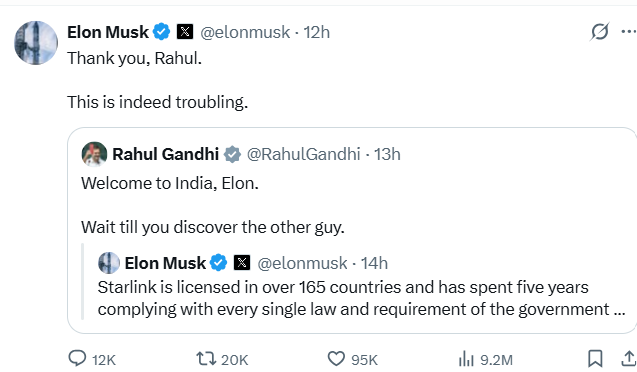
The controversy took another twist when Rahul Gandhi reacted to Musk’s remarks. Responding on social media, Gandhi welcomed Musk to India and hinted that Ambani was not the only business figure wielding significant influence.
In a pointed message, Gandhi suggested Musk should wait until he discovers "the other guy", an apparent reference to billionaire Gautam Adani, whom Gandhi has frequently accused of enjoying close ties with the government. Musk later acknowledged Gandhi’s post, adding yet another layer of intrigue to an already heated debate.
The result? What began as a telecom licensing issue transformed into a major discussion about corporate influence, competition, and governance.
Why Starlink Matters for India
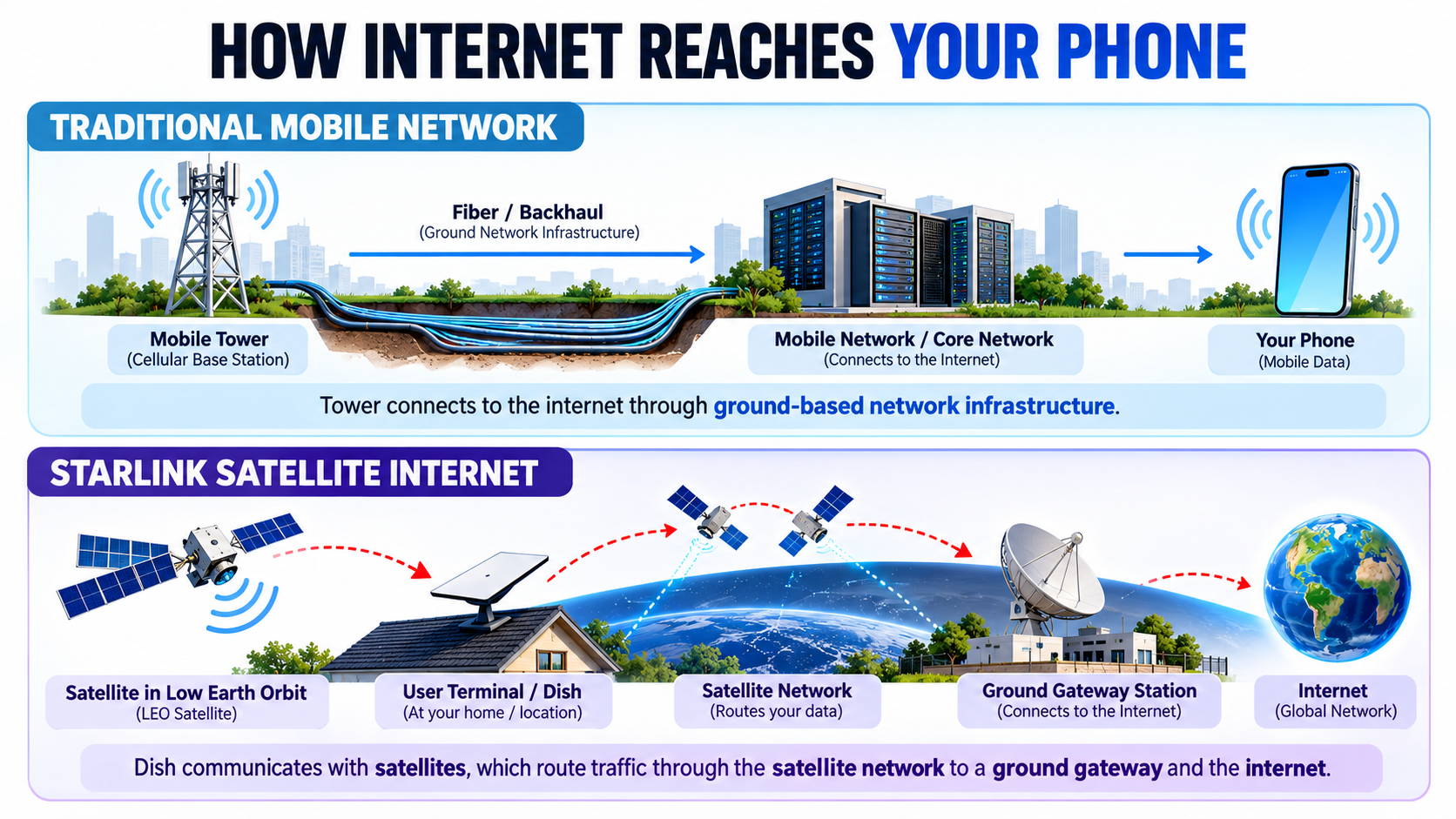
Despite the controversy, there is little doubt that Starlink could provide significant benefits to India. Unlike traditional broadband networks that rely on fibre cables and mobile towers, Starlink uses a constellation of low-earth-orbit satellites to deliver internet connectivity.
Its greatest advantage is not in cities like Delhi, Mumbai, Bengaluru, or Hyderabad, where high-speed broadband is already widely available. Instead, Starlink could become extremely valuable in “remote villages”
Many rural communities still lack reliable internet infrastructure. Satellite internet can bridge that gap.
1. Himalayan Regions
Mountainous terrain makes traditional broadband deployment difficult and expensive.
2. Islands and Coastal Areas
Regions like the Andaman and Nicobar Islands could gain better connectivity through satellite services.
3. Disaster Zones
When cyclones, floods, earthquakes, or other disasters damage telecom infrastructure, satellite internet can help maintain emergency communications.
For these reasons, many experts believe satellite internet could play a transformative role in India’s digital future.
So Why Hasn't Starlink Launched Yet?
This is where the story gets complicated.
Many people assume that if a company receives a license, it can immediately begin operations. That is not necessarily true. Starlink has already secured several important approvals in India. However, additional regulatory requirements remain.
Authorities say the company still needs:
1. Final security clearances
2. Spectrum assignment approvals
3. Compliance verification with Indian security requirements
4. Operational testing and validation
The government argues that these conditions apply to all satellite internet operators, not just Starlink. Therefore, official approvals are only one part of the process
The National Security Question
Perhaps the biggest obstacle is national security. Unlike mobile towers, satellite signals travel across vast geographical areas and can potentially spill over national boundaries.
This creates several concerns for governments:
1. Border Security
India shares sensitive borders with multiple nations like Nepal, Myanmar, Pakistan, China, Bangladesh and Bhutan. Authorities worry that satellite signals intended for Indian users could extend into neighbouring territories.
One of the biggest concerns surrounding Starlink is something known as “signal spillover.” Unlike traditional mobile towers, satellite internet beams are not confined by national boundaries and can extend beyond a country's borders.
2. Unauthorized Access
Security agencies want assurances that networks cannot be exploited by hostile actors, criminal organizations, or terrorist groups.
3. Data Monitoring and Compliance
Governments worldwide increasingly demand that telecommunications providers comply with local laws concerning lawful interception and national security investigations.
4. Military Implications
Satellite communication systems have strategic importance and can potentially be used in sensitive environments.
Because of these factors, many countries apply stricter scrutiny to satellite internet networks than to conventional broadband services.
Previous Security Concerns Fuel the Debate
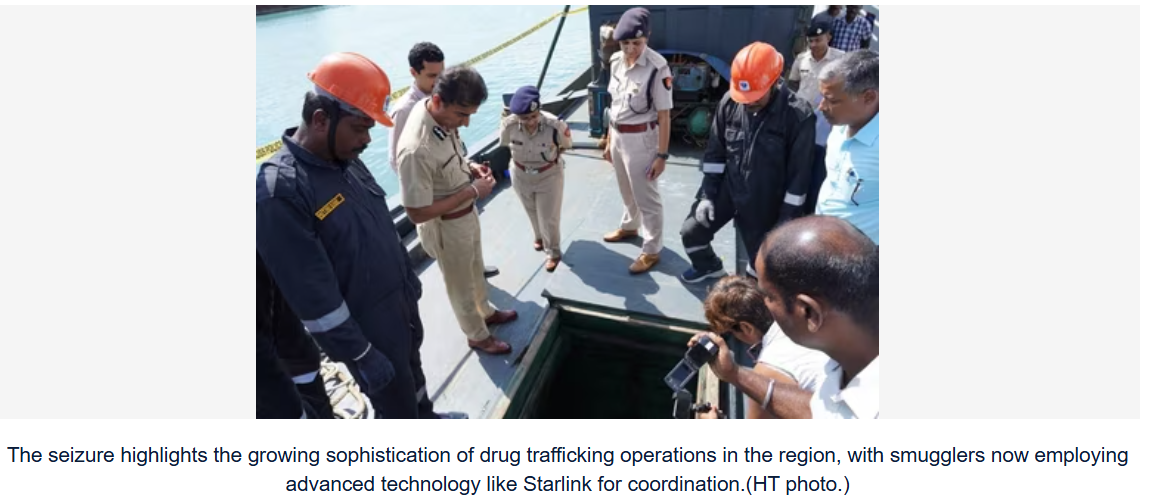
Security concerns surrounding Starlink are not entirely theoretical. Indian agencies have previously flagged incidents involving Starlink equipment being recovered during operations in sensitive regions.
Reports involving the Andaman and Nicobar Islands, as well as conflict-affected areas such as Manipur, intensified scrutiny over how satellite communication devices could potentially be used in unauthorized activities.

While Starlink has maintained that its services cannot function in regions where satellite beams are disabled, concerns among security agencies have persisted. This explains why the Ministry of Home Affairs remains deeply involved in evaluating the service.
The Ambani Angle: Rival or Partner?
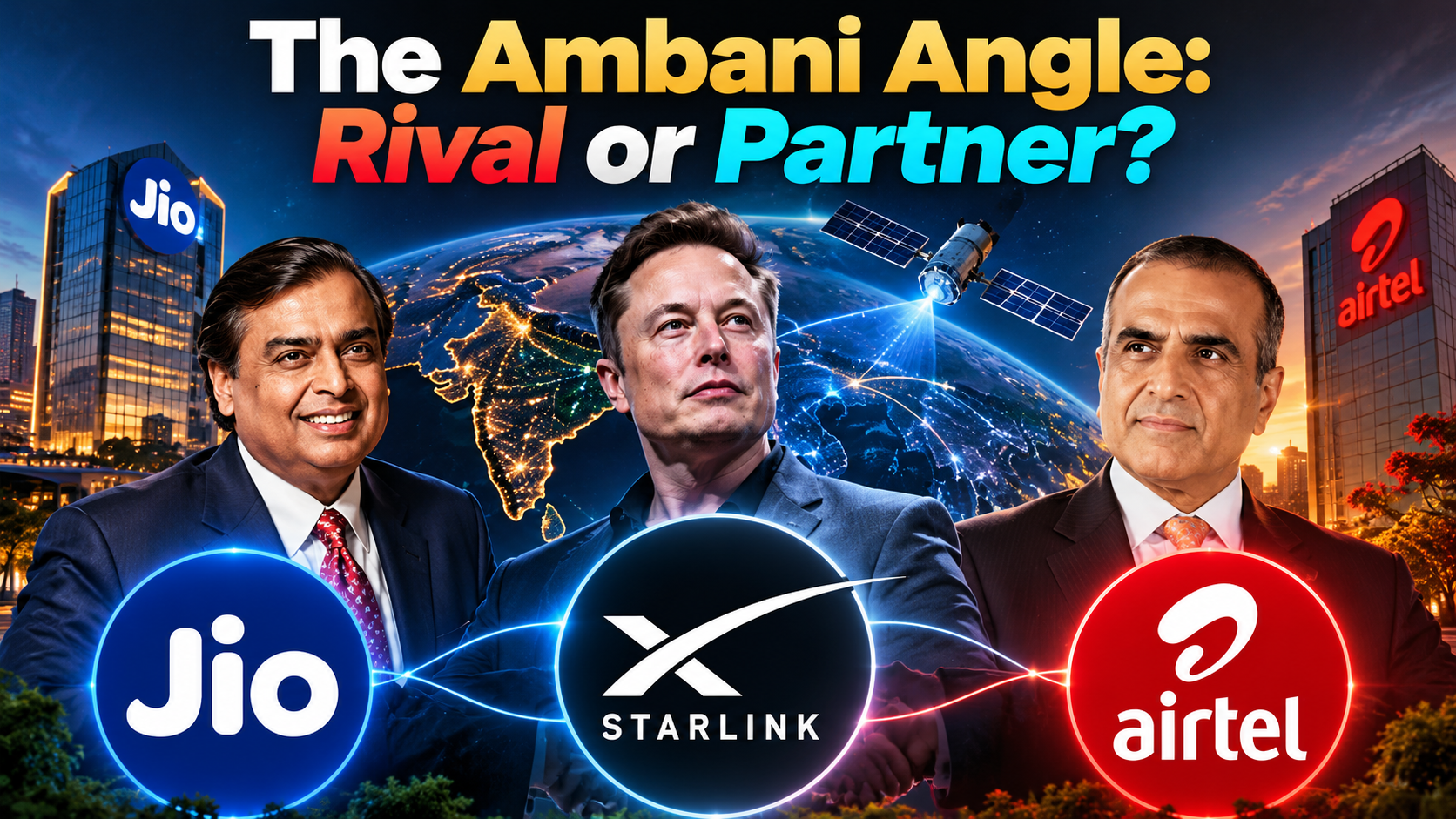
One of the most surprising aspects of the controversy is that Starlink and Reliance Jio are not just potential competitors. They have also explored cooperation opportunities.
Reliance's extensive distribution network could help Starlink expand rapidly across India without needing to build a nationwide sales infrastructure from scratch.
This creates an unusual dynamic where the companies can be partners in certain areas while competing in others. That reality makes the public exchange between Musk and Ambani-related interests even more intriguing.
Will Starlink Bring Cheaper Internet to India?
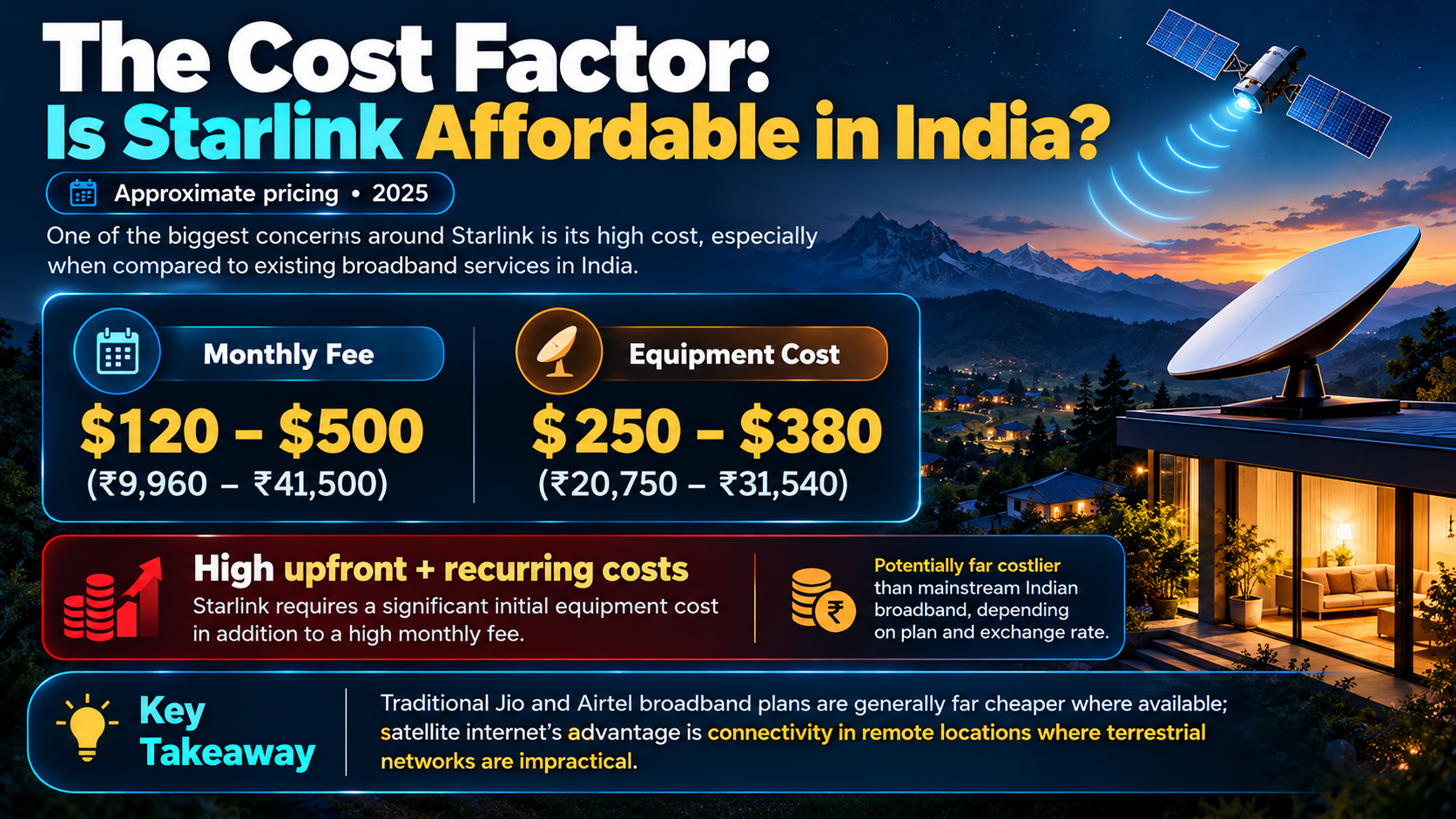
Many social media users believe Starlink’s arrival would dramatically reduce internet prices. However, the numbers suggest otherwise.
India already enjoys some of the world's most affordable internet plans. Fibre broadband providers such as Jio and Airtel offer high-speed connections at prices that are significantly lower than Starlink’s international pricing.
Potential Starlink users may need to pay:
1. A substantial upfront hardware cost
2. Monthly subscription fees significantly higher than conventional broadband plans
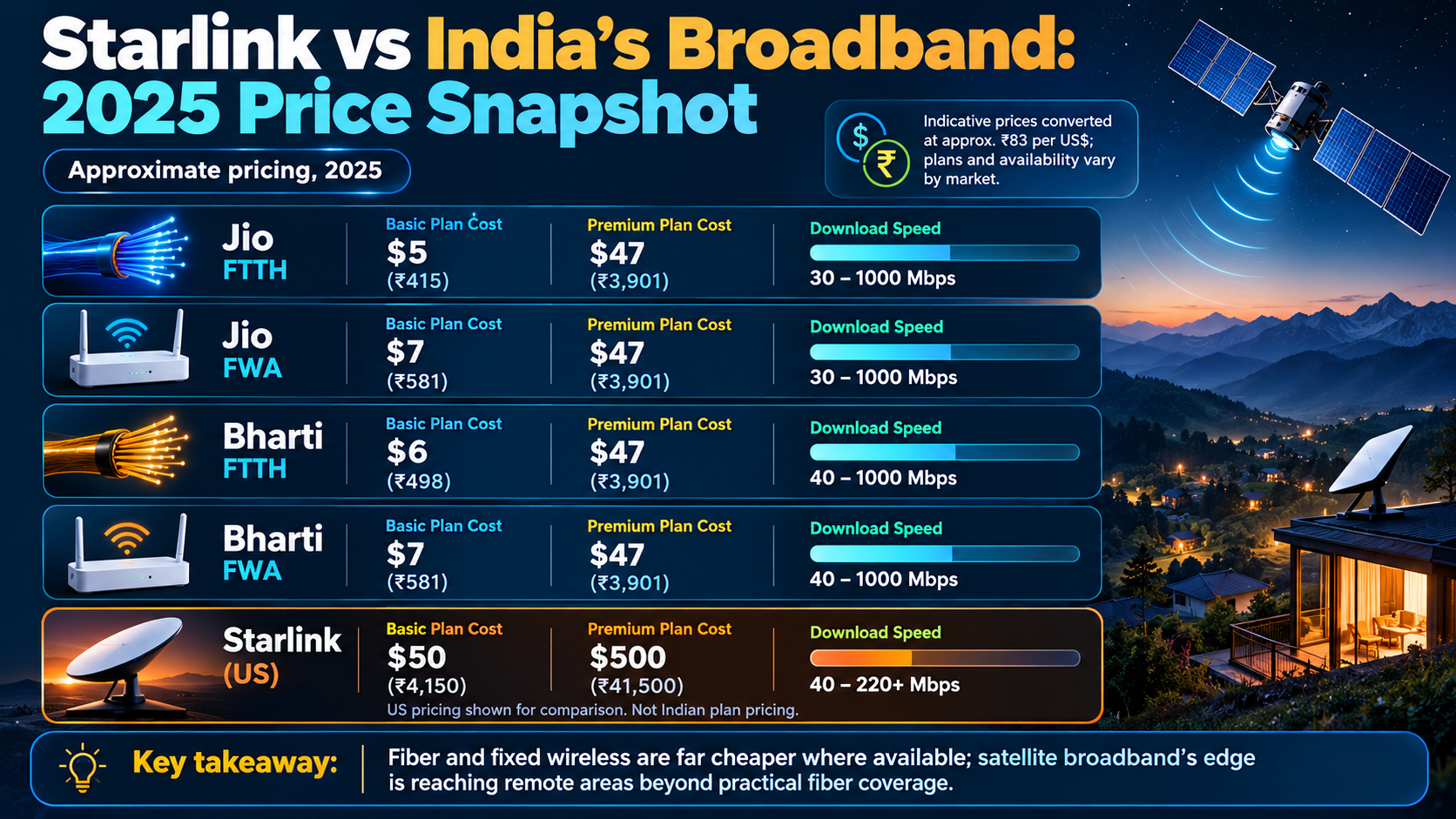
This means Starlink is unlikely to become a mass-market alternative for urban Indian consumers.
Instead, its primary value may lie in serving locations where traditional broadband is unavailable or unreliable.
The Final Verdict
The Starlink controversy is no longer just about internet connectivity. It now sits at the intersection of technology, business rivalry, politics, and national security.
Elon Musk believes excessive influence and regulatory delays are holding back Starlink's entry. The Indian government insists that all applicants are being treated equally and that security concerns must be addressed before granting final approval.
Meanwhile, political leaders have turned the issue into a broader debate about corporate power and governance. Whether Starlink eventually launches in India or faces further delays, one thing is certain: this battle is far bigger than a simple internet service rollout.
🚀 What Do You Think?
✅Is Starlink being unfairly delayed in India, or are security concerns justified?
✅ Could satellite internet revolutionize connectivity in remote regions?
✅Should India prioritize rapid technological innovation or adopt a security-first approach?
Share your views in the comments below and join the discussion!
For more in-depth analysis on geopolitics, technology, business, and national security, follow us and stay ahead of the headlines.
Written by
Ritvik DeshmukhDiscussion (0)
Sign in to join the discussion.
Loading comments…