
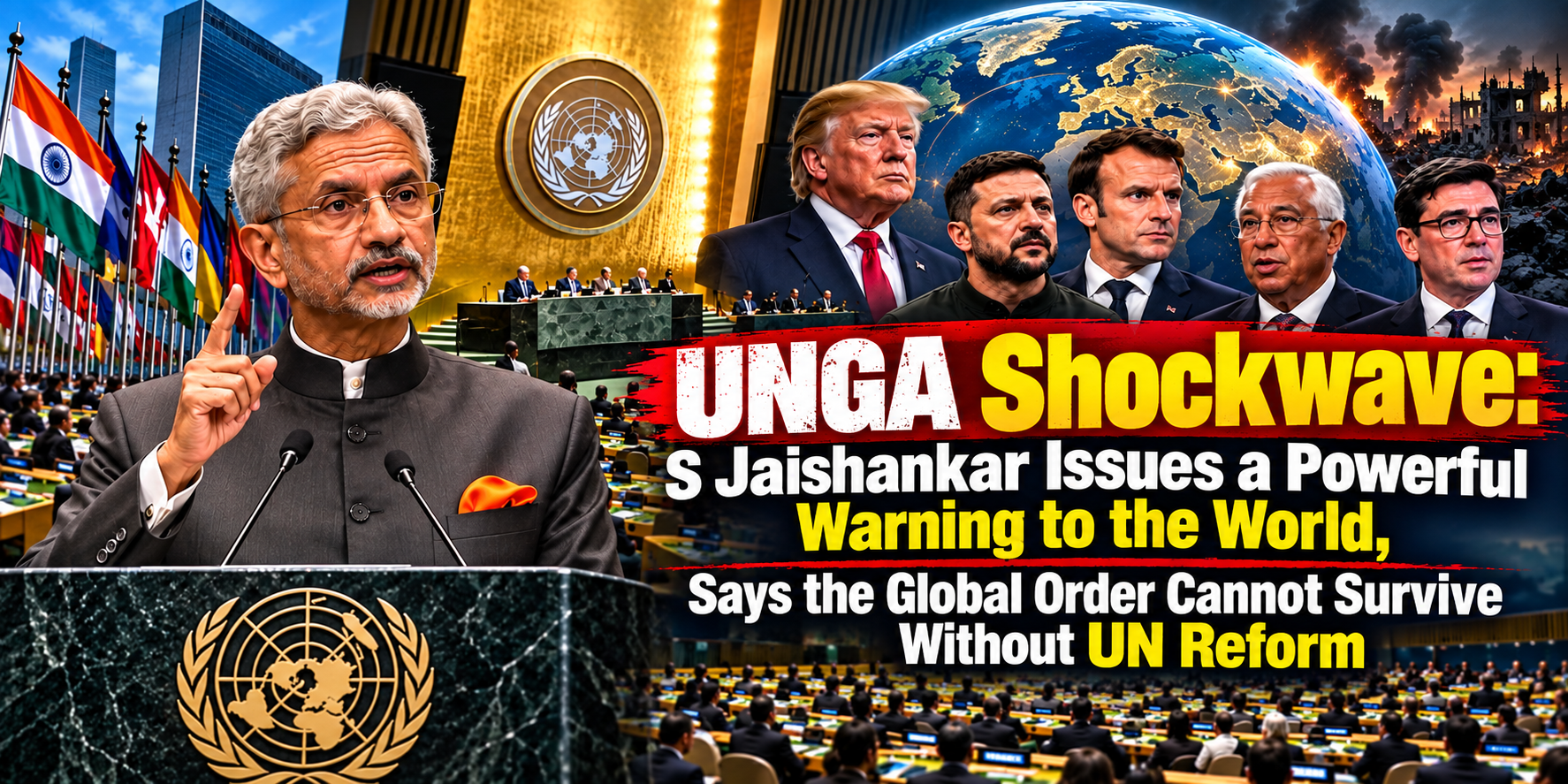
At the United Nations, India Didn’t Just Speak for Itself. It Spoke for the Entire Global South.
As world leaders gathered at the United Nations General Assembly (UNGA), speeches from nations across the globe dominated headlines. Pakistan once again focused on Kashmir, while several leaders highlighted regional conflicts and geopolitical tensions. However, India’s External Affairs Minister, Dr. S. Jaishankar, delivered a speech that went far beyond bilateral disputes.
His message was clear, bold, and strategic: the global order is under immense stress, and the world can no longer rely on outdated institutions to solve modern challenges.
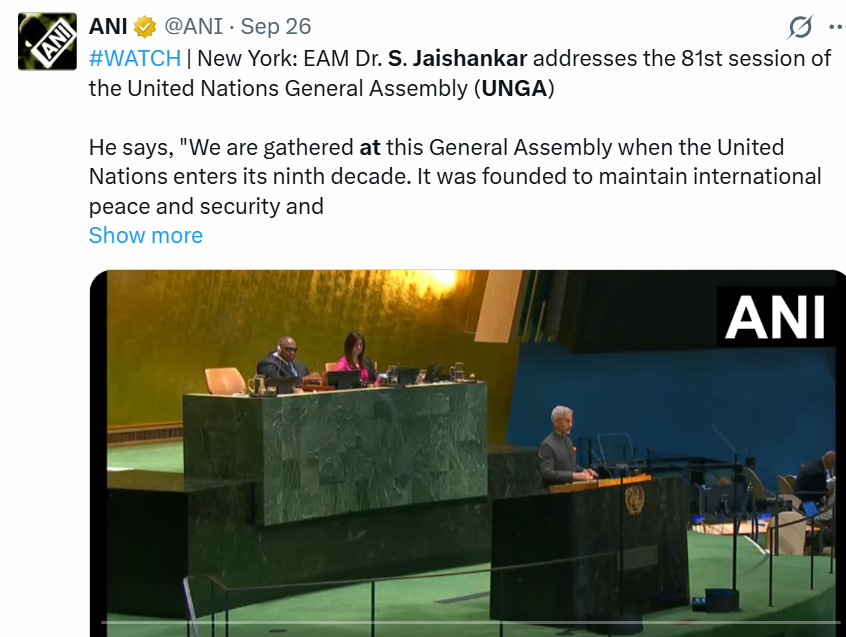
From terrorism and global conflicts to food insecurity and UN reforms, India used the UN platform to advocate not just for its own interests, but for the concerns of billions living across the Global South.
“The World Order Is Under Stress”: India’s Biggest Warning
At the heart of Jaishankar’s address was a stark reality. The world today is witnessing multiple interconnected crises. Wars are becoming costlier, geopolitical rivalries are intensifying, economic instability is spreading, and developing nations are paying the highest price.
According to India, the current international system continues to operate with institutions designed for the realities of the 20th century, while the challenges of the 21st century are vastly different.
The key question raised by India was simple: Can institutions created after World War II effectively solve today's global problems?
India’s answer appears to be increasingly clear: not without substantial reforms.
The “4F Crisis”: How Global Conflicts Are Hurting Developing Nations
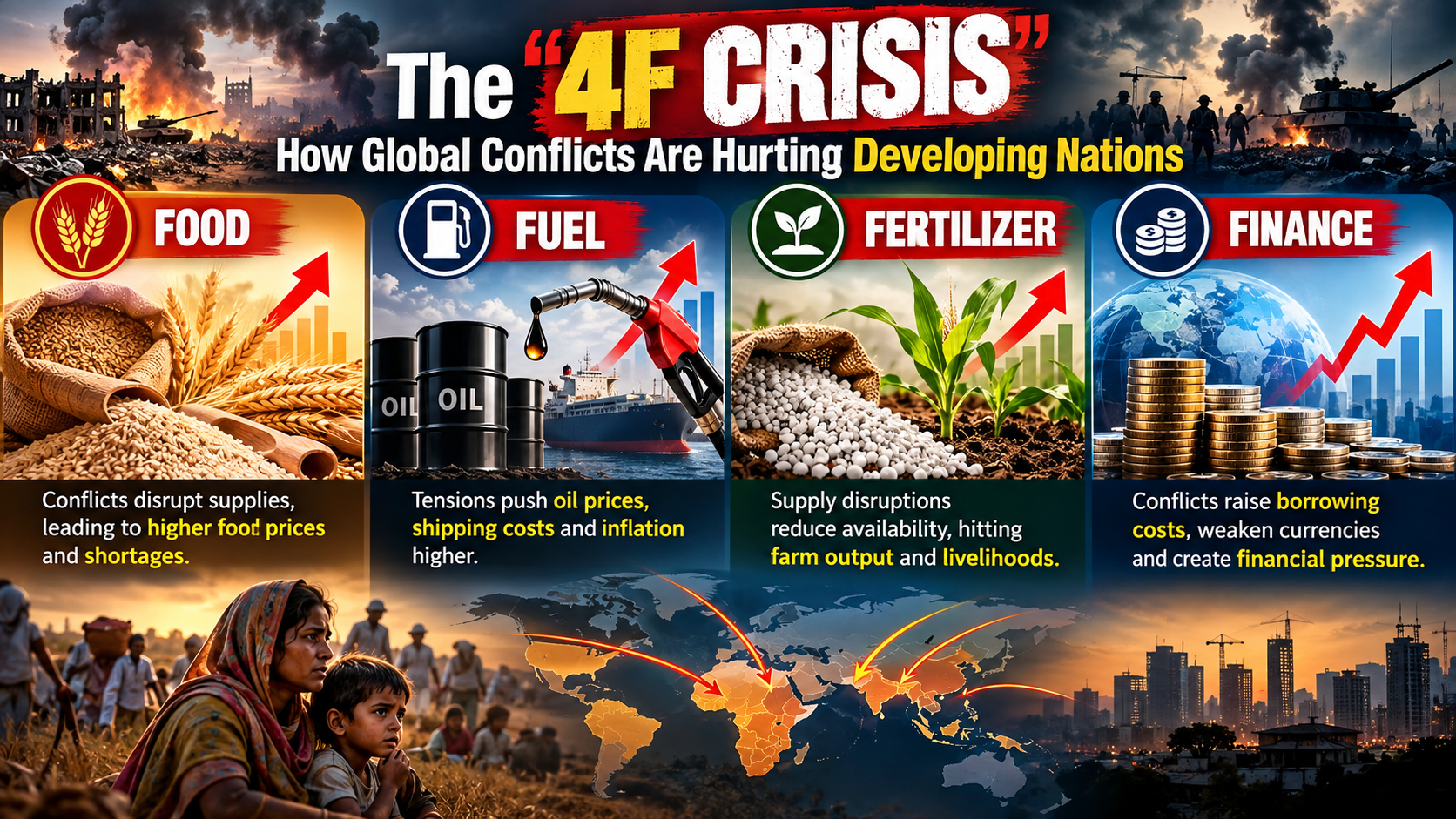
One of the most significant highlights of Jaishankar’s speech was the concept of the “4F Crisis”:
1. Food
Global conflicts disrupt trade routes and supply chains, leading to rising food prices worldwide. Countries dependent on food imports often face severe shortages and inflationary pressure whenever major geopolitical crises erupt.
For developing nations, this creates a direct threat to food security.
2. Fuel
Energy markets remain highly sensitive to global conflicts, especially in regions like the Middle East. Whenever tensions escalate, oil prices surge, shipping costs increase, transportation networks come under pressure, and inflation spreads across economies.
The consequences are felt not just by warring nations, but by billions of people globally.
3. Fertilizer
Agriculture remains the backbone of many developing economies, including India. Modern farming depends heavily on fertilizers such as nitrogen, phosphate, and potash. Any disruption in fertilizer supply chains directly impacts agricultural productivity, food prices, and rural livelihoods.
A fertilizer shortage today can become a food crisis tomorrow.
4. Finance
Developing countries require steady access to global capital for growth and development. However, during periods of conflict and uncertainty, borrowing costs rise, currencies weaken, capital flows become unstable, and financial pressure intensifies.
As a result, nations already struggling with economic challenges face even greater hurdles.
India argued that these four interconnected challenges have become the hidden cost of global wars, with developing nations bearing the heaviest burden.
India’s Growing Role as the Voice of the Global South
A major theme of India's address was its commitment to representing the concerns of the Global South.
Jaishankar highlighted a persistent global imbalance: Developing countries are often the first to suffer during global crises, but they are rarely given a meaningful role in decision-making.
From rising food prices and climate disasters to debt crises and energy shocks, the countries most affected by these challenges frequently remain underrepresented in global institutions.
India believes this imbalance must change. The message from New Delhi is increasingly consistent: If developing nations face the consequences of global decisions, they deserve a larger role in making those decisions.
This position has become central to India’s diplomatic strategy in recent years.
Why India Wants Major UN Reforms
One of the strongest aspects of Jaishankar’s speech was his criticism of the current United Nations structure. The UN Security Council still reflects the power realities of 1945, when the world emerged from World War II. Today, the international landscape is dramatically different.
There are over 190 sovereign nations, emerging economic powers, influential regional players, and rapidly changing geopolitical dynamics. Yet the structure of the Security Council remains largely unchanged.
India argues that this mismatch has weakened the effectiveness and credibility of global governance institutions.
India’s Key Demands Include:
1. Expansion of permanent membership in the UN Security Council
2. Expansion of non-permanent seats
3. Greater representation for developing nations
4. Stronger voice for emerging economies
5. Modernized decision-making mechanisms
According to India, reforming the Security Council is not merely about obtaining a permanent seat. It is about ensuring that global governance reflects contemporary realities rather than historical power structures.
BRICS vs UN? India Rejects the Narrative
During discussions on the sidelines of the UNGA, Jaishankar was asked whether the rise of BRICS could challenge the United Nations.
His response was unambiguous. India does not view BRICS and the UN as competitors.
Instead, BRICS can serve as a collective force advocating reforms within the existing international system. The objective is not to replace the UN, but to make it more representative, effective, and responsive to today's global challenges.
India’s Toughest Security Message: Zero Tolerance for Terrorism
If governance reforms formed one pillar of India's speech, counter-terrorism formed the other. Jaishankar reiterated India’s long-standing position that terrorism must be confronted with zero tolerance and no double standards.
India called for:
1. Action against terrorist organizations
2. Punishment of sponsors and financiers of terrorism
3. Consistent international standards
4. Stronger global cooperation
The minister emphasized that terrorism cannot be treated merely as a law-and-order issue. It is a challenge to national security, international stability, and global peace.
India also renewed its demand for a global consensus on defining terrorism through the long-pending Comprehensive Convention on International Terrorism (CCIT).
According to India, the absence of a universally accepted definition creates loopholes that allow state-sponsored and cross-border terrorism to escape accountability.
India’s 30-Year Push for a Global Anti-Terror Framework
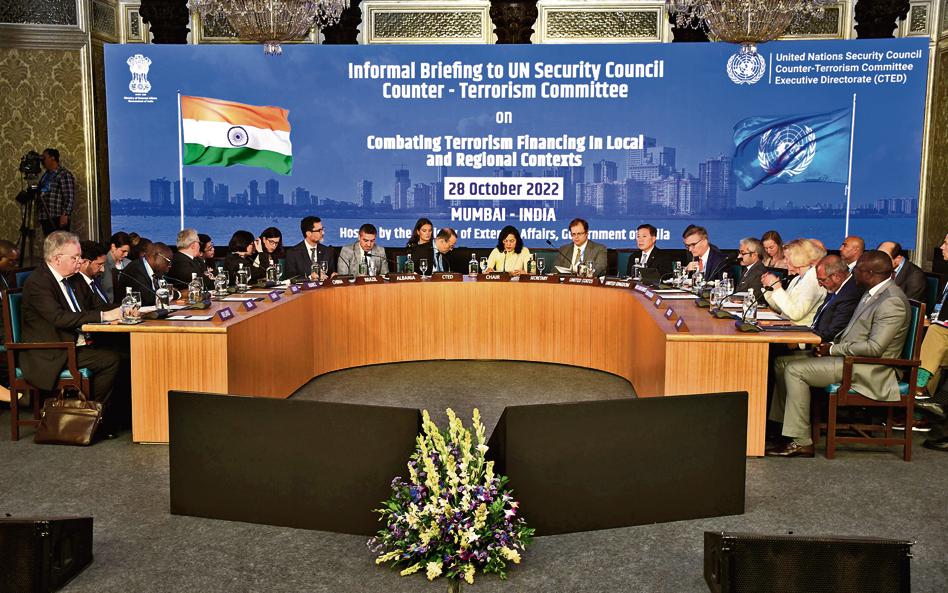
Since proposing the Comprehensive Convention on International Terrorism (CCIT) in 1996, India has consistently pushed for a universal legal framework to combat terrorism. However, disagreements among nations over the definition of terrorism and its scope have stalled progress, leaving the world without a globally accepted anti-terror convention despite repeated calls from India at the UN.
🔥 Jaishankar’s Viral Mic-Drop Moment
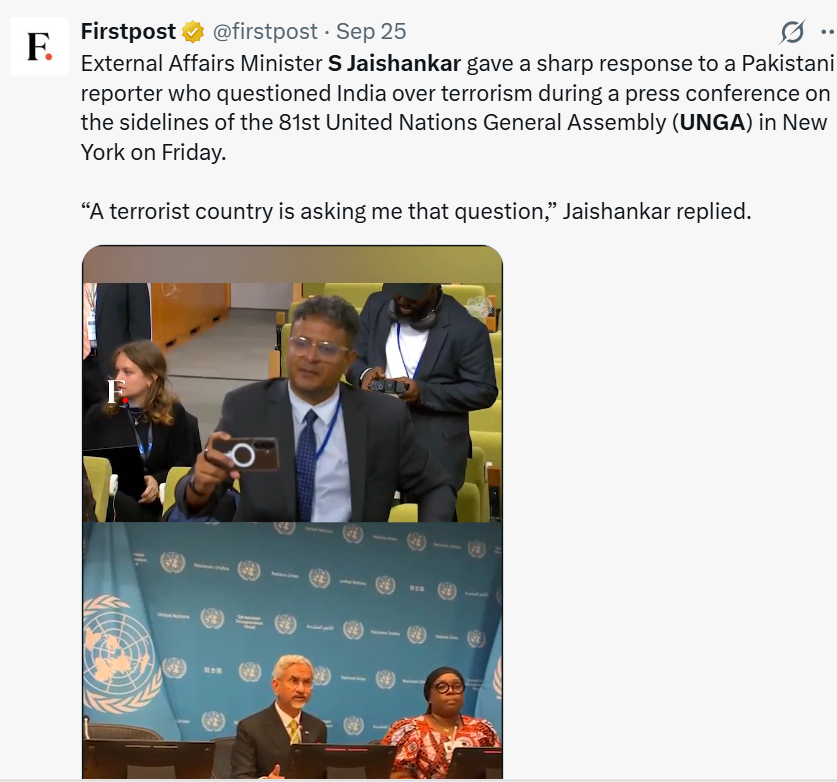
Away from the UNGA speeches, one exchange stole the spotlight. When a Pakistani journalist questioned India over terrorism allegations, S. Jaishankar fired back with a sharp one-liner that instantly went viral. In just a few words, he turned the spotlight back on Pakistan, sparking widespread discussion across diplomatic and media circles.
India’s Stand on the Israel-Palestine Conflict
On the ongoing conflict in West Asia, India maintained its balanced and consistent position. S. Jaishankar reaffirmed India’s support for a two-state solution 👉Why are 12 nations targeting trade with Israeli settlements? The answer lies in a growing effort to protect the future of the Two-State Solution. , under which:
1. Israel exists as a secure nation.
2. Palestine exists as an independent state.
India also stressed the importance of humanitarian assistance, de-escalation, dialogue, and sustained diplomatic efforts to end violence and restore stability.
The Three Pillars of India’s UN Vision
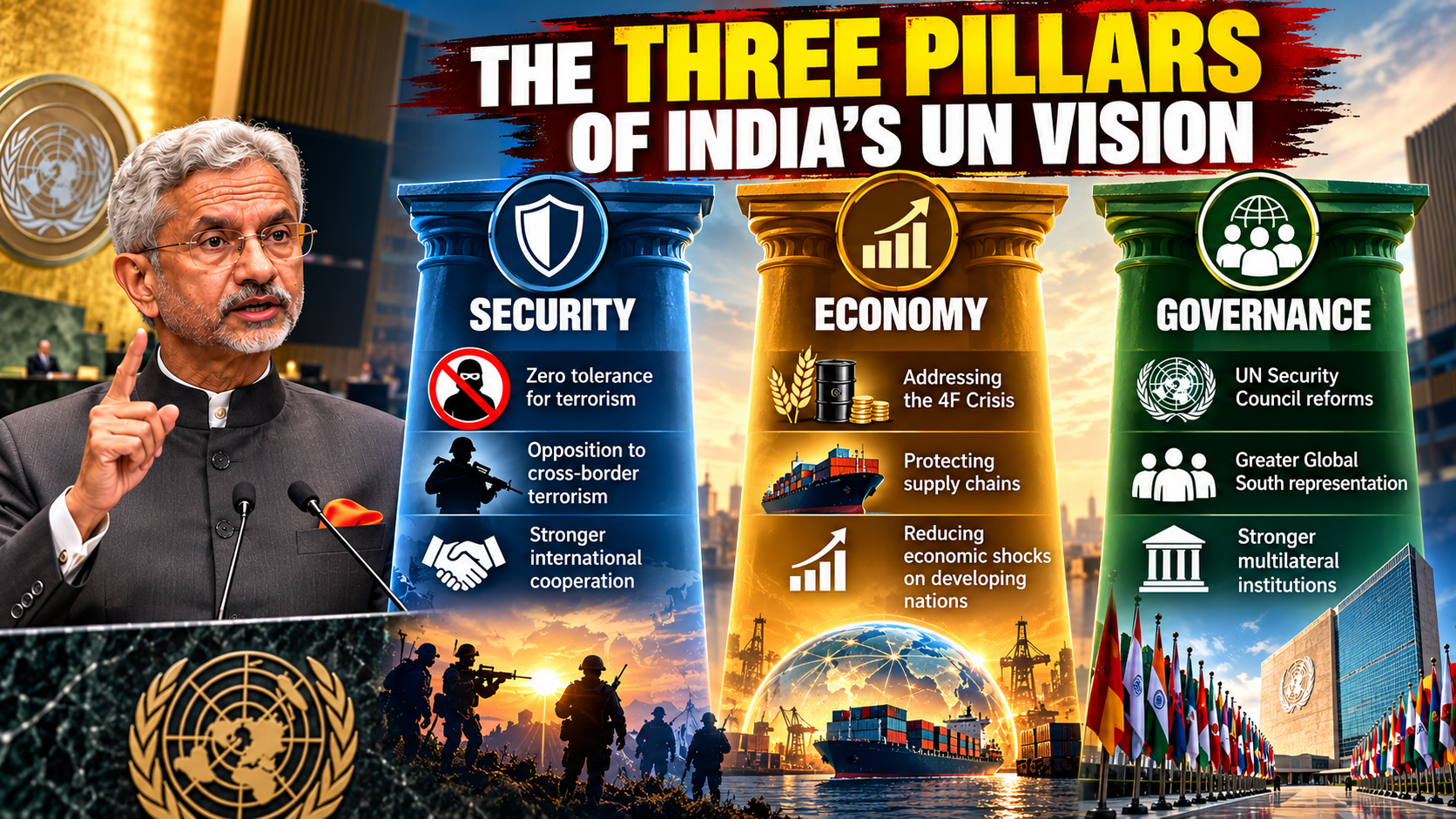
Jaishankar’s address can ultimately be summarized around three critical themes:
1. Security
a) Zero tolerance for terrorism
b) Opposition to cross-border terrorism
c) Stronger international cooperation
2. Economy
a) Addressing the 4F Crisis
b) Protecting supply chains
c) Reducing economic shocks on developing nations
3. Governance
a) UN Security Council reforms
b) Greater Global South representation
c) Stronger multilateral institutions
Together, these pillars reflect India's broader vision of a fairer, more representative, and more effective global order.
✅ The Bigger Picture: India Is No Longer Just a Participant; It Wants to Shape the Future
Dr. S. Jaishankar’s UNGA speech was not simply another diplomatic address. It was a statement of intent.
India signaled that the world can no longer afford outdated institutions, selective approaches to terrorism, or decision-making systems that exclude billions of people from the Global South.
As geopolitical tensions rise and global challenges grow more complex, India is increasingly positioning itself as a bridge between developed and developing nations and as a leading advocate for reforming the international order.
The message from the UN podium was unmistakable: The future of global governance must be more inclusive, more representative, and better equipped for the challenges of the 21st century.
🚀What Do You Think?
Do you agree that the United Nations needs urgent reforms? Should developing nations receive greater representation in global decision-making? Share your views in the comments and join the conversation on the future of world governance.
👉 Follow us for more in-depth geopolitical analysis, global affairs insights, and expert breakdowns of major international developments.
Written by
Ritvik DeshmukhDiscussion (0)
Sign in to join the discussion.
Loading comments…