
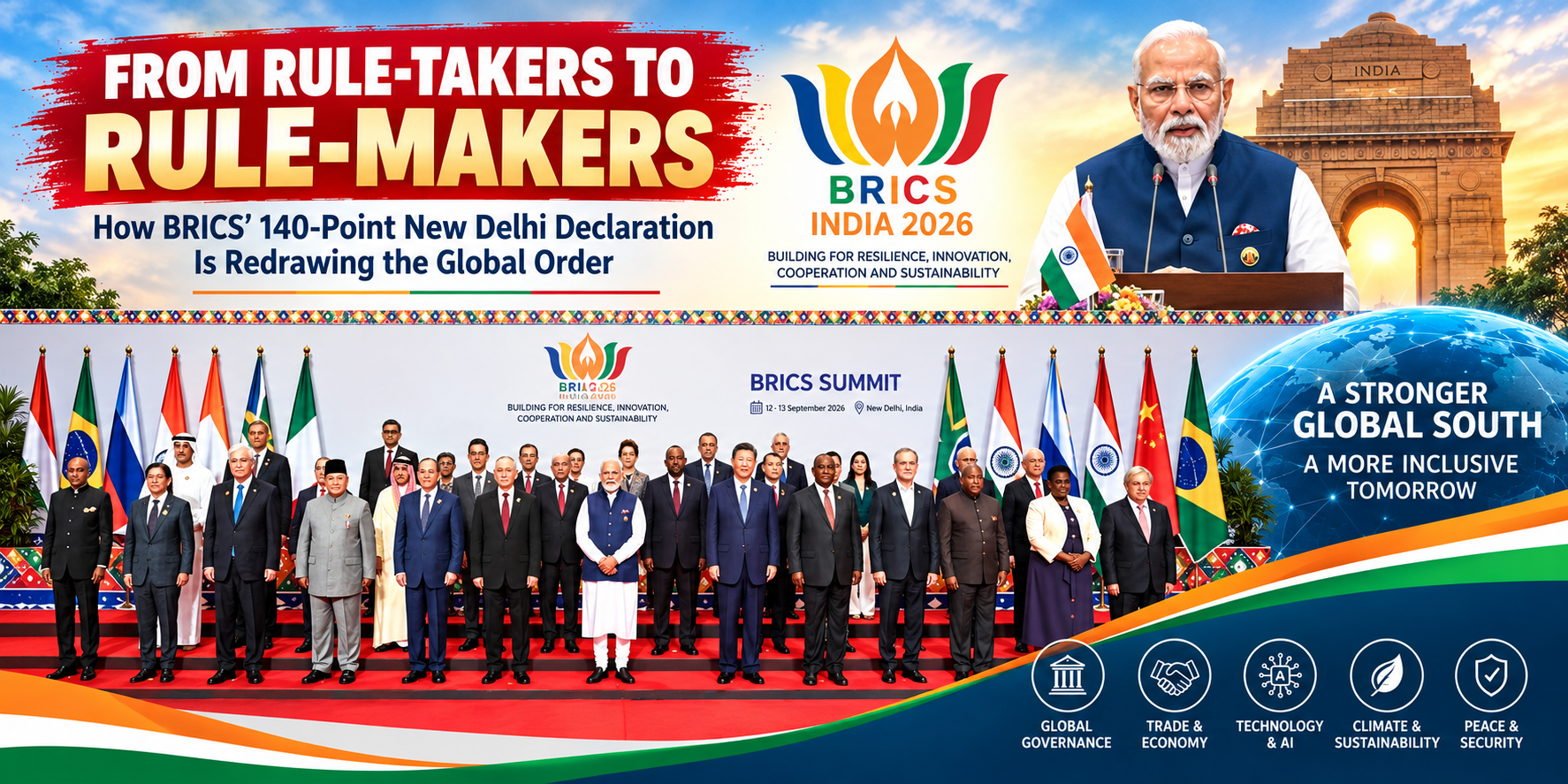
Despite deep differences over trade, sanctions, geopolitics, and regional conflicts, BRICS nations united behind a landmark declaration aimed at reforming global governance and amplifying the voice of the Global South.
The 18th BRICS Summit, hosted under India's chairmanship in New Delhi, delivered a major diplomatic milestone with the unanimous adoption of a comprehensive 140-point New Delhi Declaration. Centered around the theme "Building for Resilience, Innovation, Cooperation and Sustainability," the declaration stands out not only for its ambitious agenda but also for the rare consensus achieved among some of the world's most diverse geopolitical players.
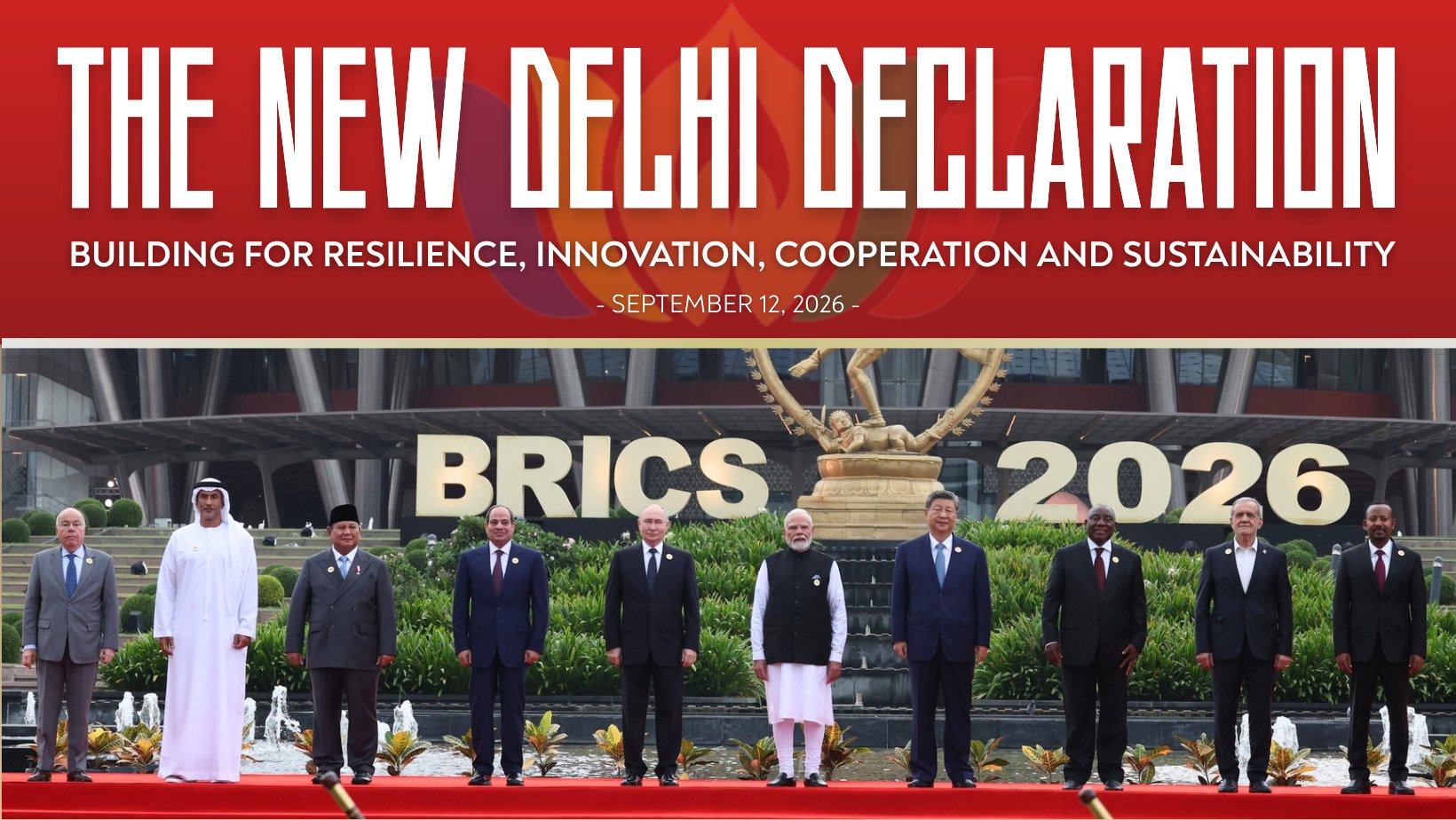
It reflects a broader ambition: giving the Global South a stronger voice in shaping the future of international politics, trade, technology, and security. It gives a powerful demonstration that even nations with differing strategic interests can unite around a shared vision for a more balanced and inclusive global order.
For decades, a handful of powerful nations have largely shaped global institutions, trade rules, and international decision-making mechanisms. The latest BRICS New Delhi Declaration signals a growing push from emerging economies to change that equation.
A Consensus That Defied Geopolitical Divisions
One of the declaration's biggest achievements is bringing together countries with vastly different strategic interests.
BRICS today includes nations that often disagree on major geopolitical questions. Countries maintain different relationships with the United States, China, Russia, and regional powers. Yet despite these differences, the bloc managed to agree on a comprehensive declaration covering global governance, trade, terrorism, AI regulation, climate policy, and regional conflicts.
In a world increasingly divided by rival power blocs, achieving such consensus is a significant diplomatic accomplishment.
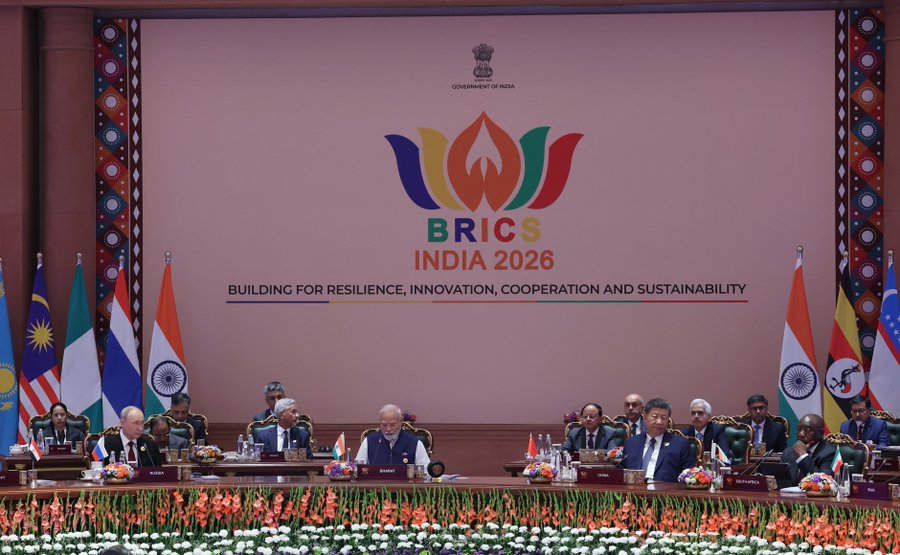
The Core Message: Reform Global Governance
At the heart of the declaration lies a powerful argument: today's international system no longer reflects modern realities.
The existing global order was largely designed in the aftermath of World War II. However, emerging powers argue that while developing nations bear much of the burden of global challenges, they remain underrepresented in major decision-making institutions.
The BRICS vision can be summed up in a simple but impactful statement: The Global South should not remain a passive rule-taker. It should become an active rule-maker.
This demand is directed toward reforming major institutions such as:
1. The United Nations (UN)
2. The UN Security Council (UNSC)
3. The International Monetary Fund (IMF)
4. The World Bank
The declaration reinforces calls for a more equitable and representative global governance system.
India Pushes Hard for UN Security Council Reform
A major highlight of the declaration is renewed support for reforming the United Nations Security Council.
India has long argued that the UNSC reflects the geopolitical realities of 1945 rather than the realities of the 21st century. As one of the world's largest economies, the most populous country, and a major strategic power, India believes developing nations deserve greater representation in global decision-making.
The declaration strengthens the broader demand that reforms can no longer be postponed indefinitely. While declarations often reflect political intent rather than immediate action, the issue of UNSC reform remains one of India's most significant diplomatic priorities.
BRICS Backs Palestine: A Strong Push for Peace and Statehood
The New Delhi Declaration takes a clear and balanced stance on the Israel-Palestine conflict, with BRICS nations collectively supporting efforts to restore peace and stability in the region. The bloc has endorsed ceasefire initiatives, unhindered humanitarian aid, and the Palestinian people's right to self-determination. It also reaffirmed support for a sovereign Palestinian state based on the internationally recognized two-state solution, with East Jerusalem envisioned as its capital. Why 12 Nations Are Banning Trade With Israeli Settlements
Additionally, BRICS voiced support for Palestine's full membership in the United Nations, signaling a stronger diplomatic push for long-term recognition and a negotiated resolution to one of the world's most enduring conflicts.
Trade Wars, Tariffs, and Economic Fairness
The declaration also raises concerns about increasing protectionism in international trade. BRICS members highlighted the growing use of:
1. Unilateral tariffs
2. Non-tariff barriers
3. Protectionist trade measures
According to the bloc, such practices undermine the principles of fair global trade and create uncertainty for developing economies.👉 How New U.S. Sanctions on Iran Could Trigger Global Trade Disruptions and Impact India
Interestingly, this message is not directed only at Western economies. It also reflects concerns within BRICS itself, where trade imbalances continue to be a major issue. For India, reducing large trade deficits and ensuring equitable trade relations remains a critical objective.
Opposition to Unilateral Sanctions
Another key aspect of the declaration is criticism of unilateral sanctions. Many BRICS nations argue that sanctions often disrupt global supply chains, energy security, and economic stability. The declaration emphasizes dialogue, diplomacy, and multilateral solutions rather than the excessive use of economic restrictions. 👉U.S. Accuses India in China's Tariff Evasion Transshipment Network
For developing countries, the concern is not only political but also practical. Sanctions can affect energy prices, trade flows, and economic growth far beyond the countries directly targeted. 👉Jaishankar vs Washington: Why India Rejects U.S. Criticism Over Oil Trade
The Climate Debate: Who Should Bear the Burden?
Climate policy emerged as another major point of discussion. BRICS countries expressed concerns over carbon-related trade measures, such as carbon border taxes, which some developed economies are introducing.
The central argument is based on the principle of Common But Differentiated Responsibilities (CBDR). Developing nations contend that industrialized countries contributed the most to historical carbon emissions and therefore should shoulder a greater share of climate-related responsibilities.

The declaration argues that environmental policies should not become disguised trade barriers that disadvantage developing economies.
No BRICS Currency, But Local Currency Trade Gains Momentum
One of the most debated topics surrounding BRICS has been the possibility of creating a common currency.
The declaration clarifies that BRICS is not launching a shared currency. Instead, the focus remains on improving cross-border payment systems and increasing trade settlements in local currencies.👉Forget a BRICS Currency: How India’s Digital Payment Revolution Could Reshape Global Trade
This approach could gradually reduce reliance on the US dollar for certain transactions without requiring the creation of an entirely new common currency. For many emerging economies, local currency trade offers greater flexibility, lower transaction costs, and reduced exposure to external financial shocks.
A Unified Stand on Terrorism
The declaration strongly condemns terrorism in all its forms. The statement also highlighted the recent Pahalgam terrorist attack on April 22, 2025, underscoring the bloc's growing focus on tackling cross-border terror networks, extremist activities, and the financial channels that sustain them.
It calls for:
1. Combating cross-border terrorism
2. Eliminating terrorism financing
3. Denying safe havens to terrorist organizations
4. Advancing international cooperation against global terror threats
For India, this remains one of the most significant outcomes of the declaration, as terrorism continues to be a central national security concern.
BRICS Enters the AI Era
Artificial Intelligence is no longer a future issue; it is shaping economies, security systems, and governance today. Recognizing this reality, BRICS leaders emphasized principles such as:
1. AI safety
2. Trustworthiness
3. Accessibility
4. Responsible development
5. Ethical governance
The move highlights the bloc's intention to play an active role in shaping global AI standards rather than merely adapting to frameworks developed elsewhere.
India's Balancing Act with China
The summit also provided a platform for renewed engagement between India and China.
Despite ongoing differences, both nations acknowledged the importance of dialogue, economic cooperation, and managing broader geopolitical challenges. Increased engagement reflects India's long-standing strategy of maintaining communication while protecting its strategic interests.
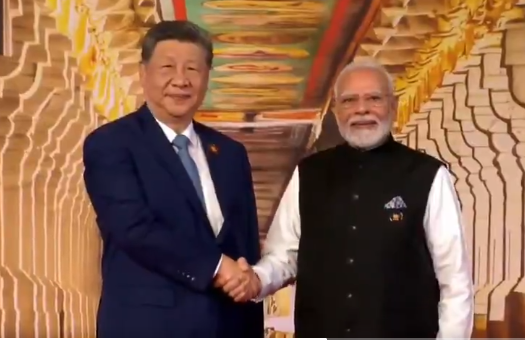
In international diplomacy, sustained dialogue often becomes as important as formal agreements.
What Does India Really Gain?
Critics often ask what tangible benefits emerge from such summits. The answer lies not in immediate outcomes but in shaping future agendas. India successfully placed several of its long-standing priorities at the center of the BRICS conversation:
1. UN reforms
2. Global South representation
3. Counter-terrorism
4. Fair trade
5. Emerging technology governance
6. Climate equity
More importantly, the declaration reflects India's growing role as a bridge between developed and developing nations, helping shape discussions that will influence global politics in the coming decades.
The Bigger Picture
The New Delhi Declaration is not about replacing one dominant power with another. It is about demanding a more balanced, representative, and inclusive global order. Whether these ambitions translate into concrete reforms remains uncertain. But one message is unmistakably clear:
The Global South is no longer content with simply following rules written by others. It wants a seat at the table where those rules are created.
🚀Stay Ahead of Global Power Shifts
Global geopolitics is changing faster than ever. From BRICS and G20 developments to trade wars, AI governance, and emerging world orders, staying informed is no longer optional.
Follow our blog for sharp geopolitical insights, in-depth analysis, and the stories shaping the future of the global balance of power. 🌍📈
Written by
Ritvik DeshmukhDiscussion (0)
Sign in to join the discussion.
Loading comments…